
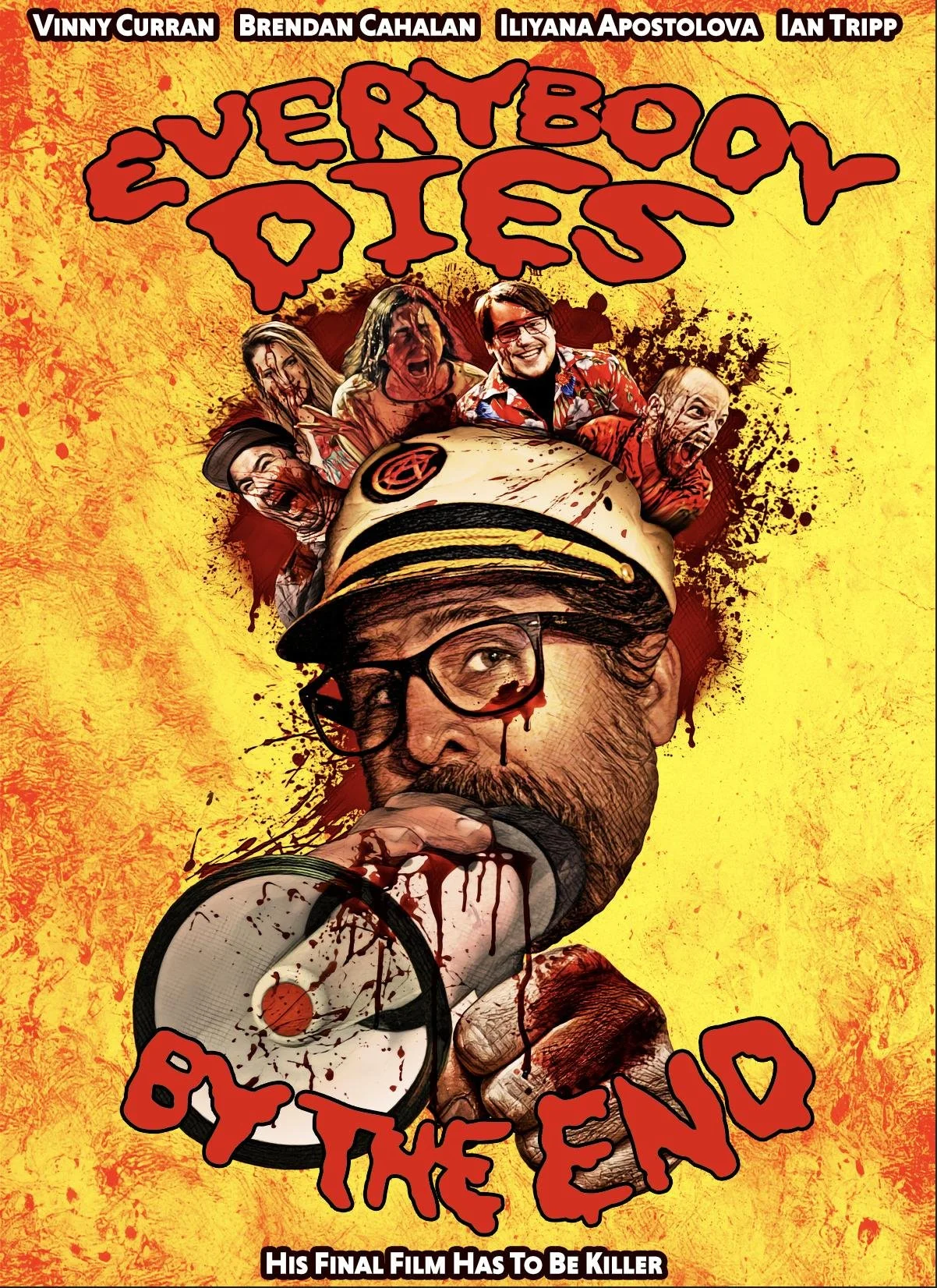
If you’re creative, you know exactly how sacrificial the art-making process can be. It’s giving of yourself unconditionally, unwaveringly committed to the work until it’s caramelized in your blood. Screenwriter Ian Tripp, who co-directed with Ryan Schafer, mines the deep wells of his craft for a disturbingly authentic spin on killing oneself for the sake of art. EVERYBODY DIES BY THE END (streaming on Tubi as of this writing) documents one filmmaker’s desperation to be heard, liked, and understood while making his last film.
Alfred Costella (Vinny Curran) is a strange, particular man. During a promo stop on a talk show, he gets into a heated argument with the host about the implications of making such graphic films and the burden of accountability. The conversation quickly erupts into name-calling with Alfred storming off the set. The disastrous appearance nearly ended his career, sending him careening off the rails and forcing him into an indefinite hiatus. Sullied from public scrutiny, his love of filmmaking faded like the setting sun, and he needed nothing but time to rediscover his passion for storytelling before he could ever step back into the spotlight.
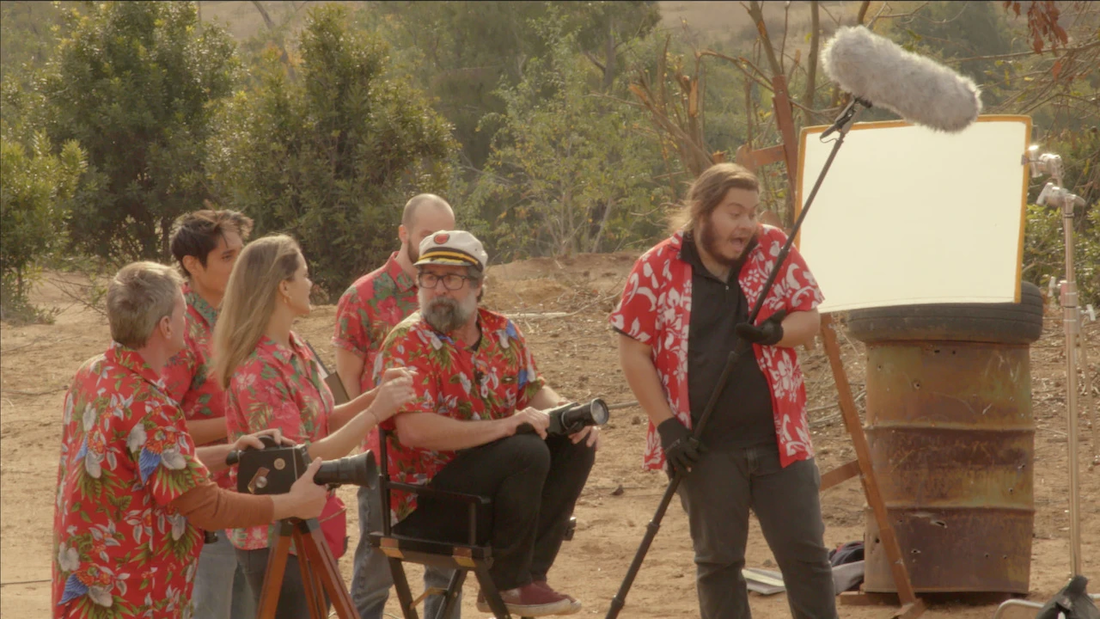
Years later, Alfred hires documentarian Calvin (Tripp) and his crew to capture the entire operation of shooting his final feature. Drama, bloodshed, and crazy antics abound on set, as Calvin peels back the layers of the production. Alfred oscillates between sly charm and throat-bursting rage over his actors' failure to understand the assignment. He’s a ticking time bomb that explodes at the slightest inconvenience. But those around him, namely Grant (Brendan Cahalan), enable him and inflate his ego. For his art to survive, his ego must be fed. And he’ll go to any length to push his actors to achieve greatness, even if that puts them in real danger. In one scene, for example, he swaps in real animal’s blood to elicit the primal responses he needs from his lead actor, Allison (Iliyana Apostolova). His creative liberties are unwelcome yet evoke the correct emotional responses Alfred needs for the film.

Dying for Your Art
An artist only survives for as long as people remember their work. It’s a way of immortalizing your being forever in the halls of artistic expression. The pressures to create, as though a mouse on a spinning wheel, can be suffocatingly arduous and seemingly purposeless. Alfred tenuously hangs in the balance, teetering between the cathartic release of creation and a longing to be worshipped as this great, magnificent genius. He’s awfully charismatic, even as Calvin’s sharp-eyed camera trims away the mystique of celebrity and exposes an insecure artist underneath.
Filming in a found-footage style was a perfect move to transmit the unease of witnessing a filmmaker collapse beneath the weight of his art. There’s an intense immediacy in the approach, also owed to Curran’s beady-eyed performance, that slithers under the fingernails. His emotional volatility pumps up the stakes; with each passing frame, you wait with bated breath for him to snap and lash out. His hunger to create unflinchingly blurs his cognitive abilities to such a degree that he loses himself entirely.
But that’s the nature of art. It’s all-consuming and relentless. It’s a monster born in your body just waiting to escape. Whether you’re a writer, painter, sculptor, or actor, an offering must be made. Each word, ball of clay, or dab of paint is a bit of flesh you willingly carve out of your body. You rinse and repeat the process until the work is done, and you have nothing left to give. Naturally, most of us never resort to murder to balance the scales and make our art feel “real,” but in a metaphorical sense, spilling blood is vital to the process.
Art Connects Us All
Once you exorcise whatever demons have possessed you, there’s a baptismal effect that initiates the cleansing stage. Once Alfred begins killing his actors for real, it’s a gleeful purification beyond his wildest fantasies. The art that he poured himself so unapologetically into is no longer his own. It now belongs to the audience. The blood, sweat, and tears mutate into a vicarious experience. From the comfort of a movie theater or their own home, viewers engage with the material in an honest way that feels as though they were actually involved. That’s the power of movies. You don’t need to have been there for you to feel every pang of guilt, shame, and anger coursing in your bloodstream.
Alfred’s last film serves as a conduit for greater power. When art transforms, it can deeply impact a viewer to such a degree that they gaze upon their own reflection. That confrontation is what the best art is all about. In his own way, Alfred challenges the delicate balance of life and death, happiness and sorrow, and creation and destruction. He’s playing God – he creates life on the page only to quickly destroy it for the camera. Those intentions lie at the heart of EVERYBODY DIES BY THE END, a perfectly quirky and haunting tale about the importance of art and how so easily many of us are killed by it.
Art is sacrifice. Both the process and outcome are brutal. But to alleviate inner turmoil or make sense of a dying world requires total selflessness. In his own way, Alfred achieved exactly what he sought to do. He created a fictional world, not far removed from reality, in which he could explore the darkest facets of human existence at its most basic level. Something animalistic happened on his set, and he simply fanned the flames and let the fire spread. Sometimes, you just have to pour out your creativity like gasoline, light a match, and see what happens.
