
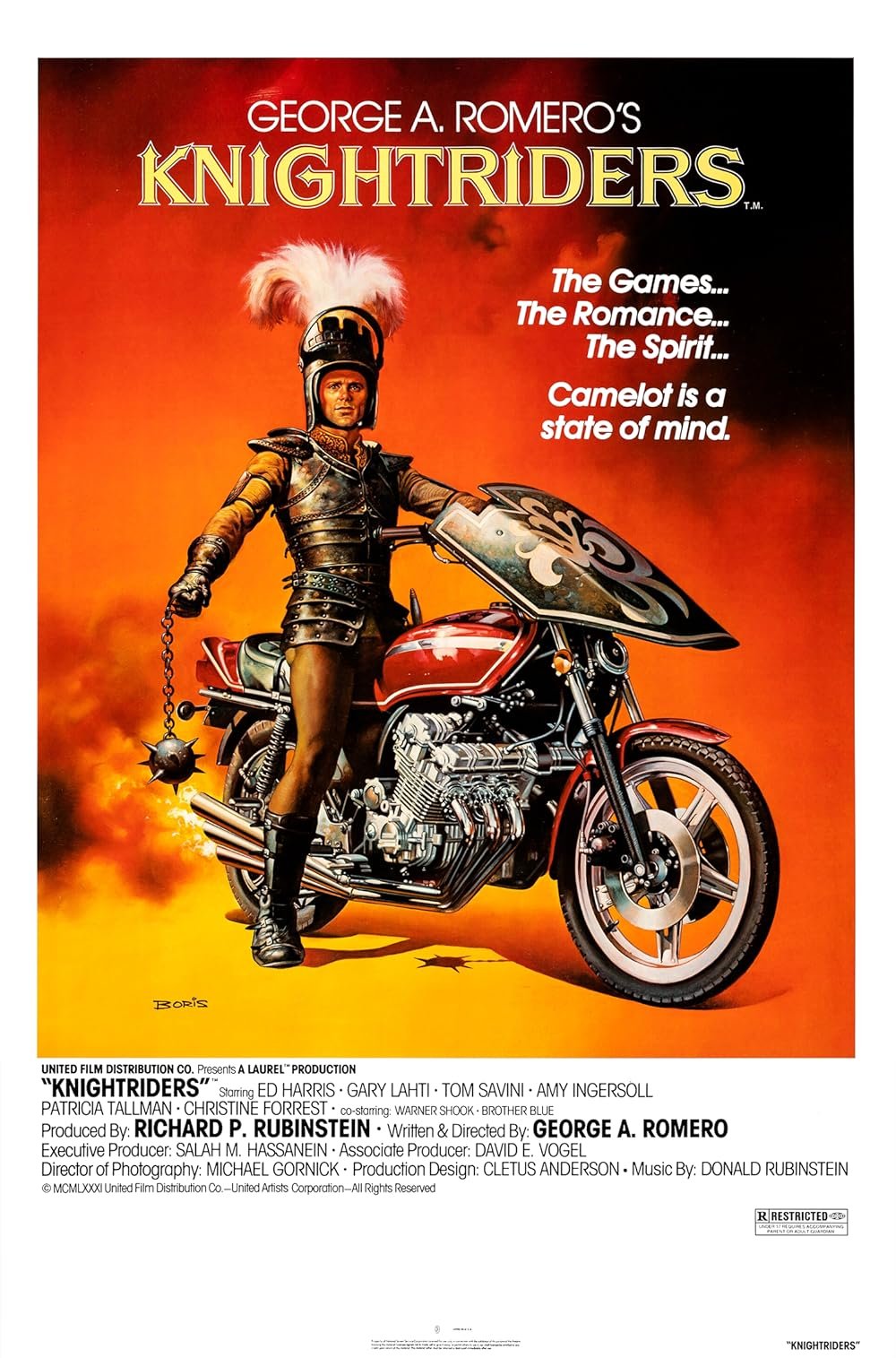
KNIGHTRIDERS (1981)
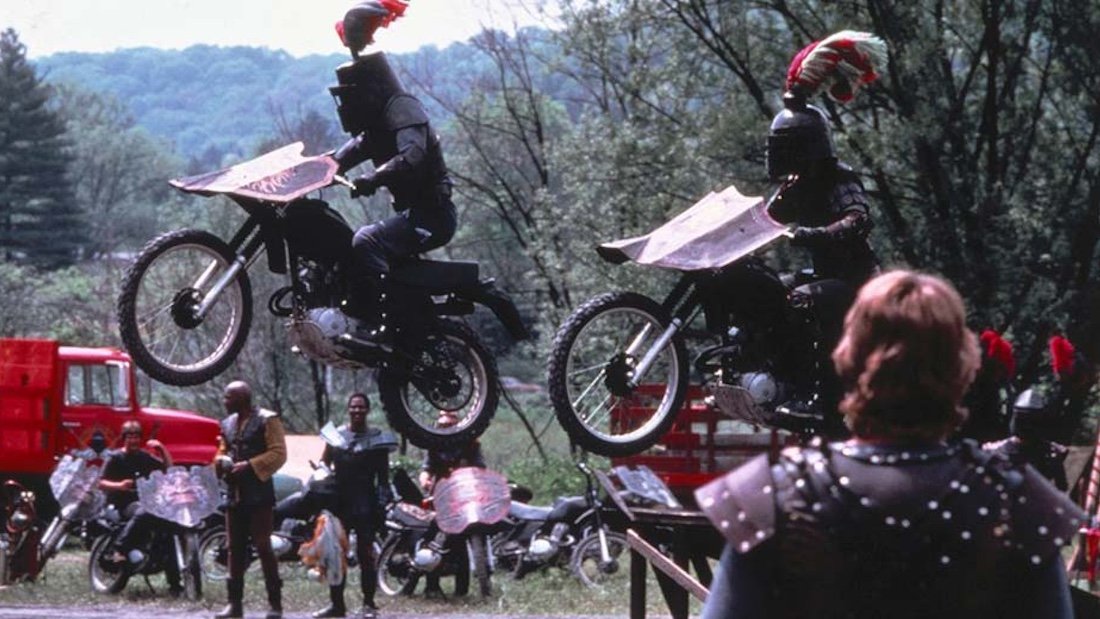
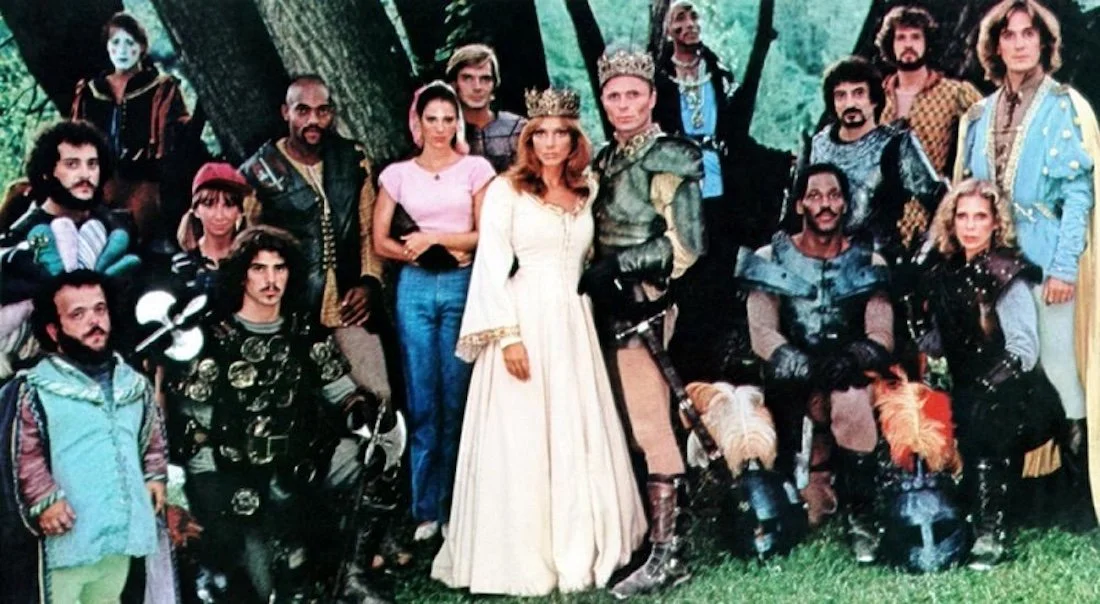
KNIGHTRIDERS is often called George A. Romero’s most personal movie. There have been approximately a thousand articles, reviews, and opinion pieces written about the film serving as a metaphor for his coming to terms with the fact that if he wanted bigger budgets following the financial and critical success of DAWN OF THE DEAD, he would need to leave his Pittsburgh indie roots behind. But it also feels like the greatest outlier in his career. Despite its tragic climax, KNIGHTRIDERS lacks the cynical view of humanity, graphic violence, and occasionally mean-spirited sense of humor of the horror films that make up most of his filmography. Even odder, especially given the decent-sized budget (for a Romero indie) of the film, Romero decided to comment on his career crossroads not with a zombie film or another horror subgenre. Instead, he turned to a genre he had flirted with in the past, but never fully embraced: the biker movie.
While he had used a biker gang to bring about the chaotic climax of DAWN OF THE DEAD and in a somewhat silly action sequence in the otherwise understated MARTIN, Romero had never embraced the ethos of a biker movie that motorcycles equal freedom. With KNIGHTRIDERS, he busts out that somewhat creaky trope (biker movies having more or less fallen by the wayside in the early ‘70s) and layers in a heavy dose of running-off-to-join-the-circus fantasy.
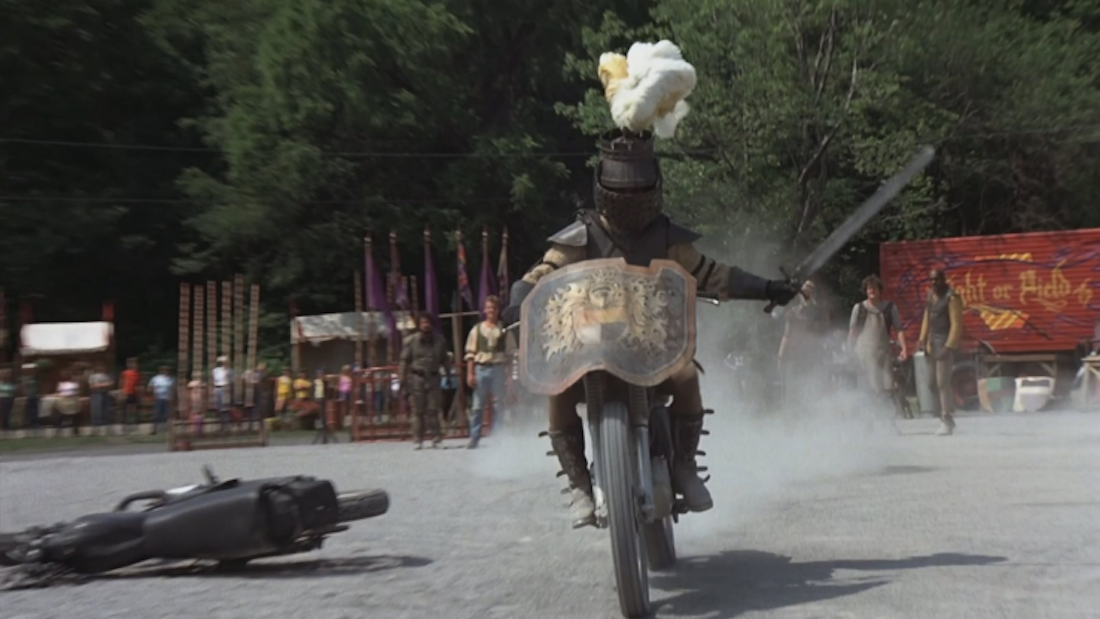
And speaking of fantasy…In what is probably the biggest swing in a filmmaking career that never shied away from big swings, the whole shebang is about a troupe of performers and stunt-people who travel the country putting on motorcycle shows inspired by the legend of King Arthur (Camelot was apparently having a big moment at the time—KNIGHTRIDERS was released in the United States on April 10, 1981; the exact same day as John Boorman’s EXCALIBUR).
That is a lot of movie to unpack and since I promised myself I would hold this piece to less than twelve hundred words, I will (mostly) focus on the biker movie aspect.
I never owned my own bike, but for a few years in my late thirties, I rode motorcycles on a semi-regular basis. Even that limited experience was enough to sell me on the restless freedom that biker movies have been offering up since Marlon Brando donned a black leather jacket in THE WILD ONE. Hell, the hook set deep enough for me that I still own a helmet and have maintained the motorcycle operator’s endorsement on my driver’s license, just in case.
So running off to join a circus of dreamers and gearheads performing stunts on bikes like they’re knights on horseback really does have a pull for me as someone who loves the thrill of opening up the throttle and still romanticizes the appeal of the open road, but who also never really connected with traditional biker movies that were simply fictionalized takes on the Hell’s Angels (whose exploits were already highly fictionalized by the gang as they believed their own fevered tales of debauchery often embellished by tabloid reporters). But KNIGHTRIDERS isn’t interested in getting the viewer to identify with a bunch of drunken, violent buffoons decked out in Nazi-regalia. Instead, where the movie finds common ground with more traditional biker movies is in its sense of anti-authoritarianism and, most pointedly, its fatalism. Much like biker movie milestones THE WILD ANGELS and EASY RIDER, the irony is that the freedom promised is the freedom of the sweet embrace of death.
Spoilers ahead for the end of KNIGHTRIDERS.
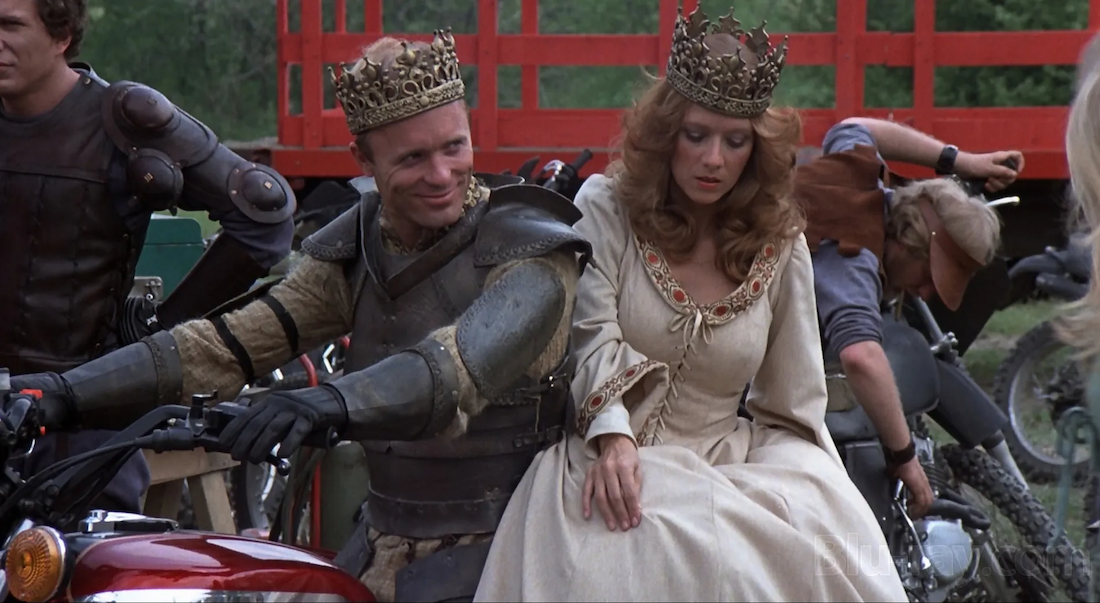
From roughly twenty minutes into KNIGHTRIDERS until his dramatic death in the penultimate scene, Romero and lead actor Ed Harris telegraph the eventual demise of “King” Billy Davis with a heavy hand. As the King Arthur stand-in, it goes to figure that Billy would eventually face the same fate as the mythical ruler. But where Arthur loses his life based on a fear of being killed by his own son and eventually turning that fear into his destiny, Billy fears living in a world ruled by money, lawyers, and commercial advertising more than he fears death. But where mere mortals could simply find a way to shuffle off this mortal coil, if that is their preference, Billy has also saddled himself with a martyr complex. He needs to know that whoever is next to take the crown will lead the increasingly large troupe of outcasts he has attracted in the right way.
Oh, and he really needs to right a few wrongs before wiping out on his ride in spectacular fashion. Because that’s what you do as a biker antihero.
It is no wonder that so many pieces focus in on the film as Romero’s self-referential portrait of the artist as young man on the verge of breaking out. Not only does Romero write his stand-in Billy as equal parts noble at heart, a stubborn mule who is too set in his ways, and a self-righteous jerk, the man he eventually hands his crown off to is a “knight” played by none other than Tom Savini (who turns in stellar work here as a brash, arrogant loud-mouth who still retains a good soul despite his ambitions—you know, basically playing himself), arguably one of his two most crucial filmmaking collaborators to that point. To make the whole damn thing even more meta, Savini’s knight is in love with a mechanic who he is constantly cheating on, played by Christine Forrest, Romero’s then-wife, the second of those most important collaborators. Of course, the irony of all of this is that Romero stayed in Pittsburgh for another fifteen plus years, continuing to grind out indies and lower-budget studio films he could shoot nearby and never made the leap to the big time that was expected or took the spectacular flame-out that he gives Billy.
But that is the difference between real life and the oft-heightened reality of genre movies. No matter the pressures that Romero felt at the time he made KNIGHTRIDERS as Hollywood came calling and he tried to reconcile that reality with the life and filmmaking collective he had put together in his beloved Pittsburgh, it was never a life-or-death situation. But put an intense actor like young Ed Harris on a Honda CBX 1050, emoting like he’s doing Hamlet…and you have the melodramatic biker flick about artistic integrity you never knew you needed. KNIGHTRIDERS is messy, self-indulgent, painfully earnest at times, and a complete original. Just like a good biker movie should be. And just like George A. Romero was when operating at his peak.
