If you’re looking for a 1970s semi-biographical science fiction movie with a singular scene so horrifying that it inspired alien abductions from The X-Files to Jordan Peele’s NOPE (2022), you’ve come to the right place. Just prepare yourself for a whole lot of ho-hum melodrama while you wait.
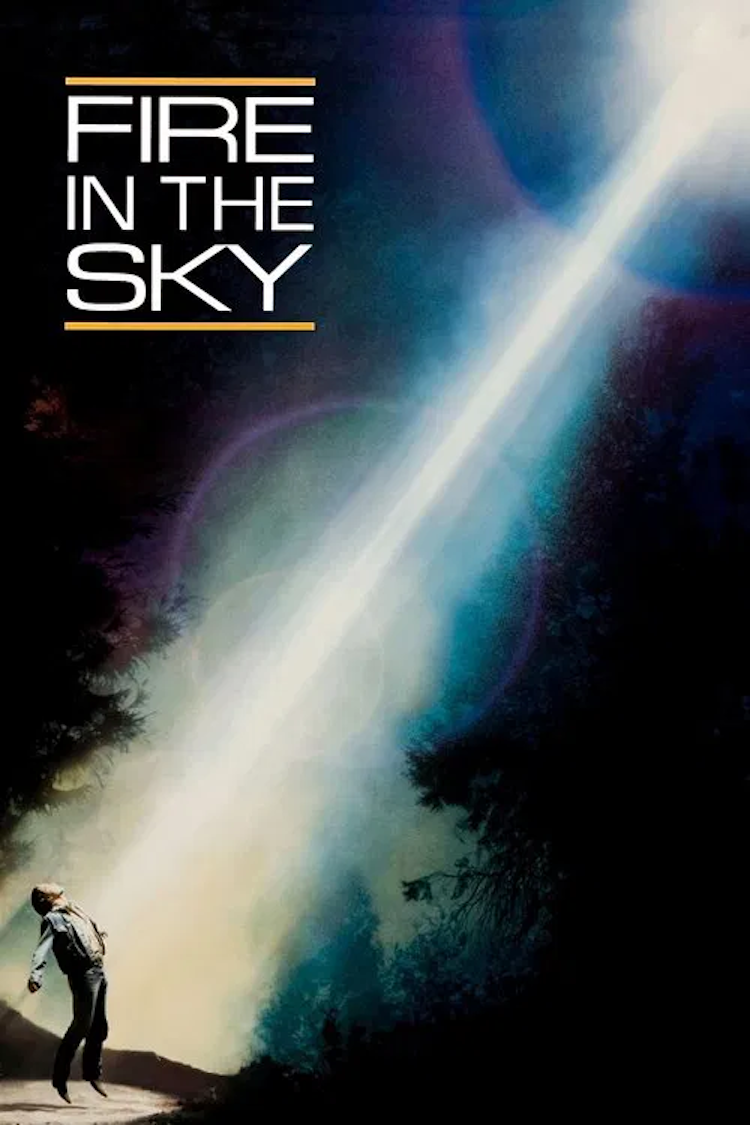
The overall production value for much of FIRE IN THE SKY (1993) felt like a movie with a made-for-TV budget. That doesn’t necessarily make it a bad movie…or at least it’s not distracting enough a reason to sway opinions. Believe me, there are far bigger distractions. The story opens mise-en-scène Snowflake, Alaska where a group of rough ‘n’ tumble loggers are booking it in a beat-up pickup to the local dive bar. There they decide to make the call…to tell police that they witnessed their friend and coworker being thrown like a rag doll from the tractor beam of a UFO. The witness statements went as well as you’d expect. In the agonizingly long five days since Travis Walton’s (DB Sweeney) disappearance, the small blue-collar town shuns, ostracizes, and, ultimately, suspects the fellow loggers of murder. And in an unfortunate decision to focus so much of the movie on proving their innocence, FIRE IN THE SKY is quickly losing momentum.
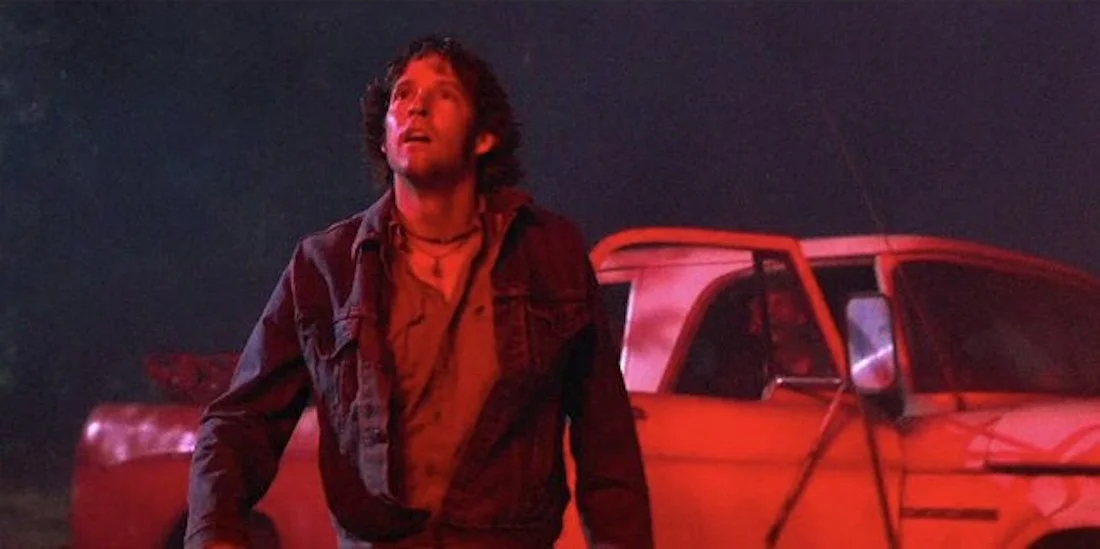
The effects from Industrial Light and Magic don’t disappoint. And there are a few shots in the scene with the initial contact with the UFO that are quite striking. The night sky bathed in foreboding red, the beam that paralyzes and subdues Travis into rigid catatonia. His waking in the craft, exploration of his surroundings, and realization of what is happening. Those twelve combined minutes of abduction/experimentation almost belong to a different movie entirely—because we don’t get nearly enough of it. Instead, we get a Daryl Dixon gruff and grimy-vibed Robert Patrick as Mike Rogers. Mike is Travis Walton’s boss and presumed best friend. And in a baffling writer’s decision: he’s the completely unlikeable main protagonist. So, let’s break it all down.
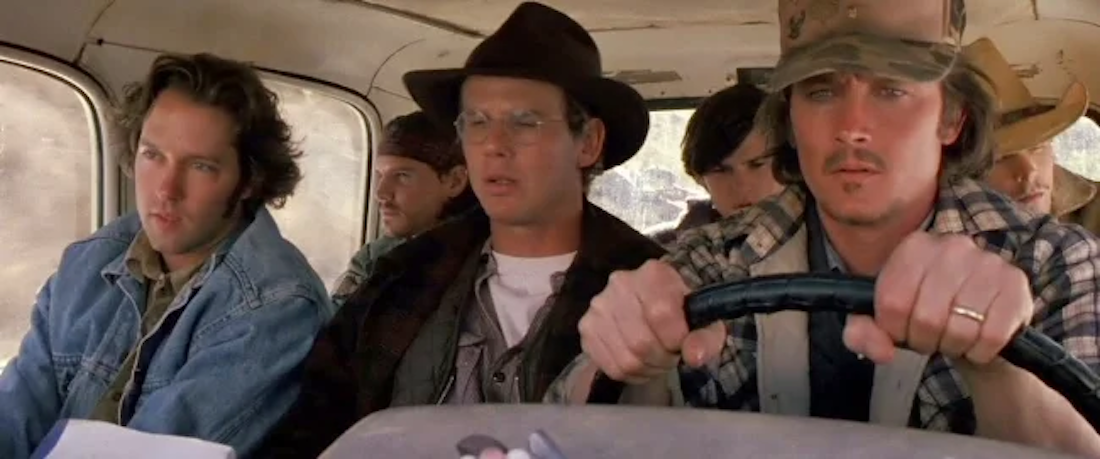
That fateful November night after a hard day’s work, the logging crew are trucking along in Mike’s pickup when a suspicious red light in the sky strikes fear for some, sparks curiosity in others. Poor Travis Walton is in the latter category, and like the young, dumb, and foolhardy boy he’s briefly shown to be in flashback, makes the young and dumb decision to jump from the truck for a better look. He finds himself directly under a larger-than-life UFO. The other men are shooketh by both the quaking ground, and the group understanding they’re in the presence of an alien craft. Then comes the beam…and young DB Sweeney really sells it: from awestruck boy to a man in true peril. The score is pulsating with discordant strings and the screams of the loggers for Mike to get them the hell out of Dodge. And he does. Mike high tails it as the other loggers presume Travis’s death. But Mike isn’t comfortable with his decision and ultimately decides to return to the scene, all too late. Travis is gone and they know exactly how it happened.
The no-nonsense Lieutenant Frank Watters (James Garner) takes their statements and immediately moves the search and rescue for a missing person into a full-blown homicide investigation. And not that this is outside the realm of believability. What’s truly unbelievable is the better movie we lost to what felt like an eternity of melodramatic persecution. Tabloids, small town gossip, and inconsequential lie detector tests make the five days feel like a full calendar year, slowing the pace of this quasi-thriller to mere Hallmark fodder (before they cornered the market on Christmas movies, that is). We lose any sense of real tension, and even a real story.
Then Travis returns, calling Mike from a gas station pay phone. He’s nude, injured, severely dehydrated, and utterly traumatized. Whew, guess this means science fiction is back on the menu. But spoiler alert: you’ll leave hungry. Mike is sure to immediately launch into how their lives have been hell—not out of worry, but for the social persecution over Travis’s assumed murder.
Nice, Mike. Real classy. Anyway, so Travis’s admission to the hospital upon his sudden return has a bit of editing panache. The cold, clinical hospital hallways and bright lights are intercut with panicked shots of Travis aboard the UFO. The doctors examining Travis for treatment echo the invasive examination from his extraterrestrial kidnappers. Then bestie Mike decides to visit Travis, who is still very much in a state of shock, again to reiterate how the last five days have been hell…for him. I really want to reach out to real life Travis Walton (still kicking at 73, by the way) and ask him to clarify the details. Not the alien stuff—I jive with that. What I wanna know is this: Was Mike Rogers really that big of a an asshole?
After Mike insisted everything was all Travis’s fault, I could’ve thrown my TV out the window. “You shouldn’t have gotten out of the truck, Travis.” This blame-the-victim mentality that saturates the movie so much that it becomes the primary conflict is so incredibly frustrating that I have to wonder if his buddies orchestrated the entire alien abduction because they just clearly hate the dude.
Then comes the ill-conceived ‘welcome home’ party for Travis. And who is responsible for this terrible—and frankly speaking—cruel experiment in psychological warfare? DB Sweeney’s Walton already has the thousand-yard stare of a combat veteran. He’s fresh out of the hospital and is immediately a sideshow attraction to the town. Now he has to perform for friends and family. But I will say that aligning the anxiety surrounding the party as a trigger to Travis’s repressed memories of what exactly happened aboard the alien vessel—that was a smart choice. So, it’s time, finally. THE scene we’re all here for…
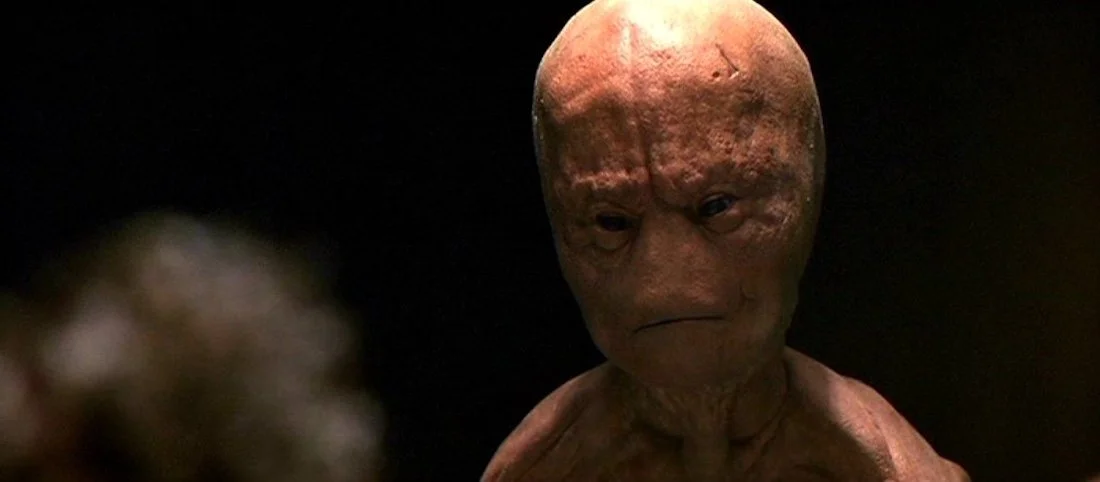
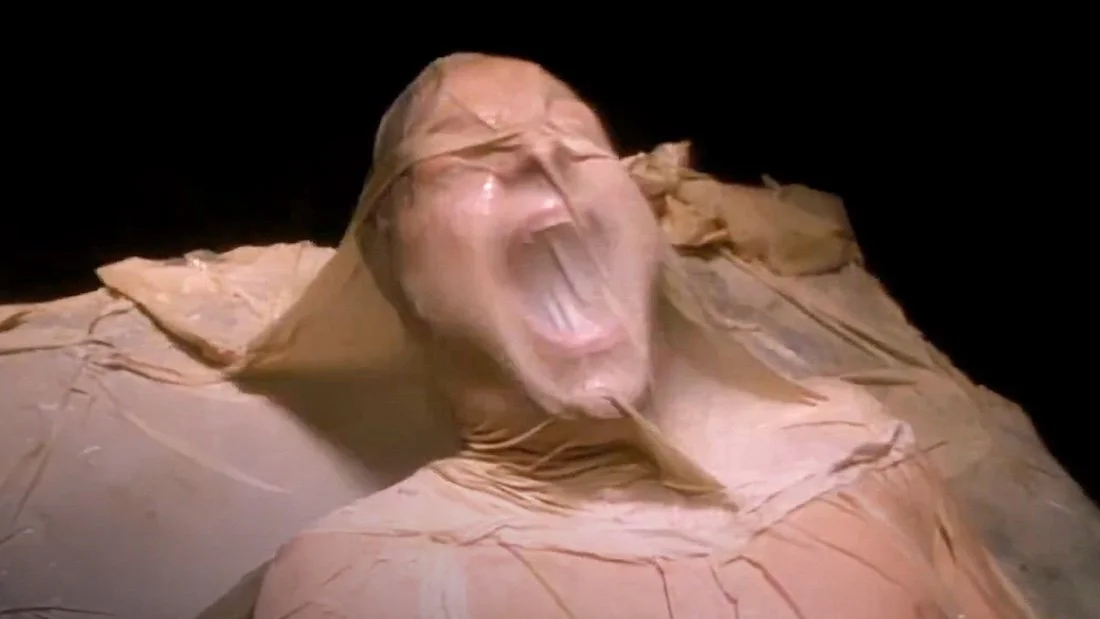
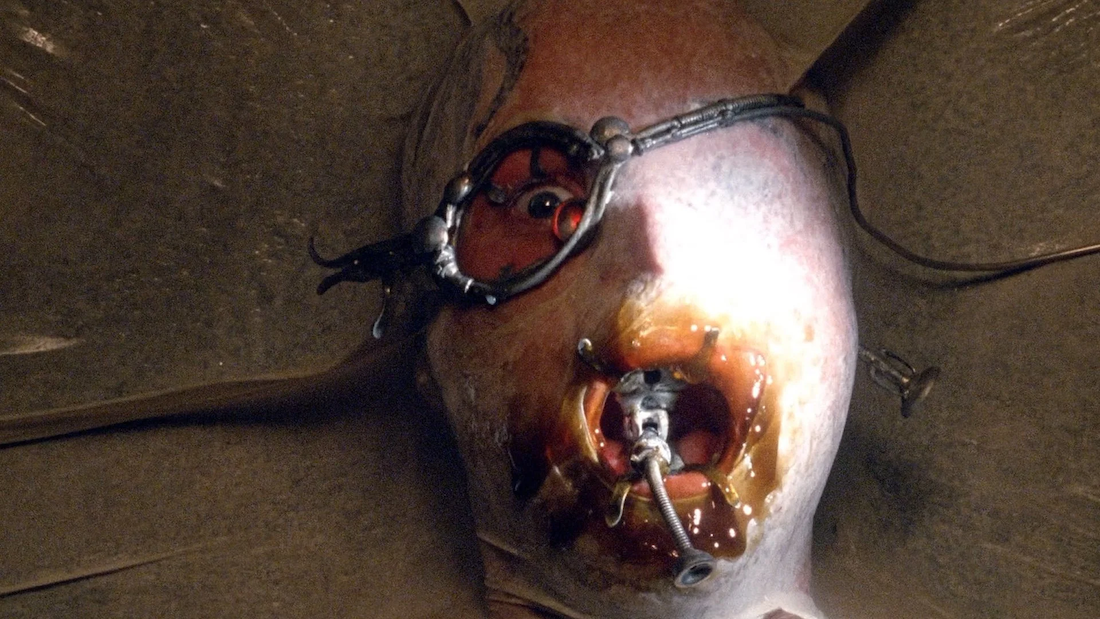
Travis wakes disoriented, surrounded by slime and detritus inside a fleshy digestive sac. The goo and grime are tactile, and we are right there with Travis, queasy with fear. He hesitantly explores the ship in zero gravity, floating through cold, damp corridors and finding familiar looking space suits. The wide-eyed slants, the bulbous heads atop slim bodies: We are about to commune with “the greys” Whitley Strieber style. But beneath those suits are crinkly little mean-faced bastards who drag Travis into a lab, strip him naked, and suffocate and subdue him with a Cronenbergian flesh sheet that constricts him to the table. The alien examiners then expose his mouth and a single eye to accommodate their experiment. This biotech nightmare sequence of black jelly, jaw clamps, throat tubes, and an ocular probe for the ages, was the defining scene that still inspires filmmakers and tops best-of-horror lists to this day. Take the movie NOPE for example. Jean Jacket’s fleshy, claustrophobic internal design that constricts its human abductees as they scream in terror—undoubtedly influenced by FIRE IN THE SKY.
But that’s all we get. Nine minutes of extraterrestrial screen time and some modern nods to the source. Is that enough for FIRE IN THE SKY to shine these thirty-some years later? Let’s return to the narrative and you can tell me. In the two years since Travis Walton’s return, Mike Rogers has been a hermit, putting himself in self-imposed exile from family, friends, and presumably a good barber. So DB’s Travis takes Mike on an apology tour at the site of where everything went down. “Sorry I got out of the truck. You’re right it’s my fault, blah blah blah.” Mike apologizes for his…guilt/temper/main character syndrome? Then they smile and laugh like it’s the end of an episode of Walker, Texas Ranger as the epilogue tells us all is well and the loggers still maintain their innocence.
WHAT!? Umm, yeah. We know you guys didn’t kill Travis, because whoop—there he is. It’s an enraging end to a muddled movie that didn’t know what it wanted to be. In short? This isn’t an exercise in slow burn. I loooove the slow burn of a well-crafted mystery/thriller/horror/sci-fi. But this isn’t a slow burn. It’s the underwhelming fireworks display in your shifty neighbor’s backyard with burnt hot dogs and piss-warm beer. After the initial oohs and ahhhs, we’re left wanting a hell of a lot more. I just don’t understand how the main story in this alien abduction movie was that the loggers were being accused and ostracized for…five days. Five days of low-stakes drama—comparatively speaking—with one epic scene curiously jammed into a movie it just didn’t belong. Don’t misunderstand. The alien abduction and experimentation were spectacular and truly frightening. But when taken as a whole, it just makes me mourn the movie we could’ve gotten.
As a matter of fact, I’ve given this matter serious consideration and decided there is one man who can take FIRE IN THE SKY to grand new heights of fear. I call upon Joel Anderson, the illusive writer and director of psychological slow burn indie horror darling LAKE MUNGO. Think about it. LAKE MUNGO has the emotional turmoil that FIRE IN THE SKY tried to achieve. It’s dark and the atmosphere is heavy with grief and loss, and a beyond-the-veil longing to be seen and understood and believed. Then comes THAT scene: a figure walking slowly from the darkness revealing the undead doppelgänger that would herald Alice Palmer’s doom. LAKE MUNGO had perfectly controlled edits, a compelling faux documentary framework, and a scene that still gives me the heebie-jeebies.
I also think there is a larger story to explore within FIRE IN THE SKY—a narrative element that’s far more compelling than the five days of interrogations. The abduction of Travis Walton and bodily violation against his will, the disbelief and public mockery, the victim-blaming even by his closest friends: all clearly analogous to rape culture.
And Joel Anderson has the directorial skills and keen sense of mounting tension to explore all of this and more, while keeping the overall dread a tonal constant. You think we can convince him to go for a FIRE IN THE SKY remake? Can we start a petition or something? I’m dead serious, Joel. Hell, I’ll write the screenplay. Guys, can we make this happen? Because this SKY seriously needs more fire.