Examining The Ambitious Alternate Ending

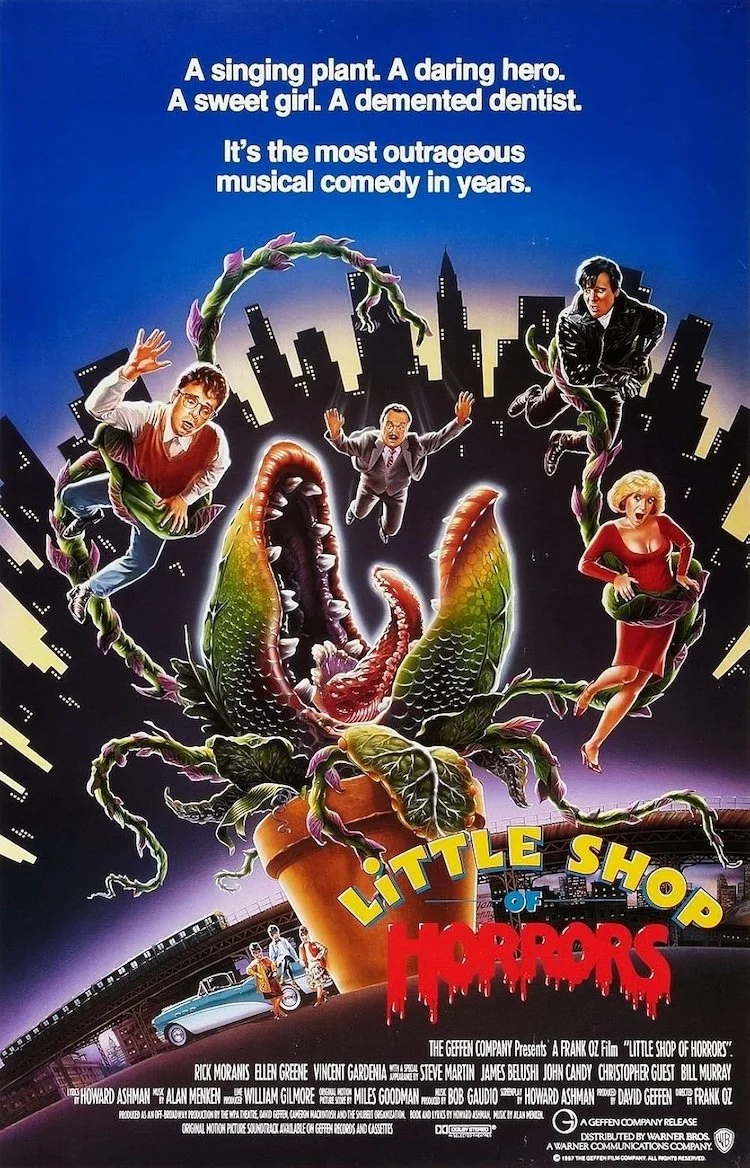
Few movie musicals have ever been as gloriously strange as LITTLE SHOP OF HORRORS, and fewer still have had a production history quite as complicated as Frank Oz's 1986 adaptation. On the surface, Oz’s film seems like an almost impossible combination: a Broadway-style musical built around a man-eating alien plant, a cast filled with comedians and theater veterans, elaborate puppetry and animatronics, and a story that ultimately asks its audience to accept both romance and horror in equal measure.
Yet it’s that combination that is precisely what makes the movie so special, and why it’s been one of my favorite movie musicals since first seeing it in theaters nearly 40 years ago now. Without a doubt, Oz and his collaborators were not simply just translating Howard Ashman and Alan Menken's stage musical of Little Shop of Horrors for the screen; they were trying to preserve its theatrical identity while taking advantage of everything that cinema could offer.
That ambition is perhaps best represented by LITTLE SHOP's original ending, a spectacular 23-minute sequence that was ultimately removed after test audiences rejected it. The ending was not some halfhearted alternate idea or discarded experiment. It was the conclusion that Oz, Ashman, and Menken all originally wanted, and it followed the darker trajectory of the stage musical’s story where Audrey is killed by Audrey II, Seymour is ultimately consumed by the plant, and the victorious creature produces an army of offspring that spreads across the world. The sequence then escalates into an enormously amazing miniature effects extravaganza, with Audrey II and its descendants destroying New York City and eventually conquering the planet – a remarkably audacious way to end what had otherwise been a surprisingly intimate musical.
That sense of scale was already evident throughout the production of LITTLE SHOP OF HORRORS. After producer David Geffen acquired the rights to bring the musical to the screen, Frank Oz was brought aboard because his background in puppetry and fantasy made him a natural fit for the material. Oz initially declined, having just completed THE DARK CRYSTAL and THE MUPPETS TAKE MANHATTAN, but eventually agreed and spent six weeks restructuring Ashman's screenplay. His goal was to find the balance between the live production's origins and the possibilities that filmmaking afforded him. Most of the stage musical's major numbers remained intact, while new material was added, including “Mean Green Mother from Outer Space,” written by Ashman and Menken specifically for the film and performed by Levi Stubbs, whose voice also brought Audrey II to life.

The production of LITTLE SHOP OF HORRORS itself was enormous by the standards of what was essentially a bizarre horror-comedy musical. Oz shot the film at Pinewood Studios in England, where the massive 007 Stage was transformed into the world of Skid Row. Production designer Roy Walker and set decorator Tessa Davies created a world that deliberately evoked the look of classic Hollywood musicals while retaining the intimacy of the stage show. At the center of it all was Lyle Conway's extraordinary Audrey II. Seven different versions of the plant were created for its various stages of growth, with the largest weighing more than a ton and standing over 12-feet tall. The production ultimately required thousands of hand-painted leaves, miles of vines, and an enormous network of cables to bring the creature to life.
The original finale for LITTLE SHOP took that ambition to an entirely different level. Rather than simply allowing Audrey II to eat Seymour and Audrey and ending the movie, Oz and his effects team created a full-scale cinematic apocalypse, with miniatures, visual effects, and multiple incarnations of the plant combined to show Audrey II escaping the flower shop and taking over New York. Hundreds of smaller plants are sold to unsuspecting customers, allowing the creature to reproduce on a massive scale before the sequence culminates with a gigantic Audrey II looming over the Statue of Liberty. This finale for LITTLE SHOP OF HORRORS was conceived as the ultimate payoff to the story's increasingly dark Faustian bargain, and it honored the ending of Ashman and Menken's theatrical production rather than softening it for the screen.
But then the movie was shown to an audience, and the response was devastating. At an early test screening for LITTLE SHOP in San Jose, audiences reportedly responded enthusiastically to the musical numbers, but everything changed once Audrey and Seymour died. Frank Oz later recalled that the theater essentially went silent, and the film received only a 13 percent recommendation score when the studio's benchmark for release was 55 percent. A second screening in Los Angeles produced essentially the same reaction.
What makes this situation so fascinating is that the ending of LITTLE SHOP OF HORRORS itself was not necessarily the problem. On stage, audiences understood the conventions of the theatrical experience, so when they watched the actors they had grown attached to die, those performers would still be alive when the curtain came down and could return for their bows. The cinematic experience did not provide that same emotional distance as Rick Moranis and Ellen Greene were not going to emerge from behind a curtain once the credits began to roll. Seymour and Audrey were simply gone, and that left a mark on those moviegoers.
Oz eventually came to recognize that distinction between these presentations of LITTLE SHOP OF HORRORS. As he later explained in a commentary track for the film, he eventually realized that what worked for a stage audience did not necessarily translate to the movie screen. Because the audience had become emotionally invested in Seymour and Audrey, their deaths transformed what had been an intentionally dark joke on stage into something much more heartbreaking in a movie theater.
So, Oz and Ashman went back to work on LITTLE SHOP OF HORRORS. The original ending was dismantled, the film was reshot, and a new conclusion was created in which Seymour destroys Audrey II, saves Audrey, and gets the (mostly) happy ending the theatrical audience had rejected. The new finale gave LITTLE SHOP the emotional release audiences were apparently looking for while still allowing the filmmakers one last mischievous nod toward the darker story: the final image reveals a tiny Audrey II blooming in Seymour and Audrey's idyllic suburban garden. It is a wonderfully dark little joke, suggesting that perhaps the nightmare is not quite over like everyone believes.
Ironically, the happier ending did exactly what the original production had struggled to accomplish: it made LITTLE SHOP OF HORRORS commercially viable without completely abandoning its macabre personality. The film opened on December 19, 1986, after its release had been pushed back from July to accommodate the reshoots. Although Warner Bros. considered its roughly $38.7 million theatrical gross disappointing against a reported $25 million budget, critics responded warmly, and the movie gradually found the audience it deserved through home video and subsequent releases. LITTLE SHOP OF HORRORS also received two Academy Award nominations, for Best Original Song and Best Visual Effects, the following year.
For years, the original ending existed primarily as a tantalizing piece of LITTLE SHOP history. A degraded black-and-white workprint appeared on an early VHS release before that edition was recalled, leaving fans with an incomplete glimpse of what Oz and Ashman had originally envisioned. In 2012, Warner Bros. finally located the necessary elements to restore the sequence, allowing the director's original vision to be reconstructed in color and presented as the film's alternate ending. The restored version premiered at the New York Film Festival that September, nearly three decades after the movie first reached theaters.

Watching that ending of LITTLE SHOP today, it is difficult not to marvel at how ambitious it was. The sequence is excessive, bizarre, expensive-looking, and completely committed to the idea that LITTLE SHOP OF HORRORS could end as a full-blown monster movie. It is also understandable why audiences in 1986 recoiled from it. The theatrical ending ultimately works because Seymour and Audrey have become the emotional heart of the film, and their survival gives the audience the catharsis it had been denied by the original finale.
But the alternate ending for LITTLE SHOP OF HORRORS deserves to be seen for what it was: not a mistake, and certainly not an unnecessary indulgence, but the culmination of the production's original creative philosophy. Oz, Ashman, Menken and their collaborators believed they could honor the darker ending of the stage show while embracing the scale of cinema, and they went remarkably far in trying to make that happen. The fact that audiences ultimately forced them to change course does not make that ambition any less impressive. If anything, it makes the restored finale of LITTLE SHOP one of the most fascinating artifacts of 1980s genre filmmaking, as it stands as this spectacular reminder of just how much was possible when a movie this wonderfully weird was willing to dream that big.