

IS GOD IS: The “R” In Revenge Is For “Reconciliation”

A good revenge movie should leave the viewer foaming at the mouth. Little is more satisfying than watching someone get what they deserve, especially at the hands of the person(s) they wronged. When I watched Aleshea Harris’s IS GOD IS (2026) back in May, I was moved by how far the film pushes past that initial intrigue and delves into the much more complicated headspace of those who seek vengeance. For those who need a re-cap: IS GOD IS follows twins, Racine and Anaia, seeking to hunt down their cartoonishly evil father who is responsible for the burn scars that mark them and their mother’s bodies. Throughout their adventure they come across traces of their father’s past lives which they use to track him and his new family down. The only clear bad guy in this movie is the dad (AKA ‘The Man’ or ‘The Monster’) played by Sterling K. Brown who delivered a phenomenal performance. However, there are other characters whose intentions are far from benevolent yet are justifiable to themselves. Racine and Anaia’s mother, affectionately referred to as God (played by the amazing Vivica A. Fox), sets everything into motion after asking her own daughters to execute their father. This is some biblical shit.
[SPOILERS AHEAD FOR IS GOD IS — BUT GO SEE THIS MOVIE]
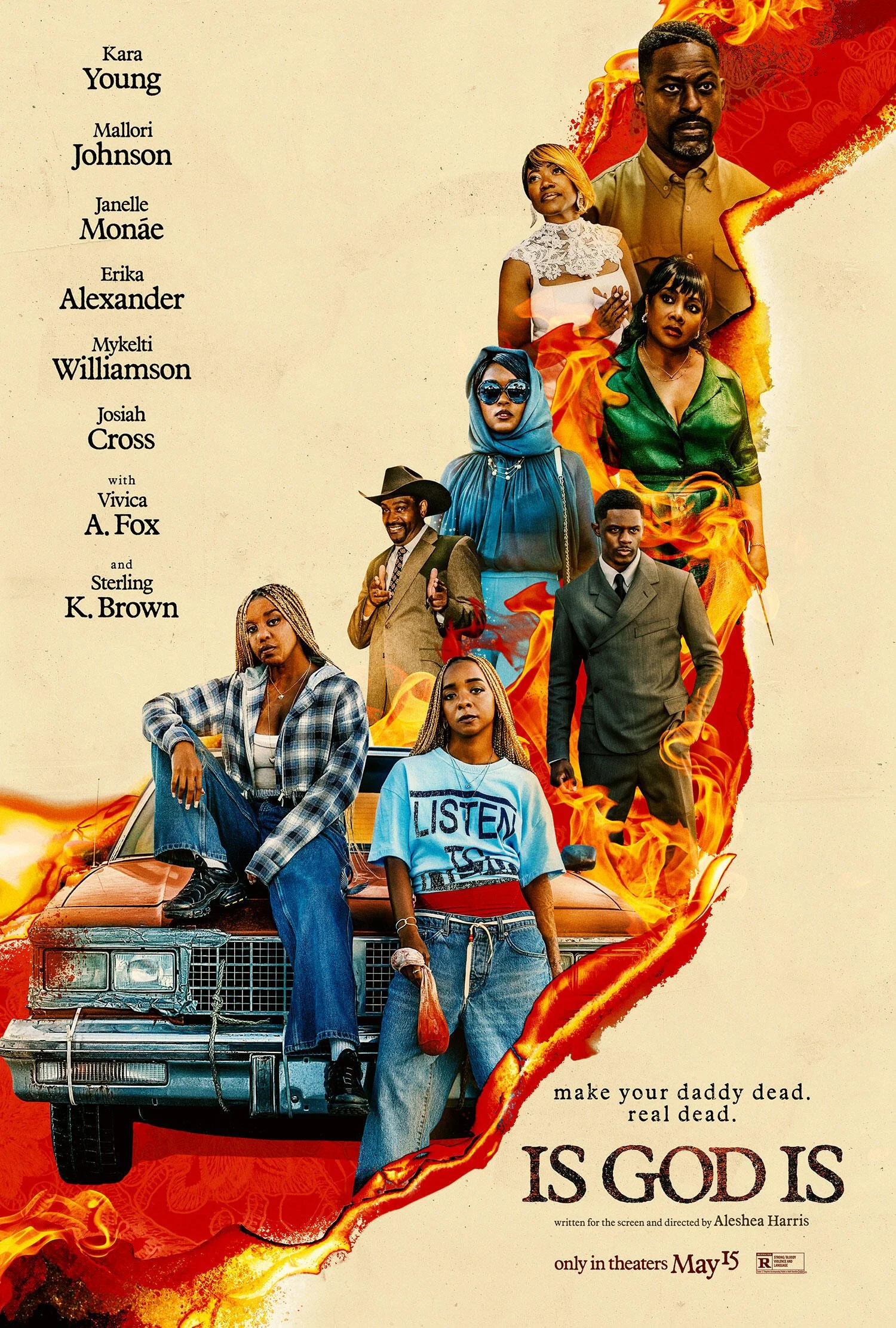
I have a lot of sympathy for God, you’re supposed to, but it does raise a few eyebrows to reach out to your adult daughters for the sole purpose of having them kill your evil ass ex. This resentment, the kind that accumulates to the point of bleeding out into the people you love, is something that ultimately seals the fate of every major player in this movie; it’s what led Racine to be pulled into the fire at the end, it got Riley killed, and left Anaia all alone without her second half. Something that I keep coming back to with this movie is whether this was all worth it or not. More importantly, what does it mean for something to be worth it?
To me, Racine and Anaia were completely justified in how they handled this mission bestowed upon them by their mother. Anaia longed for peace, to live in a world that didn’t feel constantly hostile towards her. Racine wanted blood. From her perspective, The Monster ruined her life, ruined everything. The world Racine lived in was one that she felt could only be survived. It’s no wonder that she was so quick to cosign patricide, and why she was hellbent on making good on their promise to God even after Anaia was begging her to give it up. Should Racine have listened to her sister? I don’t know, I don’t think so, but I also believe Racine’s worst crime was bringing Anaia along for the bloodbath. The issue is, they’re kind of a packaged deal, no way Anaia would have left Racine on her own like that and Racine herself admitted that she needed Anaia. This is what I meant about resentment, how it never stays isolated, it permeates, it has to. Like fire, it needs something to feed off, and the same way Racine used Anaia to keep her going, God used her twin daughters to stoke that bitterness… but I kind of get it. At the risk of sounding contentious, I would argue that Racine had to die in order for her to exact her revenge on The Monster. Bear with me now, because I understand why this sounds a little perturbing. Because Racine herself had gotten lost in seeking revenge, she wanted everything about The Monster to die; his wife, his other kids, and therefore herself (she is part of him after all).

I truly believe that Racine would have done everything the same if given the chance. For her, dying for justice, for God, for Anaia, for herself, was worth it if it meant killing as much of that man as possible. Anaia gets away, not because she doesn’t hate The Monster or that she found the ability to forgive him (actually, one of my favorite details about this movie is the fact that no one forgives him), but because she was willing to detach herself from him, she’s able to let go. ‘Let go’ in this case doesn’t mean relinquishing all the bitter feelings, but it does mean choosing to move forward rather than giving him the chance to influence any more of her life than he already has. IS GOD IS goes out of its way to distinguish between the lasting impact of The Monster and how that impact informs the twins (and God) in how they maneuver through the world. Let me be clear, I don’t want to make a simple ‘hurt people hurt people’ argument (that would be boring as hell). What I do want to point out is how important I think it is that the different perspectives Anaia and Racine hold are understandable given everything they know (and later learn) about their father. I believe Racine thinks what she did was worth it, I’d even argue that Anaia shares that sentiment (even if it’s only because she knows that’s how Racine feels). When The Monster holds on to Racine after being set ablaze, the obvious implication is that she’d become enraptured and inevitably consumed by her desire for revenge. That being said, I don’t think she’d change anything if given the chance. I feel like Racine knew that there was no coming back from what they were doing, and I don’t just mean in the sense that they’d be wanted for several murders.
IS GOD IS does a lot when it comes to distinguishing between revenge and punishment, but what I think it does best is let the different perspectives of each character who’s done dirty hang in the air for the audience to sit with. The ending of the movie is semi-sweet, and I’m sure there are plenty of viewers who thought Racine was becoming no better than The Monster, or that God was the real antagonist for goading her daughters into committing acts of violence they otherwise wouldn’t have. I don’t ascribe to either of those interpretations, but I find it significant that there are so many avenues someone can go down with this movie. As tragic as it is hopeful, IS GOD IS forces you to sit and think about how much vengeance is worth, the differences between revenge and justice, and the long-term ramifications of trauma on those who have been victimized and the people around them.