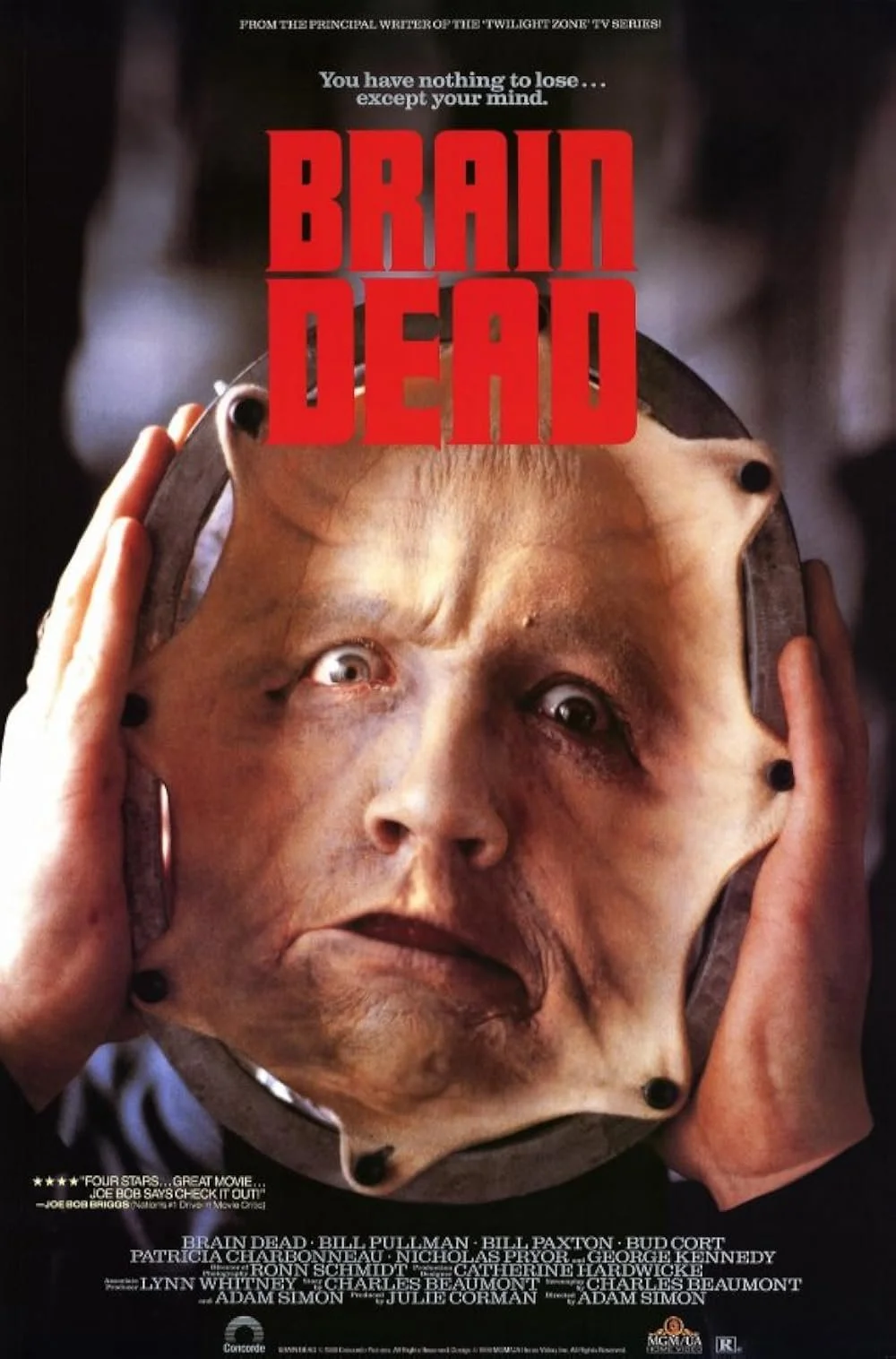
BRAIN DEAD (1990)

Charles Beaumont never spoke for himself. In his fourteen years of active work as a writer, from 1950 to 1964, he sold ten books, 73 short stories, 22 articles, 14 columns, 13 scripts for the big screen, and 68 for the small—but he never gave an interview. However much of his work hewed autobiographical, Beaumont never admitted it publicly; only to friend and fellow genre scribe William F. Nolan did he reveal that “Miss Gentibelle,” a horrifying short story about an abusive mother who dressed her son as a daughter and killed his pets as punishment, was based on his own childhood. It’s more telling of the man as most knew him that he’d rather shrug off his early years as “one big Charles Addams cartoon.” You wouldn’t know by talking to him that he was the second-most prolific screenwriter on THE TWILIGHT ZONE, inching out the more venerated Richard Matheson and falling short of only Rod Serling himself. In The Twilight Zone Companion, which serves in part as a fond memorial to Beaumont, colleagues and co-writers recall him as a force of friendly nature whose predilection for plumbing the show’s darkest depths was always at odds with his contagious vitality. To Nolan, his ease with the uneasy was what made him one-of-a-kind:
Chuck was the perfect TWILIGHT ZONE writer, more than [Richard] Matheson or Rod Serling, even. Matheson is very much of a realist who can mentally lose himself in those worlds. He doesn’t live in them the way Chuck lived in them. Chuck actually lived in THE TWILIGHT ZONE.
It’s only appropriate that BRAIN DEAD, inside and out, feels like an epitaph from the fifth dimension.
In the late 1980s, decades after Charles Beaumont’s untimely demise, producer Julie Corman tasked some Concorde Pictures interns with reviewing the considerable stockpile of scripts she’d acquired with her husband Roger across thirty-odd years in the B-movie business. They only found one worth dusting off; a script so old that it was copied on carbon paper. Between assignments on Roger Corman’s Edgar Allan Poe cycle—namely THE PREMATURE BURIAL, THE HAUNTED PALACE, and THE MASQUE OF THE RED DEATH—Beaumont wrote a spec screenplay entitled “Paranoia,” a psychological thriller about a brain surgeon trying to enter someone else’s mind at the potential cost of his own.
First-time director Adam Simon, soon to be of CARNOSAUR fame, updated some mad science for The Walkman Age, but the story remained right at home in the ZONE.
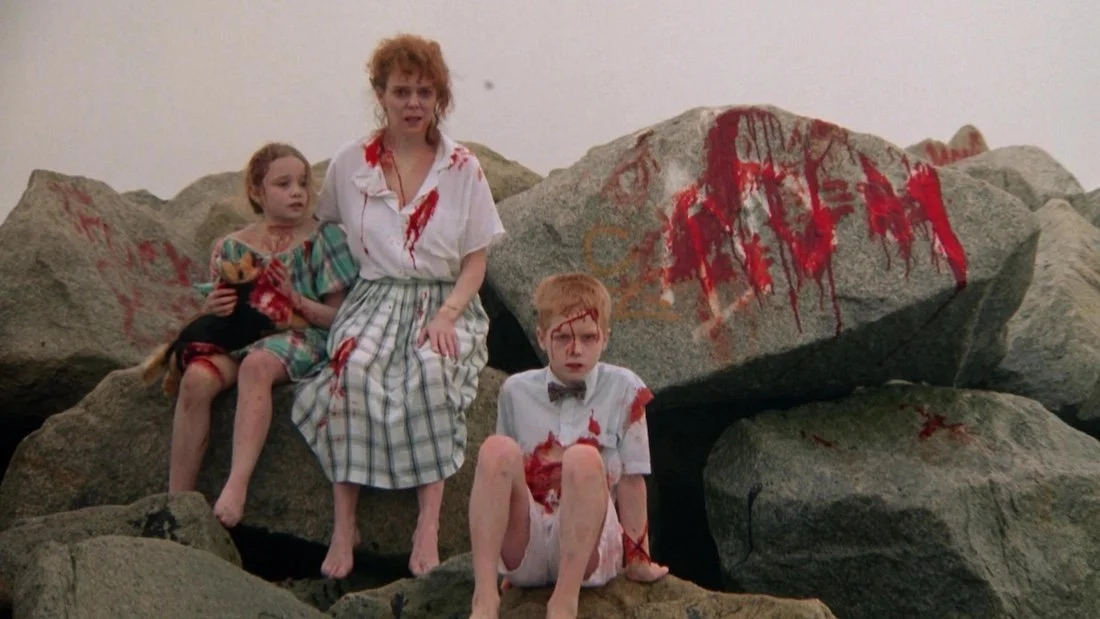
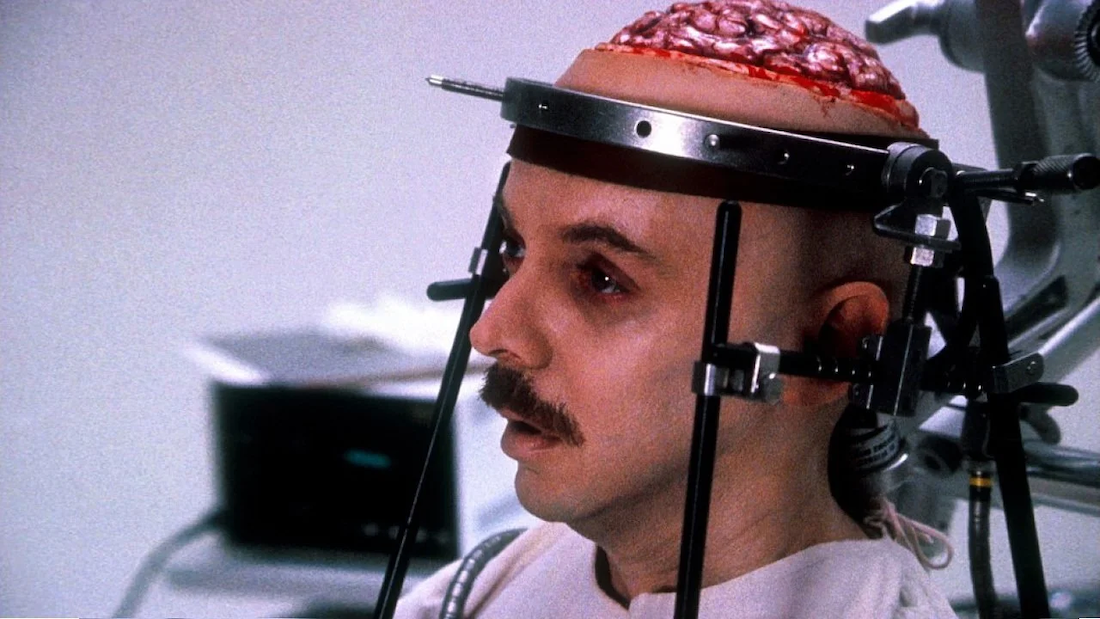
Bill Pullman plays “brain man” Dr. Rex Martin, essentially Herbert West if he’d only applied himself. His breakthrough technique would allow the surgical extraction of memories by poking the right grey matter and asking the right questions. Theoretically, at least. He’s content to spend his days anthropomorphizing jars of dead meat until sleazy suit and old friend Jim Reston, played by nominative doppelganger Bill Paxton, calls in a favor. Dr. Halsey, the visionary mathematician behind the Eunice Corporation’s latest breakthrough, has suffered a psychotic break, killed his family, and destroyed all evidence of...whatever he’d broken through. The company needs that proprietary information recovered or, if Martin can’t deliver, destroyed, while he’s in the cranial neighborhood. And, as a dystopian mega-conglomerate that could never, ever exist in the real world, Eunice owns everyone involved, secretly funding Martin’s research and publicly operating the mental hospital that wouldn’t notice a sudden decline in its latest patient. So, it’s not really a favor at all and the meter’s already running: “I haven’t got four years. I haven’t even got four weeks. Why not...cut it out?”
Between production of the fourth and fifth seasons of THE TWILIGHT ZONE, when he was only 34, time started running out for Charles Beaumont. The show’s unassuming powerhouse suddenly couldn’t focus long enough to pitch an idea, let alone turn in a draft. His last few contracted episodes were ghost-written by friends desperately trying to keep him employed. Within two years, he couldn’t even hold onto an idea. After Beaumont tearfully ended his trips to the cinema with Nolan and fellow ZONE writer John Tomerlin because movies no longer made sense to him, they came to the same non-conclusion on the drive home: “’Shit, something is horribly wrong with Chuck, and I wish to God we knew what it was.’”
Dr. Martin’s life starts falling apart almost immediately, right around the time Bill Paxton lays out the plot while grinning like a Halloween decoration: “Look at it this way, could be worse—you could be the patient, and Halsey could be the doctor!” Soon, he’s hit by a car...or is he? And a man in a bloodied, white suit won’t leave him alone...or will he? And his wife is having Cinemax sex with Reston on their dining room table...or are they? Is Martin jabbing at Halsey’s brain or has somebody already jabbed his?
The All-A-Dream fake-out is one of the oldest cliches in the book, possibly even predating the invention of books, but Beaumont ingeniously applies a classic equation of anti-comedy—a joke is funny the first time, tired the second, and hilarious the hundredth. There are so many overlapping twists, turns, and retreats that it’s difficult to even remember what baseline reality we’re supposed to be clinging to. Adrift in the literalized sea of Halsey’s subconscious, Pullman kicks at an unseen id-beast, amusing its keeper, played by a perfectly cast Bud Cort: “You can’t get hurt in your own brain!” His brain eats him alive immediately thereafter.
Doctors at the time could not give Charles Beaumont a diagnosis— Alzheimer’s and Pick’s disease, the likeliest candidates, required an autopsy for confirmation—so they gave him a sentence instead. Their only thin condolence was that—whatever was eating him alive—it had already eaten so much that he wouldn’t notice losing the rest. Beaumont died on schedule, just three years later, at the age of 38.
The script that became BRAIN DEAD was written years before the disease found him. The startling similarities, of an unassuming scholar suddenly and violently becoming his own case study, are pure coincidence. If anything, the source of Beaumont’s fascination with unreality may stem from the adolescent case of spinal meningitis that some suggest dominoed into his eventual death. He convalesced in a room covered with novelty wallpaper that looked like bookcases, a counterfeit reality that only existed through the crack between sight and touch.
BRAIN DEAD is a labyrinth of rooms with fake bookcases on the walls. It is a pulpy, prophetic, strangely beautiful, and occasionally perverse eulogy for Charles Beaumont and his macabre obsessions that, by twist of fate, happens to have been written by the man himself before he even knew he was dying. The film deserves more than its non-reputation as something accidentally watched instead of Peter Jackson’s BRAINDEAD. It’s certainly worth more than a trivia question about the only intersection of Bills Pullman and Paxton. Charles Beaumont, the unsung author of so many nightmares, is worth more than that, too.