
I’ve been seeing a lot of lists for summer-themed movies lately. I love lists. I love themed lists especially, and when it comes to summer movies, there is so much fun to be had. Between the horrors at camp, summer sports, summer vacation, and coming-of-age stories, there’s almost no way to make a comprehensive list. But I did notice a trend: most of the films on these lists—while super entertaining and fully deserving—rarely stepped into the realm of challenging. I get it. Traditionally, summer is for fun and just as much a vacation for our brain as it is for our body. JAWS (1975), JURASSIC PARK (1993), THE GREAT OUTDOORS (1988), THE SANDLOT (1993), all these feed the brain in an exhilarating way. They satiate a sense of adventure and uninhibition even when the protagonists are unfortunate. I am a super fan of summer as well. Among all my fall loving friends, I am one of the few that loves the heat, the sun, the sports, and the nature.
But summer has another layer of expression that we often don’t acknowledge. The listlessness of hot days, the way time crawls, how your brain wanders, and the way it is a transitional period for many whether, either because of children growing older or simply the way life moves faster. Maybe it’s because I have memories of growing up in endless summer weather (Okinawa, Japan), that the season also greets me with deep feelings of reflection and melancholy. Nevertheless, it’s for this reason that I don’t think any summer list is complete without movies like KIKUJIRO (1999), and especially FLOATING WEEDS (1959) directed by Yasujiro Ozu.
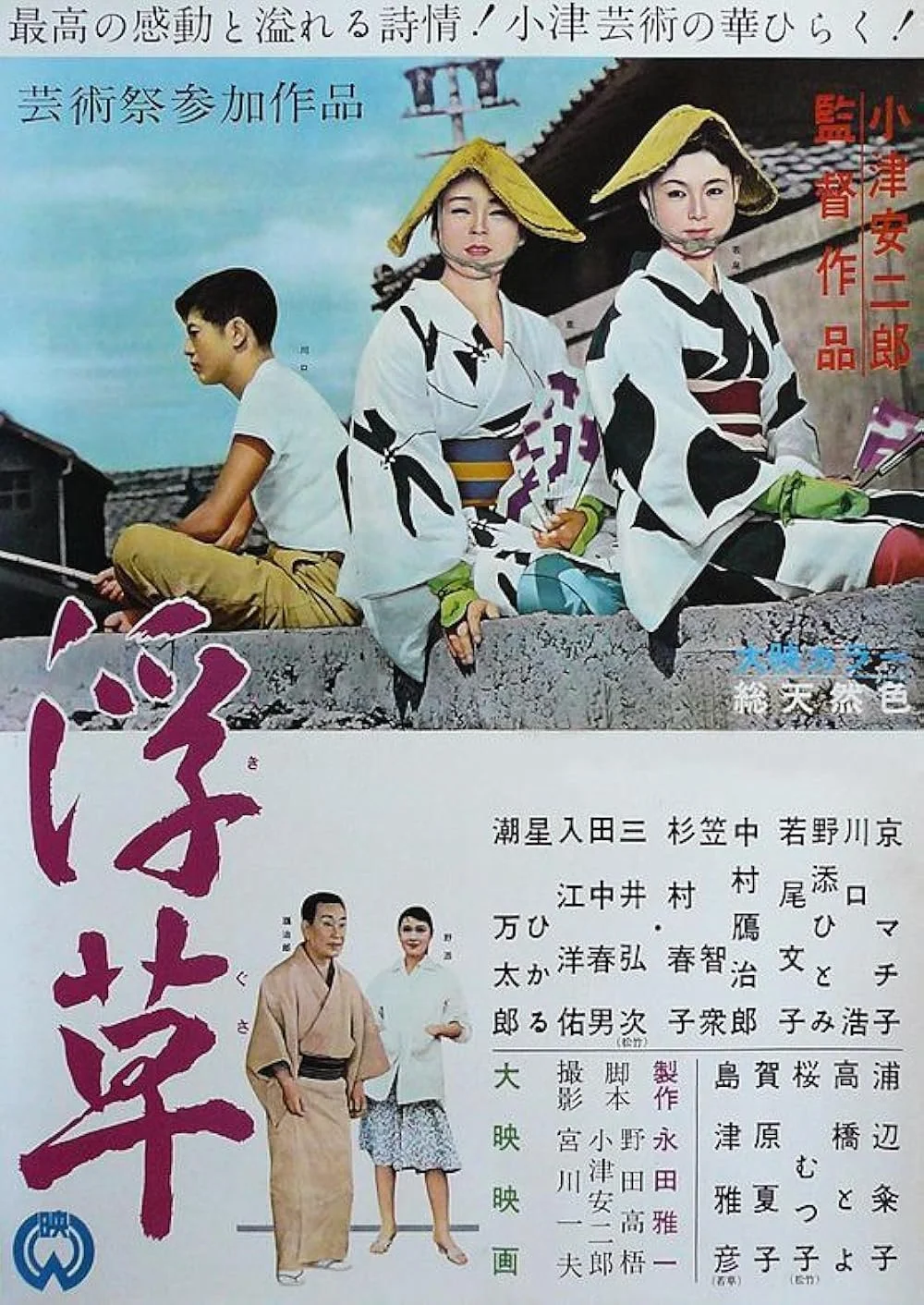
FLOATING WEEDS is a remake of the silent film A STORY OF FLOATING WEEDS (1934) also by Yasujiro Ozu. It is about Komajuro, the leader of a traveling troupe of kabuki actors, who returns to the town of his longtime mate and adult son. The son only knows the actor Komajuro as his uncle and believes his biological father to be deceased. It is during this visit that Komajuro’s current mistress discovers this secret and becomes jealous. Her jealousy sets off a chain of events that alters everyone’s lives in the troupe and in Komajuro’s family. This remake was done in color, and while the story remains the same as the original, the tone of the latter is more forgiving which seems to reflect Ozu’s softness from aging.
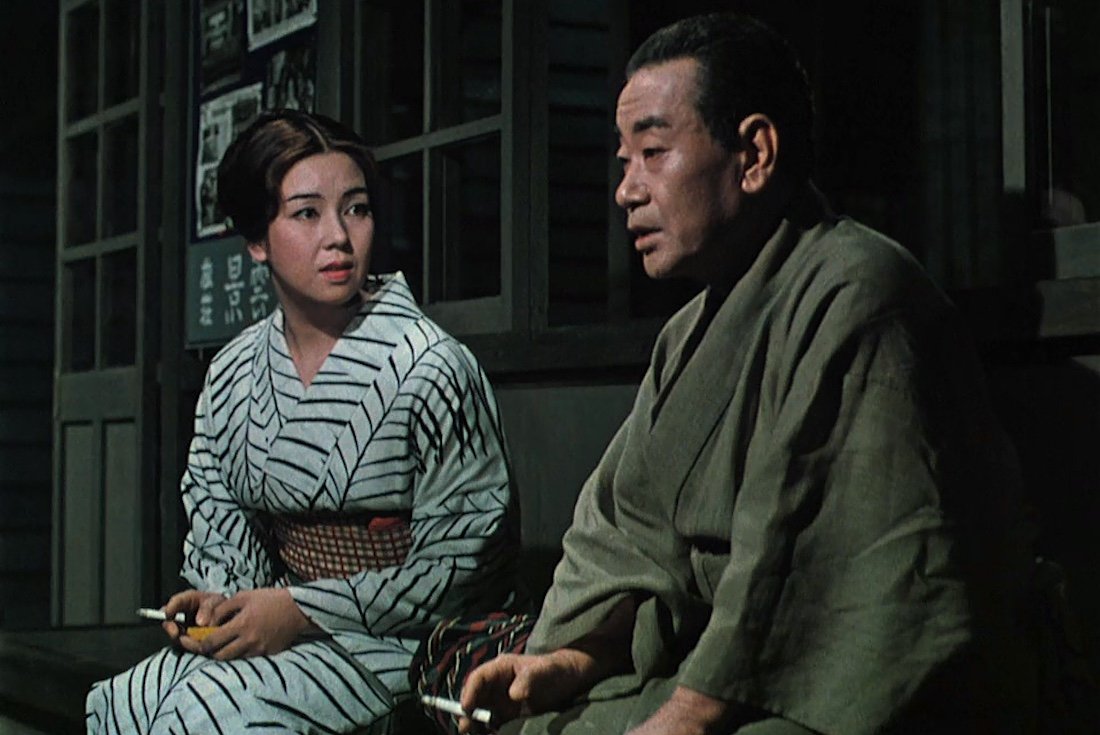
I don’t know where to begin in praising the work of Yasujiro Ozu. All I know is that in my experience of watching the films from this legendary Japanese director, I am consistently speechless afterwards. This is in part due to the extraordinary visual beauty, but also his narratives of ordinary life leave me overwhelmed and temporarily unable to process all my complicated feelings. He writes and portrays realism in a way that feels so whole that in one sense it is reassuring to be accepted fully as human. Yet, it is simultaneously terrifying to be outed as such and seen for both the angels and devils that coexist inside all of us.
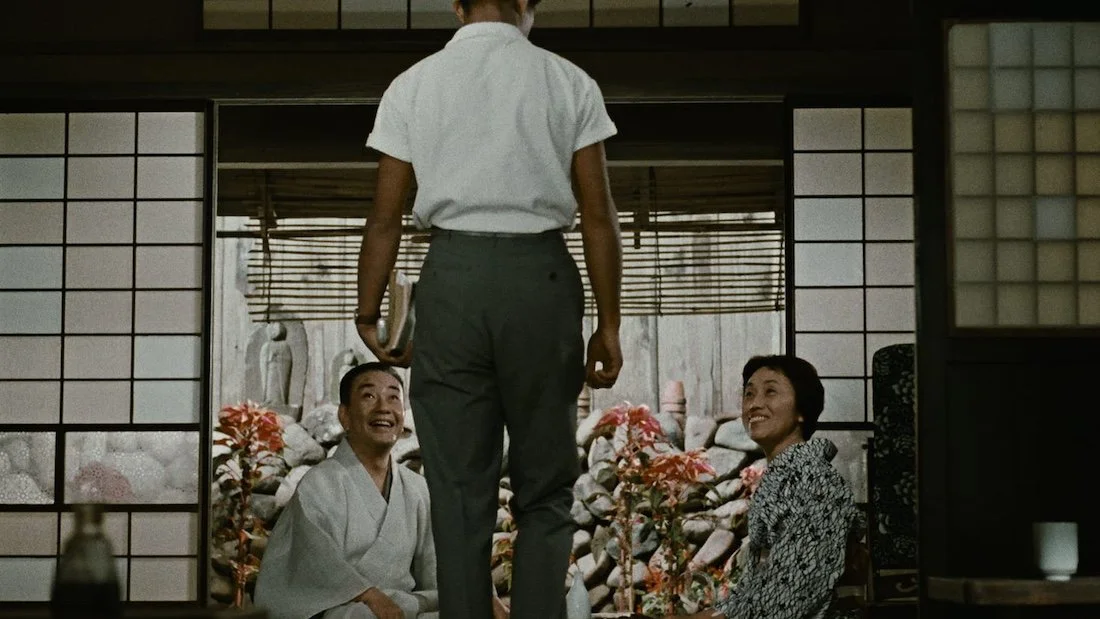
Ozu is a master of film composition. While his camera work is famously simple and consistent—low to the ground, direct, no unnecessary zooms or unexpected perspectives—it feels innovative and masterful. His composition and storytelling (both visually and narratively) are precise, stylistic, dramatic, and apply to the smallest details. Every frame has its own story. Every shot is a photographic feast for the eyes. His stories center around ordinary people and the drama found within daily life. His movies feel like documentaries with no true villains or heroes.
At first glance, there doesn’t seem to be anything particular special to his film style, yet you find yourself consumed by its realness. The best way to describe Yasujiro Ozu’s mastery is that he makes his movies look so simple and true to life, through profound use of color, framing, and detailed set planning. I can watch a film of his on repeat and discover new concepts with every viewing. What’s more, no viewing feels the same. I walk away with different viewpoints and feelings each time.
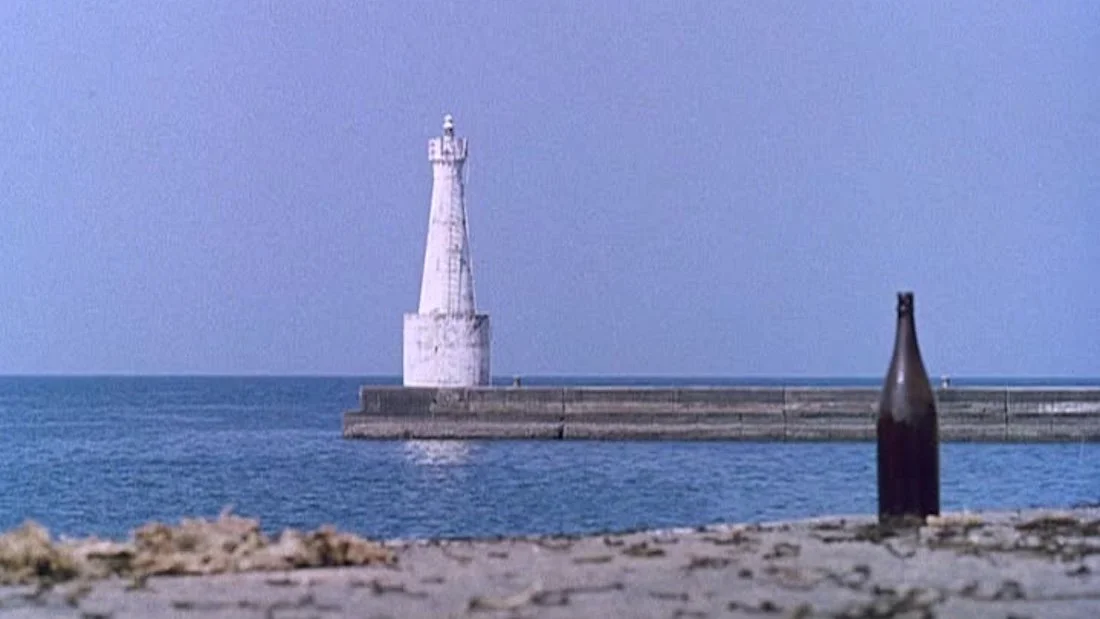
Two of my favorite examples of this composition come from the very beginning and the very end of FLOATING WEEDS. In the first scene, we see a white lighthouse that is almost bottle-like shaped in the distance of the bay. In the foreground, there is a black drinking bottle that mirrors the shape of the white lighthouse. This is the yin and yang, the balance, and wholeness of what is to come. The last scene is a train pulling away in the darkness, and while the shot is mostly black in color, two red circles of light glow symbolizing the characters reconnecting and moving on like floating weeds.
FLOATING WEEDS is the perfect name for this movie. It describes people without roots, or those who get their energy from moving place to place. Not everyone wants the white picket fence life, and when those people fall in love with those people who do want the picket fence, hearts are broken. But, in a world full of different kinds of people, these interactions are unavoidable. I don’t know what the universe is telling me, as this is the third Japanese movie I’ve watched recently where this is the central theme. It has made me reconsider my own personality and desires from life.
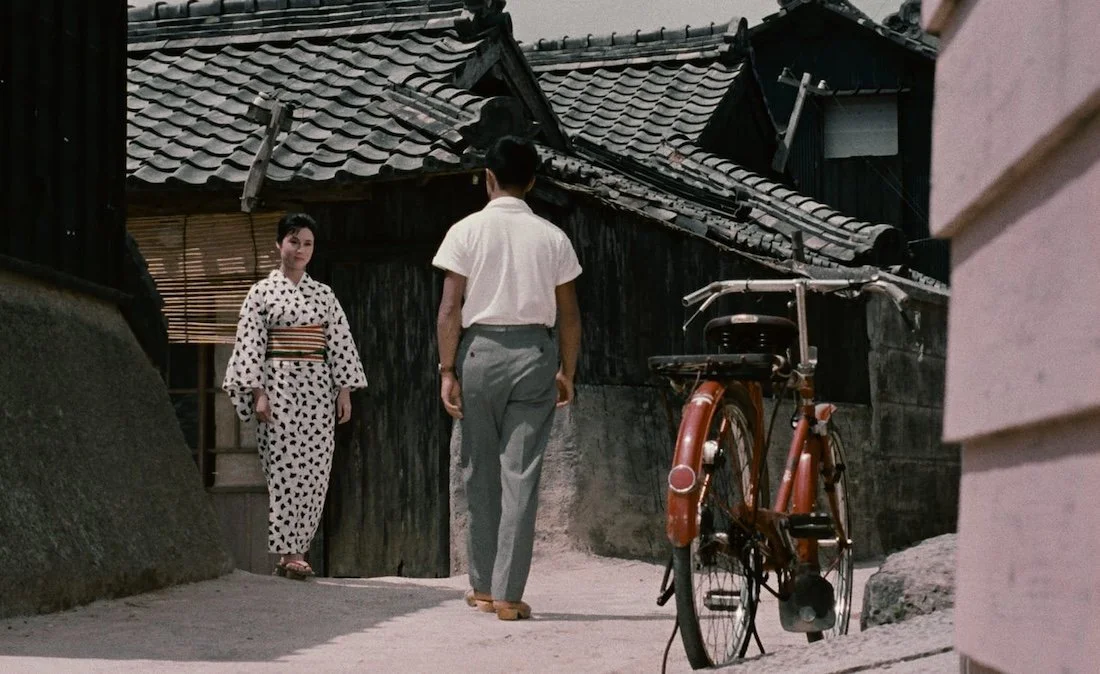
Another reason I love this movie, and why I highly recommend Japanophiles watch Ozu films, is that he is one of the best at what I would call “demystifying” Japanese people and Orientalism. Aside from their clothes being different and various architectures, at the core, these are flawed, loving, hardworking, tired, and stressed-out people just like you and me. His stories and the themes from them are extremely universal. It doesn’t feel like you are watching a “Japanese” film in the sense of the stereotypical, overly mystical and perfect zen world of Japan. There is no kawaii or Ghibli atmosphere to be found. Nor does it feel like it is the other extreme of the seedy underworld of violence, gore, sex, and exploitation. It is a beautiful and important representation of Japanese people simply as people and not a trend or stereotype. As Japan continues to be one of the most popular tourist destinations in the world, I implore people to remember that it is a vacation to you, but a home, with everyday strife, to them. I think more media like Ozu in the cultural zeitgeist would do a lot of good for bridging that intercultural gap.
Summer movies can live comfortably in so many genres. If you’re ready for a quieter and more thoughtful look at summer and how the season itself can change people, I recommend you add FLOATING WEEDS to your list.