
THE CITY OF VIOLENCE (2006)
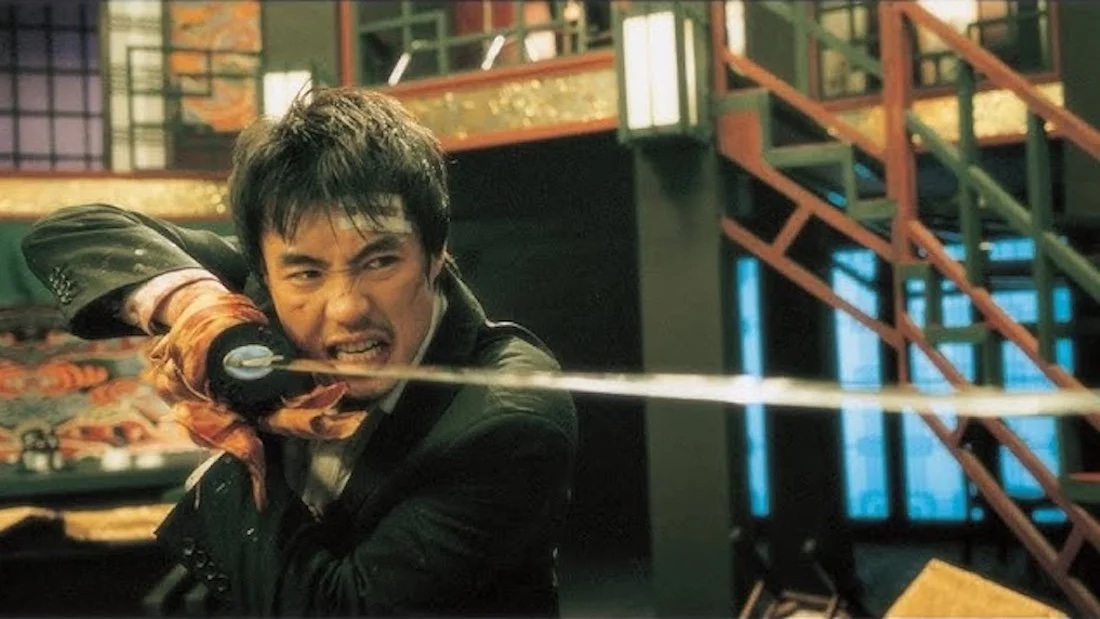
At the time of this writing, Kenji Tanigaki’s THE FURIOUS is playing in theaters and any action fan worth their salt should be checking it out. Starring heavy hitters such as Miao Xie, Joe Taslim, Yayan Ruhian, and Brian Le, director Kenji Tanigaki teams up with action and stunt coordinator extraordinaire, Kensuke Sonomura, for the film’s unbelievable stunt choreography. It has some of the best hand-to-hand fight sequences of the year and the way in which bodies pile on top of each other with Sonomura’s trademark CQC, grapple-laden choreography must be seen to be believed.
Many critics and pundits (admittedly, myself included) have claimed that this movie features “the best action since THE RAID.” This might be true, but those assessments might also point to a lack of interest in or knowledge of the action space as a whole. In fact, colleagues and friends have pointed out that there are many films that scratch this particular itch. Historians and connoisseurs like Frankie Balboa, Priscilla Page, and Brandon Streussnig have made entire watchlists with films that people can check out in the lead-up to THE FURIOUS or watch in the wake of it.
This is my contribution to such watchlists. Are you looking for another film that features a famed director and equally legendary stunt choreographer teaming-up to leave it all on the field in terms of what they have to say on the genre? And if so, what else fits the bill?
The answer is THE CITY OF VIOLENCE.
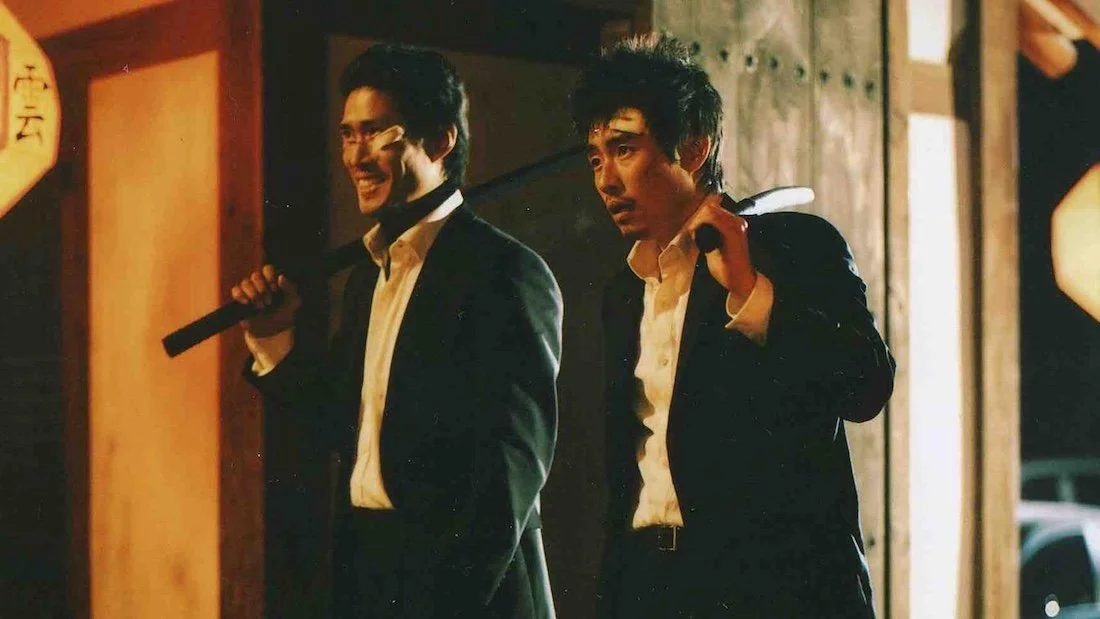
Directed by Ryoo Seung-wan, the film celebrates its twentieth anniversary this year. As a collaboration between himself, and Jung Doo-hong (who serves as the film’s lead actor, second unit director, and fight choreographer), the duo put their stamp on the martial arts genre in South Korean cinema. It’s a showcase for the pair, with Seung-wan crafting a bouncy, yet visually dynamic film thanks to flashy scene editing while Doo-hong gets to flex his fight choreographer background and acting prowess in equal measure as the film’s fashionable protagonist, Jung Tae-soo. Those elements, along with its deep Neo-noir sensibilities, makes for a film that is absolutely electric.
The films follows Tae-soo, Yoo Seok-hwan (Ryoo Seung-wan), Pil-ho (Lee Beom-su), and Yoo Dong-hwan (Jeong-suk Yun), a quartet of friends who reunite after twenty years following the recent death of their fifth member, Wang-jae (Ahn Kil-kang). Tae-soo, a Seoul police detective, soon teams up with Seok-hwan to investigate Wang-jae’s murder. Unlike THE FURIOUS or THE RAID, THE CITY OF VIOLENCE is not filled with wall-to-wall action. Instead, it focuses on the interpersonal drama between these friends reuniting after so long. Interspersed between these dramatic encounters are two fight sequences in which Seung-wan and Jung Doo-hong put everything they have into crafting their lasting contribution to the genre of martial arts cinema.
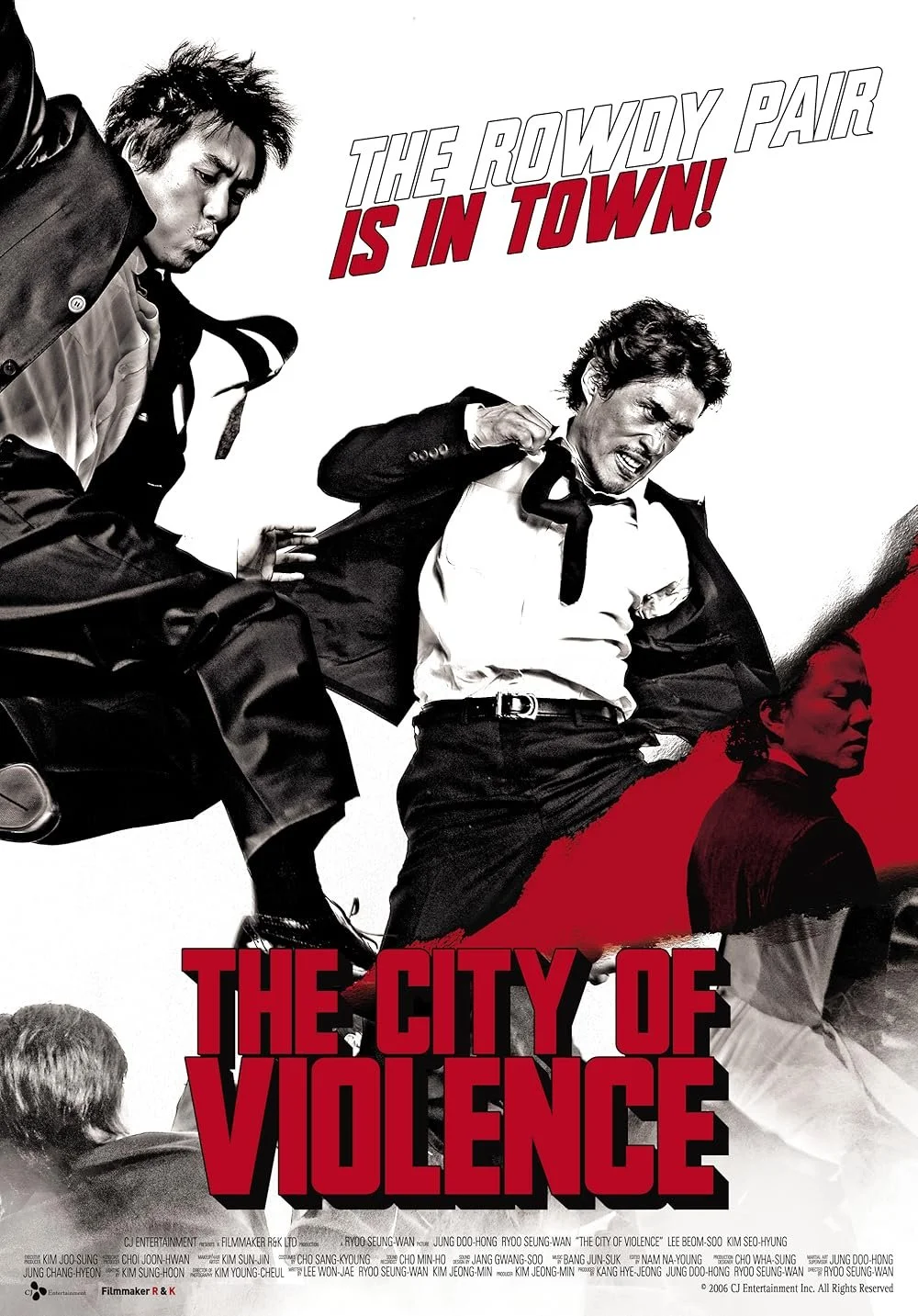
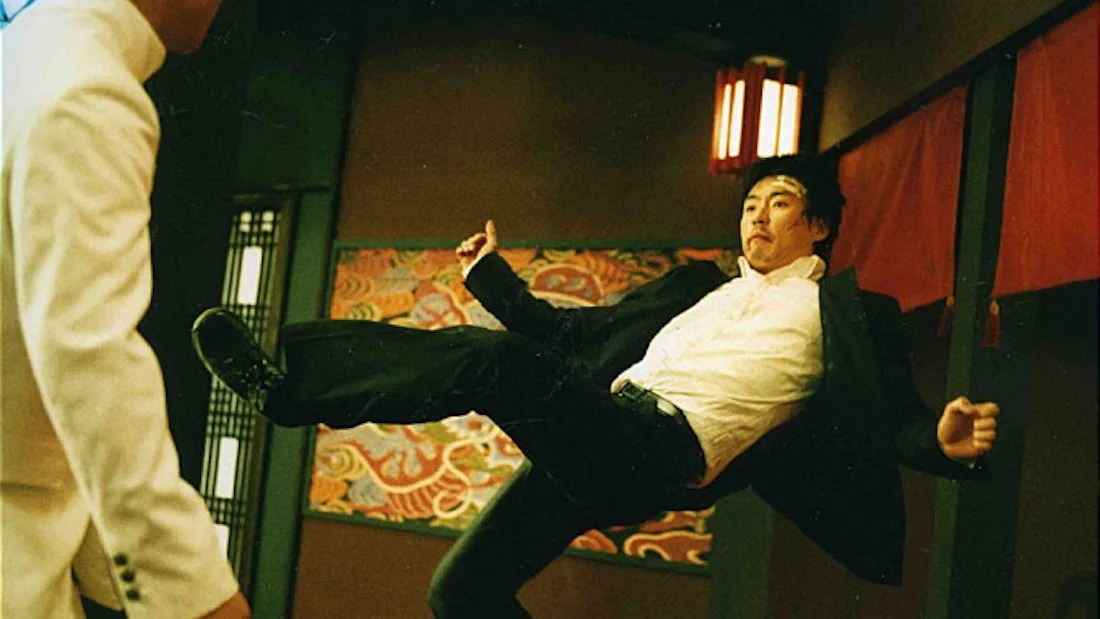
The first of these scenes comes around the film’s midway point. In it, the all-black trench coat and turtleneck wearing detective is suddenly assaulted from all sides by several youth gangs. From breakdancers and schoolgirls, to bike junkies and baseball uniform-clad psychotics, Tae-soo takes a beating as he runs, jumps, and stylishly kicks his way to survival. It’s only Seok-hwan’s timely arrival that Tae-soo is saved and the two can fight their way out, narrowly evading the seemingly endless swarm of teenagers.
The entire sequence is an extended homage to Walter Hill’s 1979 ‘survive the night’ classic, THE WARRIORS, in which a group of embattled youths are wrongly accused of murder and forced to go on the run. Additionally, it’s a sequence that fits within the larger thesis of the film. On a macro level it showcases how the city has changed, with the gangs of teens running amok, disrespecting elders, and making the urban metropolis their playground. And on a micro level it shows how the group of five friends have since diminished. Where once the five of them could take on a throng of endless bullies with reckless abandon, now with only two of them, they struggle to even run away. The scene is a fantastic showcase of character work, storytelling, and kinetic fight choreography. One that has just as much to say about the transformation and degradation of this small South Korean town over the last twenty years as it does Doo-hong doing some incredibly stylish jacket flipping jump kicks.
The second major action set piece is an extended third act brawl that runs for the final 20 minutes of this 92-minute film. In it, Tae-soo and Seok-hwan arrive to assault Pil-ho’s compound from the outside. As Pil-ho sits down to have dinner with Boss Jo (Jo Deok-hyeon), Tae-soo and Seok-hwan begin fighting through an army of cooks outside, until they’ve locked themselves into a narrow corridor inside with a horde of knife-wielding guards. The action in this climatic showdown is as varied as it is exhausting, progressing from hand-to-hand combat and frenzied knife fighting, before falling back to an exhaustive knock-down, drag-out confrontation with Pil-ho and his personal bodyguards. It’s an exhilarating, if extensive sequence. But the film’s light tone, coupled with the Spaghetti Western-esque score and energetic editing means the events are brimming with so much character and flair that any fatigue is hardly noticeable. In short, the entire last act of the film is an expert craftsman bringing everything he’s got to paint what may arguably be his masterpiece.
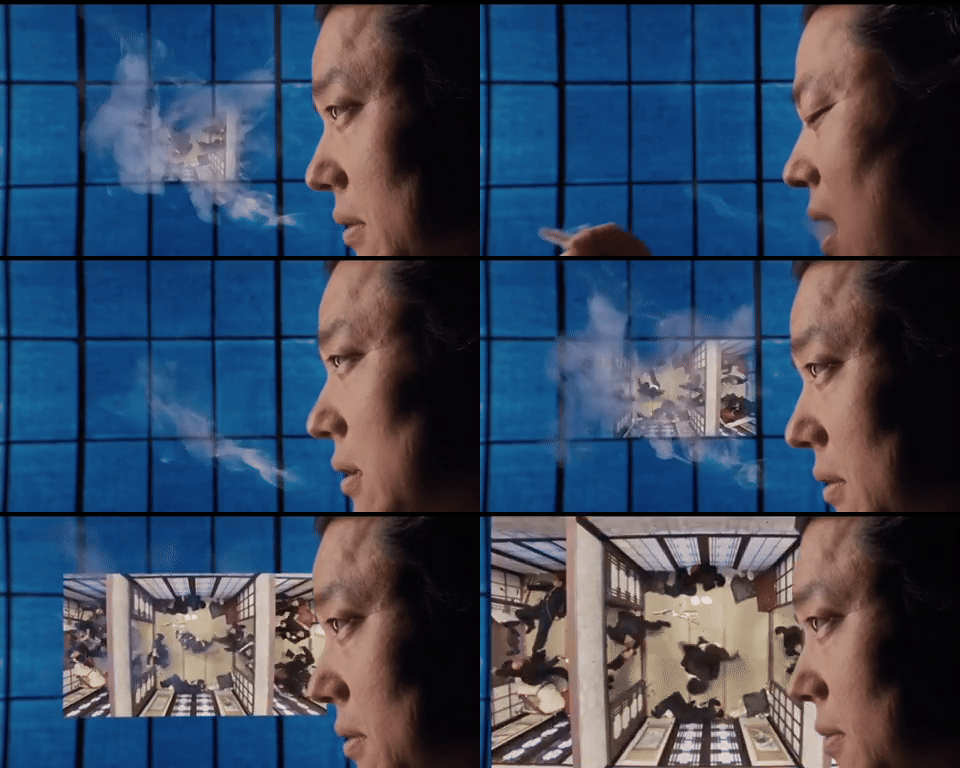
Of the many defining aspects of the third act, Lee Beom-su’s Pil-ho is perhaps the secret ingredient. Throughout the film, his character has been trying to turn the small town into a tourist destination, slowly eroding its culture and identity over the course of twenty years. His greed and desire to be taken seriously leads him to bribe, bully, and betray many of the local townspeople, until he eventually facilitates Wang-jae’s murder, who is trying to stop him. In the third act, all his scheming is undercut when Boss Jo, the local head of the criminal organization he has been trying to court, insults him by emphasizing how much of a ‘hick’ he is. Pil-ho’s bitter realization that he will never be accepted by Boss Jo and his cronies is stylishly intercut between Tae-soo and Seok-hwan’s continued assault through the compound. In the end, Pil-ho is unable to escape his past, literalized in the form of Tae-soo and Seok-hwan rushing towards him, while also never being able to truly gain the respect he craves due to his background and association with them.
Boss Jo’s continued insults cause Pil-ho to lash out, violently bludgeoning the man to death in front of a room full of subordinates. Pil-ho is quickly abandoned by the remainder of the organization, leaving him and his elite guard to face Tae-soo, and Seok-hwan. Pil-ho’s pitiful tragedy is that he sought to raise himself above his station, and in doing so he alienated himself from his friends, while still never being good enough for the organization he betrayed them all for. By the time Seok-hwan delivers the final blow, Pil-ho is the architect of the destruction of his home, his family, his profession, and ultimately himself.
It’s Pil-ho’s death, followed quickly by Tae-soo’s that is the film’s bitter denouement. The real tragedy presents itself not just as the corruption and transformation of this small South Korean town, but also as the dissolution and death of the group of friends at the film’s center. Tae-soo’s final thoughts are of a happier time, where twenty years ago the group of friends once believed nothing would break them. It’s contrasted with Seok-hwan as the lone survivor, sighing at the destruction all around him before the film cuts to black. For a film as relaxed as it is throughout, tonally it’s a fitting final image, one with an undercurrent of deep cynicism about what happens next to Seok-hwan. Here, Ryoo Seung-wan masterfully mixes in the Heroic Bloodshed genre with trademark South Korean Neo-noir-isms to deliver a devastating crescendo that is as chaotic as it is bleak.
In the last few years, I’ve caught up with a few blindspots that hit like a lightning rod. The first time I watched THE EXORCIST III, I was so awestruck with its atmosphere, performances, and William Petter Blatty’s writerly dialogue that I needed an hour to decompress from it. My discovery of Michael Mann’s THIEF was a chance encounter when I saw the 4k restoration was playing at a nearby theater. I left the film having been gobsmacked by how fully formed Mann had arrived with his first feature.
Ryoo Seung-wan’s 2006 feature is another lightning bolt of discovery for me. In collaboration with Jung Doo-hong, the two go all out to deliver one of the most exciting martial art films of the 21st century. The film is packed with character, from its stylized scene transitions, breezy score, and flashy fight choreography that give it equal parts panache and ethos. And while the movie is difficult to secure due to a number of issues regarding its circulation, if you can secure a copy, it is a recommendation of the highest order. If you’re curious after THE FURIOUS, and the pairing of Kenji Tanigaki and Kensuke Sonomura has you looking to scratch that martial arts itch, then for its twentieth anniversary, give yourself over to Ryoo Seung-wan’s THE CITY OF VIOLENCE.