

MOTHER TRUCKIN’ MAY: ICE ROAD: VENGEANCE (2025)
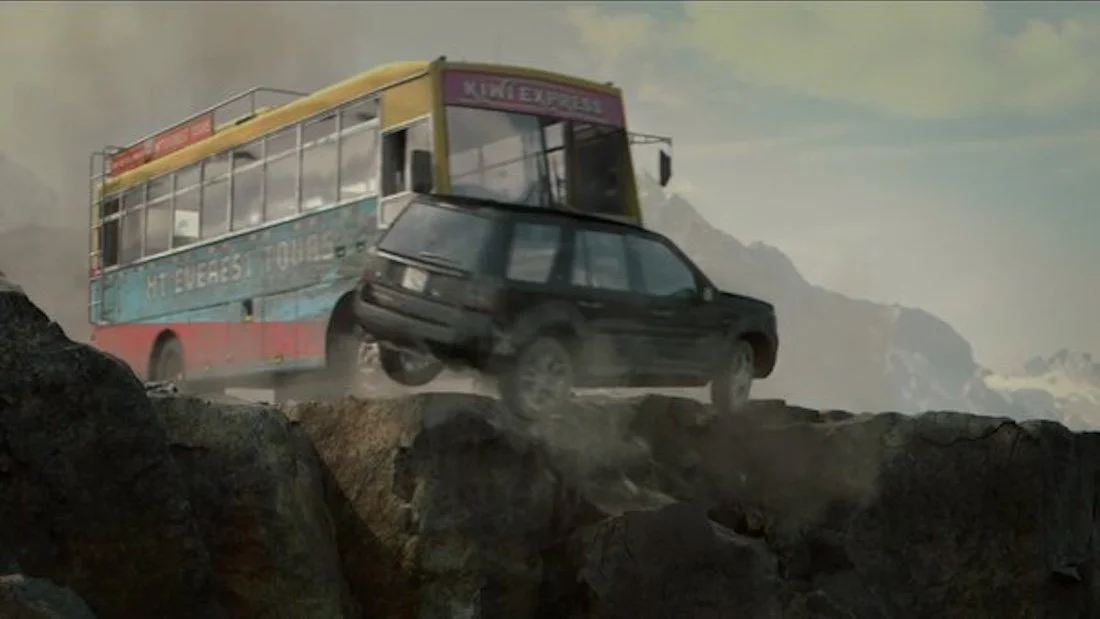
Actors Liam Neeson and Marcus Thomas and director Jonathan Hensleigh return with ICE ROAD: VENGEANCE, the sequel to 2021’s THE ICE ROAD. Hensleigh and company try valiantly to differentiate the two films from each other and, while the effort is admirable, much like its predecessor, the results are a mixed bag.
ICE ROAD: VENGEANCE opens on Neeson’s Mike McCann scaling a mountain in the Black Hills of South Dakota known as The Needles. It feels like an attempt to show that, although four years older than in the previous film, McCann isn’t ready to go quietly into that good night.
The first thing that Hensleigh does to differentiate the two films is wisely move its setting. The first film has McCann navigating the northern wilds of the network of Manitoba ice roads. ICE ROAD: VENGANCE largely takes place throughout the treacherous roads that wind along the Himalayan Mountains in Nepal. This is a wise change, necessitated as it was the last wish of his departed brother to have his ashes scattered over the summit of Mount Everest. The cast is led by Neeson who is thankfully relieved of being too much of an ass-kicking grandfather type. In the new film that job mostly falls to Bingbing Fan, who plays a competent and deadly Sherpa named Dhani Yangchen. Marcus Thomas returns in the flashbacks as John “Gurty” McCann, the aforementioned dead brother who acts as a spirit guide for Neeson’s character, in keeping with some of the Eastern mysticism sprinkled throughout the movie. Another pleasant change between the two ICE ROAD installments is that, instead of an enormous diesel 18-wheeler, the sequel uses a nimble tourist bus to navigate the narrow roadways through the mountains.
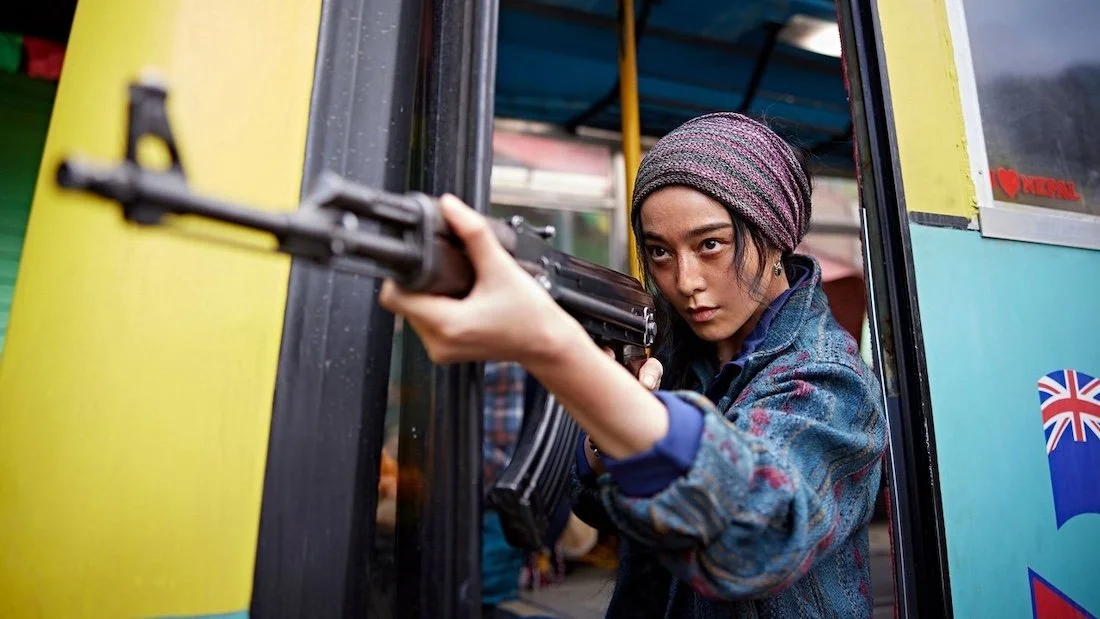
The plot of the previous ICE ROAD was set off by a gas explosion at a mine. VENGEANCE’s main narrative thrust is kicked off by a supposed bus accident on the treacherous mountain roads involving the grandfather of the Rai family. The Rai family are the lone family unwilling to sell out the land to build a hydroelectric dam the on the river which is the hub of all activity in the village. This is where we meet the villain, Rudra Yash (played with a calculating evil by Mahesh Jadu). Yash is the one pushing hardest for the hydroelectric dam on the river, boasting how it will modernize the village of Koadri. At a rally to drum up support for the hydroelectric project, we meet the surviving members of the Rai family—Vijay played with youthful enthusiasm by Saksham Sharma, and his father Ganesh, played with kindly elderly charm by Shapoor Batliwalla.
A second plot development that furthers the action is a daring kidnapping. A pair of mercenaries (working for Yash) board the bus that McCann and Yangchen are on as they seek to deliver Gurty’s ashes. The kidnappers are almost successful in their attempt to kidnap Vijay, but thanks to a quick-thinking professor Myers—played by Bernard Curry, whose character is investigating the human rights abuses of the Nepalese government—the men are thwarted. A gunfight ensues which frees the kidnapped younger Rai from corrupt police charged with interrogating him. In the ensuing chaos Professor Myers dies, and McCann and Yangchen successfully flee the area thanks to some more ludicrous motoring antics from McCann, after taking over for the original driver, Spike (Jeff Morell). Along with Spike and Vijay, joining the rag tag crew is Professor Myers’ daughter Starr, a seemingly spoiled American tourist played with eventual kindness and empathy as well as a brief flash of choreographed violence by Grace O’Sullivan.
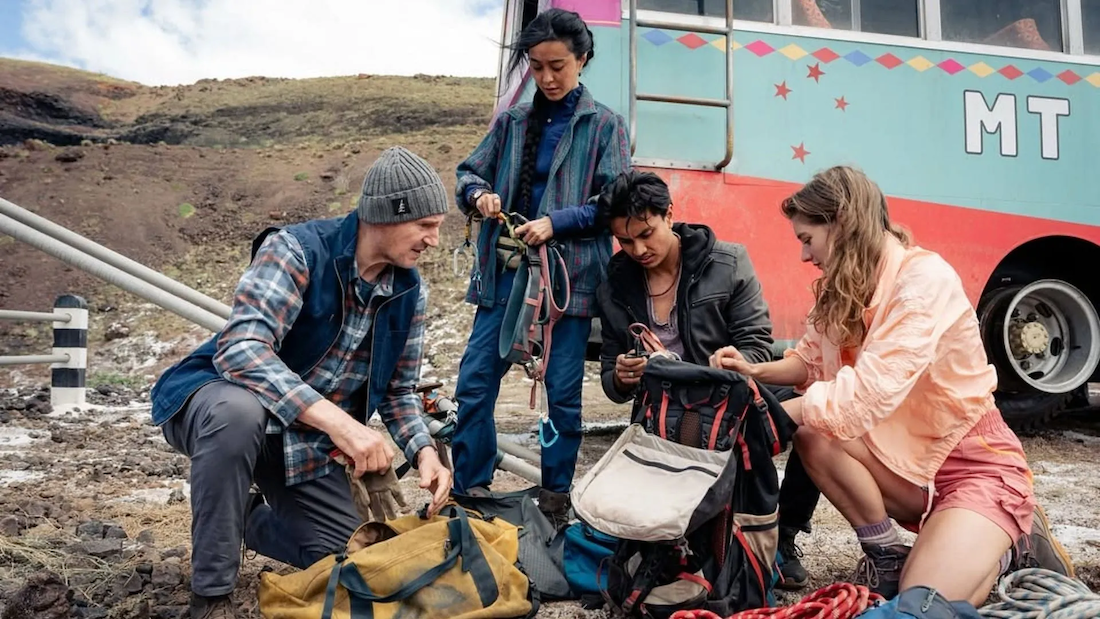
While in the original ICE ROAD the inclusion of the subplot about the corrupt mining company seemed to strain credulity and feel unnecessary, Hensleigh’s use of the corrupt business interests in the sequel makes more sense. Like in the first film if we were only watching McCann deliver goods to the communities it wouldn’t be much of a movie. It would not have been much of a movie if we were simply meant to watch McCann deliver his brother’s ashes to the base camp of Mount Everest—it would be an uneventful slog..
Another thing that works in ICE ROAD: VENGEANCE’s favour is the scenery. Of course there are CGI flourishes, much like in the original film. However, the breathtaking views are excellent visual reminders to the audience of what is at stake to the people of Kodari village and the land around it, as is the plan of the corrupt and sinister Yash.
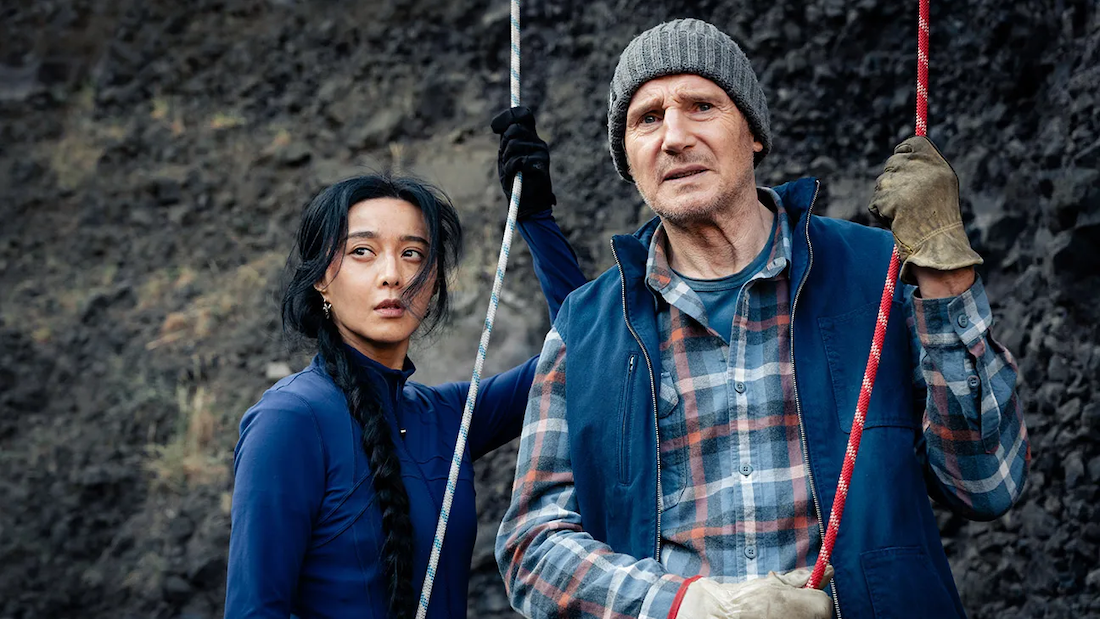
My favourite set piece in the film, much like in its predecessor, involves a nifty piece of driving. For McCann, Yangchen, Starr, and Vijay to escape the clutches of the corrupt police officers and power-mad titan of industry, they must navigate a perilous decline in the mountains. The laws of physics would declare the attempt a suicide mission, but thanks to a leftover piece of machinery from a now defunct Chinese operation in the area, they make the attempt. With the winch the group according to Mike has a 50/50 shot at traversing the steep decline, and making the hairpin turn near the bottom of the ravine. But of course, nothing can ever be so straightforward. The winch meant to lower them gently down the side of the mountain into the mouth of the ravine stalls, and without Mike’s quick thinking the group would have crashed into the side of the mountain. Luckily, the bus only ends up seemingly disabled on its side at the bottom of the road. The moment is played with deathly seriousness and, although it seems entirely preposterous, it is genuinely affecting work by the filmmakers to invest the audience in the moment.
Perfection (or anything close to it) evades ICE ROAD: VENGEANCE, as the contrivances of the plot seem more necessary than they do in its predecessor. But it ends satisfyingly enough for me to recommend the film. I don’t know where (or if) the franchise goes from here, but by the time the credits roll, everything seems to have reached a pleasant end.