

For the month of October, we’re counting down the best horror movies of 1995! Check back every day for a new entry in the list.
The important thing to note is: it gets better. That’s a good thing to remember in these volatile times, but it also pertains to today’s 1995 entry in a few ways. First, the films in this 1995 countdown list do improve from CANDYMAN: FAREWELL TO THE FLESH. Secondly, the CANDYMAN franchise itself gets a major improvement with Nia DaCosta’s 2021 rebootquel. That’s not to say that the second CANDYMAN outing is garbage; it’s a totally serviceable (if fairly problematic) follow-up to the stellar 1992 original. There are some good aspects to it and interesting elements. It just pales in comparison to its predecessor and doesn’t bring much new to the table. However, I come to praise CANDYMAN: FAREWELL TO THE FLESH, not to bury it.
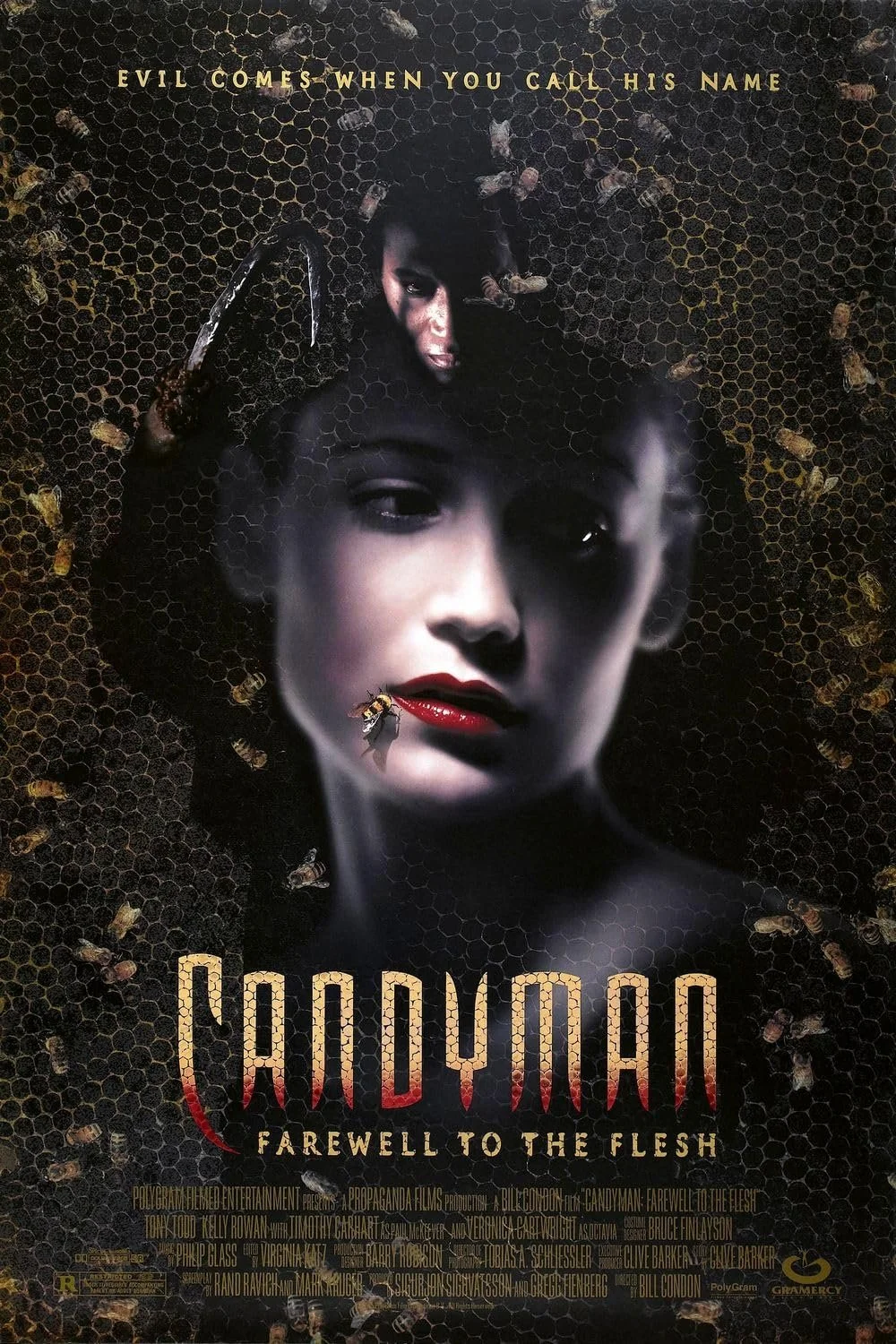
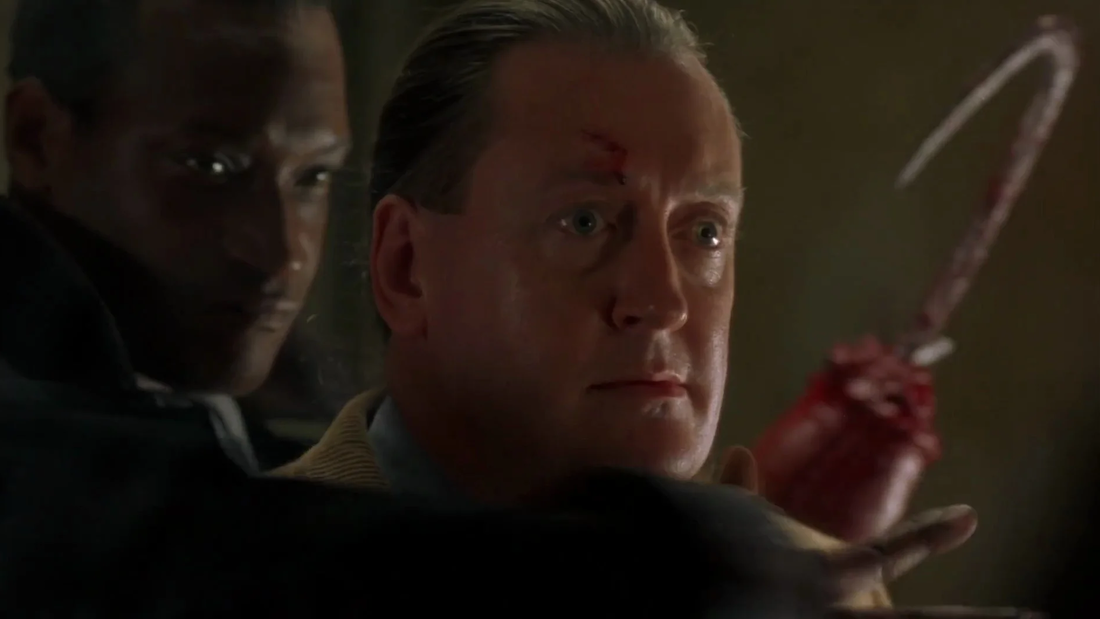
For those unaware, CANDYMAN: FAREWELL TO THE FLESH relocates from Chicago to New Orleans during Mardi Gras. The movie quickly recaps the previous entry and Candyman lore via the pompous windbag professor (Michael Culkin) that briefly appeared in the 1992 film. And then it dispatches that character in a fine but not gruesome-enough fashion, but at least we get an early appearance by Candyman (Tony Todd reprising his role). Soon we’re introduced to Annie (Kelly Rowan), an art teacher whose family has some ties to the Candyman legend. As bodies start to pile up, Annie shows her students that the Candyman myth is just an urban legend and speaks his name five times in the mirror. Soon, things continue to go awry, more bodies start getting hooked, all while Candyman seems to have a larger plan involving Annie and her family.
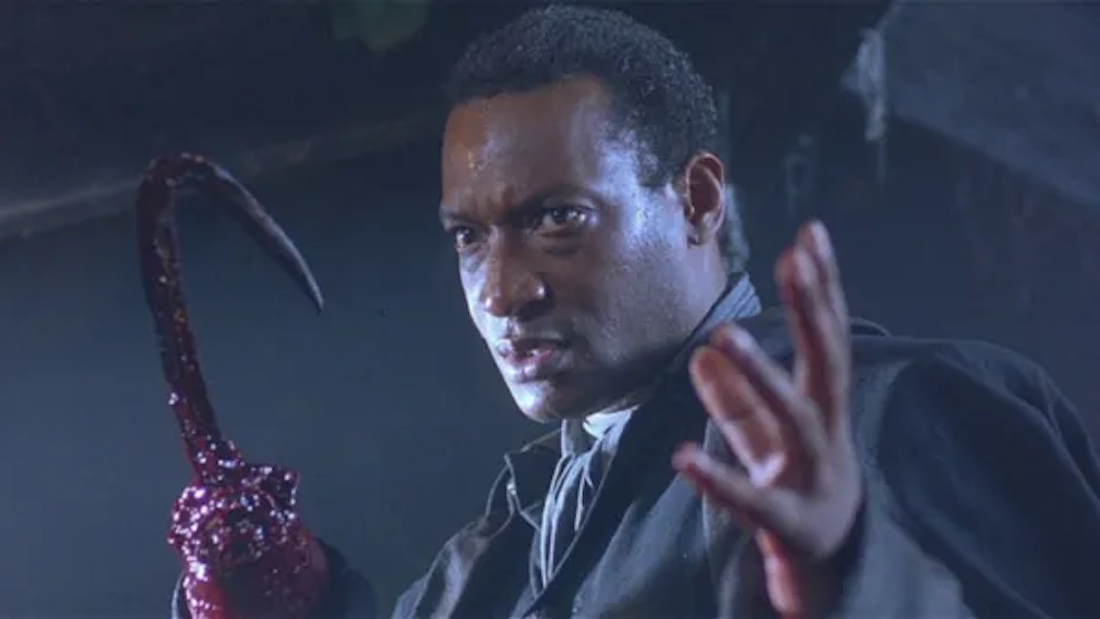
CANDYMAN: FAREWELL TO THE FLESH’s best asset is Tony Todd. The greatly missed icon is truly mesmerizing as the titular character, his deep baritone voice luring in his prey with some great dialogue (a lot cribbed from the first movie) while remaining stoic in the face of their terror. As he does in all the entries in the series, Todd lends a real sense of pathos to his vengeful killer. Like many slasher figures, Candyman’s origin is one borne from tragedy, but Todd and director Bill Condon infuse the character with a sense of tragic righteousness. Candyman lives in rumors and whispers because the horrific truth is too much for people to openly discuss. A child of slaves horribly tortured and murdered while a crowd of white onlookers cheered is not a sensational story created around a campfire but instead an amalgam of atrocities pulled from America’s ugly history. Tony Todd plays this beautifully, never seeming to be out for vengeance or rage but desperate compulsion to keep his story alive at the expense of those who dare doubt it.
The New Orleans setting is a nice change from Chicago, though it leans a bit heavy into the patois and Mardi Gras gimmick. The expository radio announcer (Russell Buchanan) is a bit much, but it’s a fun enough attempt to add a sense of place to the proceedings. But one big issue that CANDYMAN: FAREWELL TO THE FLESH can’t surmount, and that lingers from the first movie as well, is that it feels like a Black story where all the Black people are pushed to the outside. Except for Todd, all characters of color are tertiary at best and mostly used to move the plot along. The unfortunate white savior vibe that existed in Bernard Rose’s 1992 film is made even worse in FAREWELL TO THE FLESH. Better writers than I—majority of them Black authors—have pointed out how, while CANDYMAN is a good movie, it does feel like it's directed by a white person, which creates all sorts of weird dissonance around the story and how audiences should interact.
So...that’s not great. I’d say it’s a sign of the times, but lord knows that it’s still a problem to this day with various filmmakers being the wrong messengers to deliver a message. Upon revisiting, it was much more glaring to me this time around.
But being problematic doesn’t necessarily negate the good of CANDYMAN: FAREWELL TO THE FLESH. Again, Todd is fantastic as always and creates one of the most compelling horror icons of the late 20th century. The music by Philip Glass sounds very similar to the previous movie, but it’s still a great haunting score that makes everything feel increasingly creepy and unsettling. Genre legend Veronica Cartwright does a great oversized turn as Annie’s mom, a terminally ill woman who speaks her mind but has lots of secrets. And it’s worth noting that this probably led to director Bill Condon working on GODS AND MONSTERS, which then led to his work on DREAMGIRLS, the two best TWILIGHT movies (BREAKING DAWN Parts 1 and 2), and more. Condon does an okay job here with a pretty good assembly of acting talent, and conjures some intriguing visuals with cinematographer Tobias A. Schliessler, but is often let down by the script.
CANDYMAN: FAREWELL TO THE FLESH is a mixed bag. There’s lots of stumbling blocks that get in its own way to being a true great sequel, but it would be wrong to dismiss it outright when there’s so much good to be found in it. Any time spent with Todd as the titular character is time well spent as it is just such a great performance and characterization. The story raises complicated questions about American history and race. And while it is NOT prepared to adequately tackle those questions, it is still nice when a horror sequel is still about something more than just a body count. People would be forgiven for skipping FAREWELL TO THE FLESH (and 1999’s CANDYMAN 3: DAY OF THE DEAD) to go straight to DaCosta’s 2021 follow-up, but there are certainly still some shining moments in CANDYMAN: FAREWELL TO THE FLESH that are deserving of revisiting and praising.