Number 6 — SPECIES

For the month of October, we’re counting down the best horror movies of 1995! Check back every day for a new entry in the list.
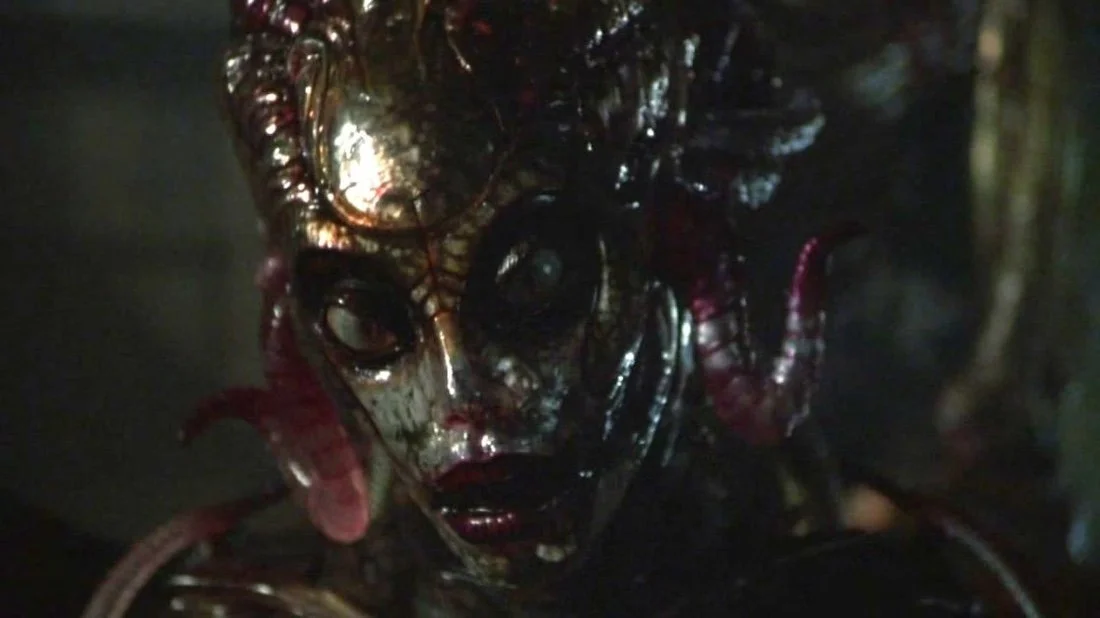
On July 7th, 1995, Roger Donaldson and MGM Productions—along with a collaboration from legendary artist H.R. Giger—unleashed a new alien terror on moviegoing audiences named SIL, in Donaldson’s film SPECIES. The human version of the creature was played by two relative newcomers at the time—Natasha Henstridge (who never hit the heights her beguiling beauty warranted) and Michelle Williams (who would next move on to a cornerstone WB series Dawson’s Creek, before wowing audiences with her acting talent, to become one of the most sought-after actresses of her generation). SPECIES was a different blend of horror movie than audiences were used to at the time. Donaldson’s picture felt as much a blend of sci-fi with a dose of a fugitive picture.

The movie begins in a clandestine US government laboratory facility in the out-of-the-way town of Dugway, Utah. A young SIL (Williams) is kept in her enclosure inside the enormous facility. We also see a pair of lab workers clad in stark white hazmat suits carrying with them a pair of cyanide canisters, letting the audience know without saying what’s about to happen. The film’s Dr. Frankenstein of sorts, Xavier Fitch (Ben Kingsley), is overseeing what he assumed is the termination of his hybrid creation, a single tear staining his cheek as he watches. Of course, nothing in SPECIES goes according to plan. In a later exposition dump delivered by Kingsley at his most charmingly forced, we find out SIL is a human/alien hybrid. It is during the same exposition dump that we meet the rest of the picture’s other main players: Alfred Molina, playing a harried, socially awkward anthropologist with the handle of Dr. Stephen Arden; Marg Helgenberger before she was swallowed up by the enormously popular CSI franchise, playing biologist Dr. Laura Baker, with an air of competence that shines throughout; Michael Madsen’s Preston Lennox, who has a cat and takes care of the government’s many clandestine problems, with his usual easy charm and sly winning grin; and rounding out the bunch is Forest Whitaker at his squirrelly early career best as an empath named Dan Smithson, who feels like an outsider from the rest of his co-stars. It’s his empath character as much as it is SIL’s stranger-in-a-strange-land archetype that forms the emotional core of SPECIES.

While Fitch and his motley crew of scientists, empath, and a mercenary get brought up to speed on exactly what they are dealing with, SIL is out in the world. Since her escape from captivity, she has stowed away on a pair of trains and is befriended by the conductor of the commercial train. The woman shows her kindness that will unfortunately and unsurprisingly not be repaid. One of the most terrifying scenes in the film, is when SIL’s skin begins to bubble with seeming and horrific life, first on her hands and then her face, as the terrified girl stares in the mirror shrieking in horror at her visage. Soon tentacles emerge from her skin, slithering around the space free of her control. The tentacles pinning her to a wall and quickly surround her to form a terrifying chrysalis. The kind train conductor (Esther Scott) she befriended comes by to do a check on the young passenger but instead finds the cabin in slovenly condition. With no sign of SIL, she searches deeper into the cabin. Once in the bathroom she discovers the nightmarish cocoon on the restrooms wall and ceiling. It’s a gruesome pulsing structure that pulls her in with a projectile tentacle. After a brief cutaway to the train barrelling down the track westward bound, we next encounter SIL transformed into a goo and slime-covered grown woman (Henstridge), slithering out of the cocoon.
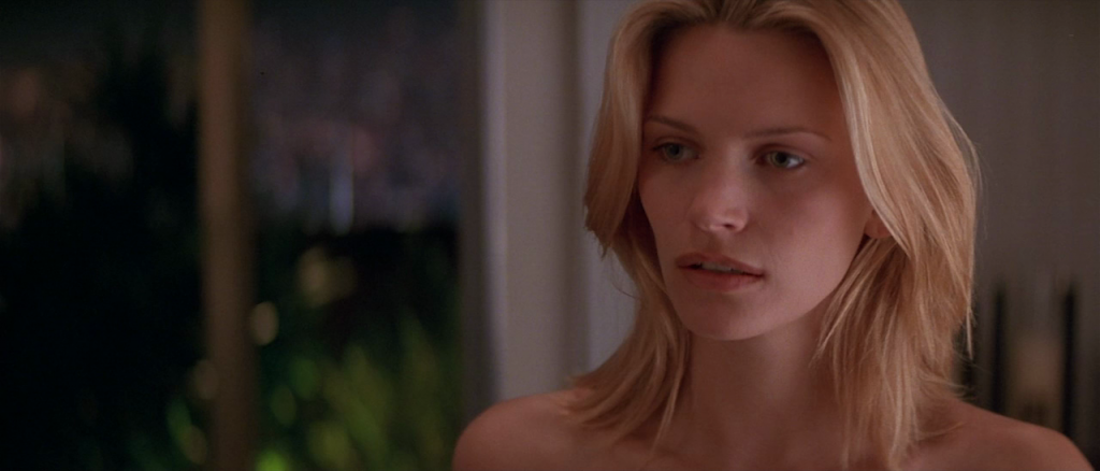
Another aspect of SPECIES that feels in keeping with its horror lineage is the penchant for nudity. Without sounding too untoward, while Henstridge is obviously a beautiful woman, it doesn’t feel like the film only or intentionally panders to horny adolescents. The nudity, if not entirely necessary, does make sense when you put it in the context of (Helgenberger’s character points out) a creature that has no code of morality or shame drilled into her. Fitch and his usual team of scientists and government ghosts weren’t interested in her as anything more than a human-looking lab rat, so what need would there be to their minds to teach her anything of the world, something she was never grown with the expectation of experiencing.
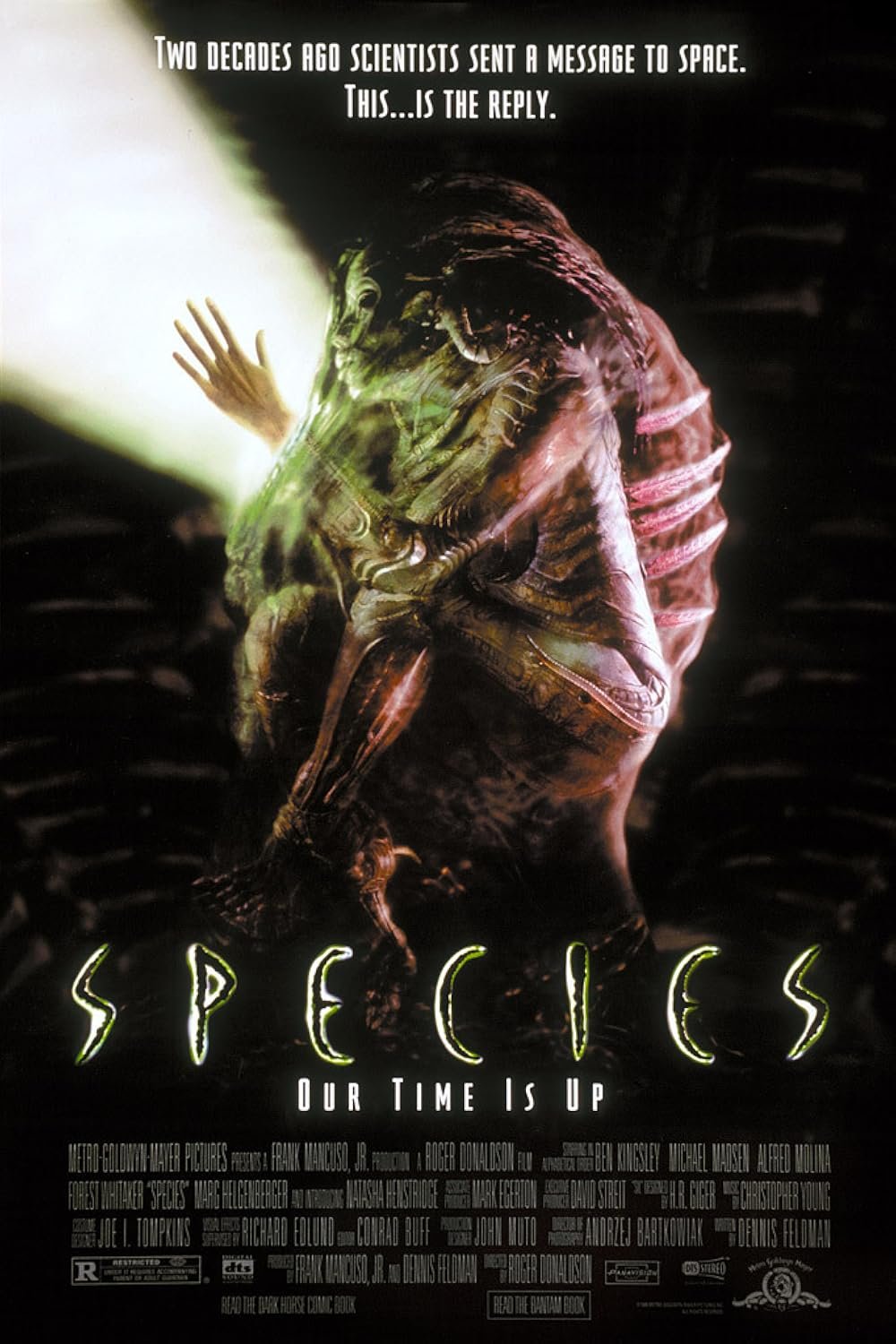
Screenwriter Dennis Feldman took what could have been a simple story and blended a lot of elements together from other genres. It uses aspects of sci-fi, a slasher picture, and a chase picture, without neglecting any of the elements of horror. SPECIES takes these disparate multi-genre pieces and uses them to keep the audience engaged with the story, instead of using a simple paint-by-numbers narrative. Results may vary, but I think Fieldman succeeded in making a multifaceted, worthwhile horror picture.
Of course, like all films, SPECIES is not without its flaws. Some of them are easier to overlook than others. The main thing that keeps Donaldson’s work here from being an all-time sci-fi horror classic is the choice to make SIL, in her monstrous form, mostly CGI. Looking at it with 2025 eyes—and not with the same eyes and easy to suspension of disbelief of my 15-year-old self in 1995—it doesn’t hold up to scrutiny in the same way as that other H.R. Giger’s famous cinematic design, the Xenomorph. The CGI doesn’t detract entirely from the film, but SIL in her final form doesn’t feel alive in the way the rest of Donaldson’s film does. I understand why the decision was made, knowing CGI is generally cheaper to use, but still it felt like a disappointing choice for one of my favourite horror films of that decade.
SPECIES is not a film that came along and redefined horror or science fiction film making. It is however despite its flaws a fitting entry into that cannon warts and all. Donaldson crafted something his own special hybrid with SPECIES, and I am glad it broke out into our world.