

For the month of October, we’re counting down the best horror movies of 1995! Check back every day for a new entry in the list.
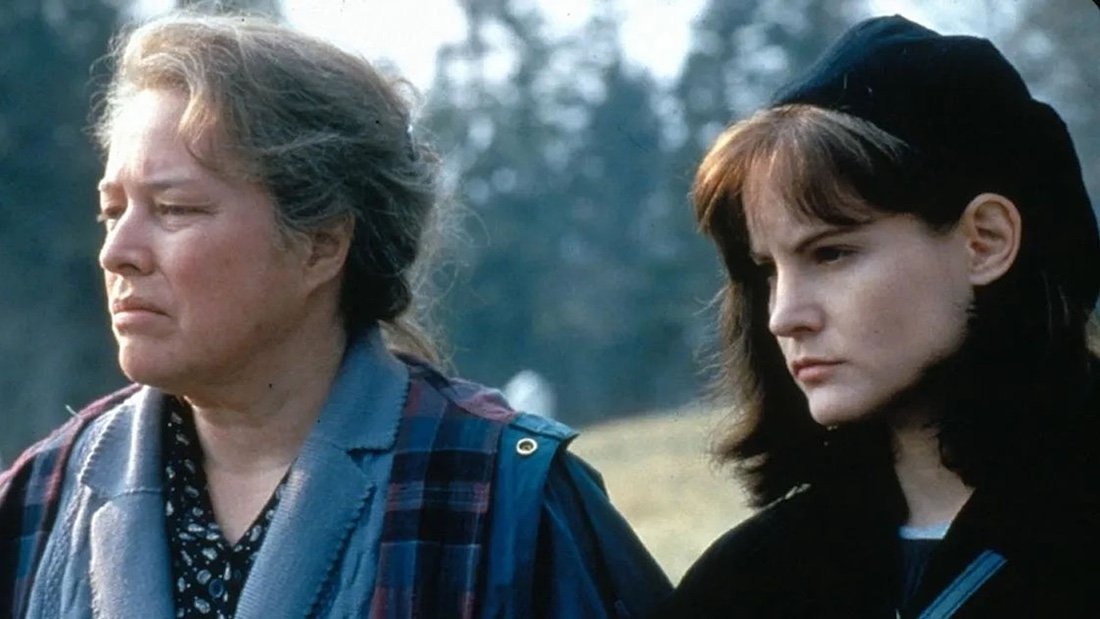
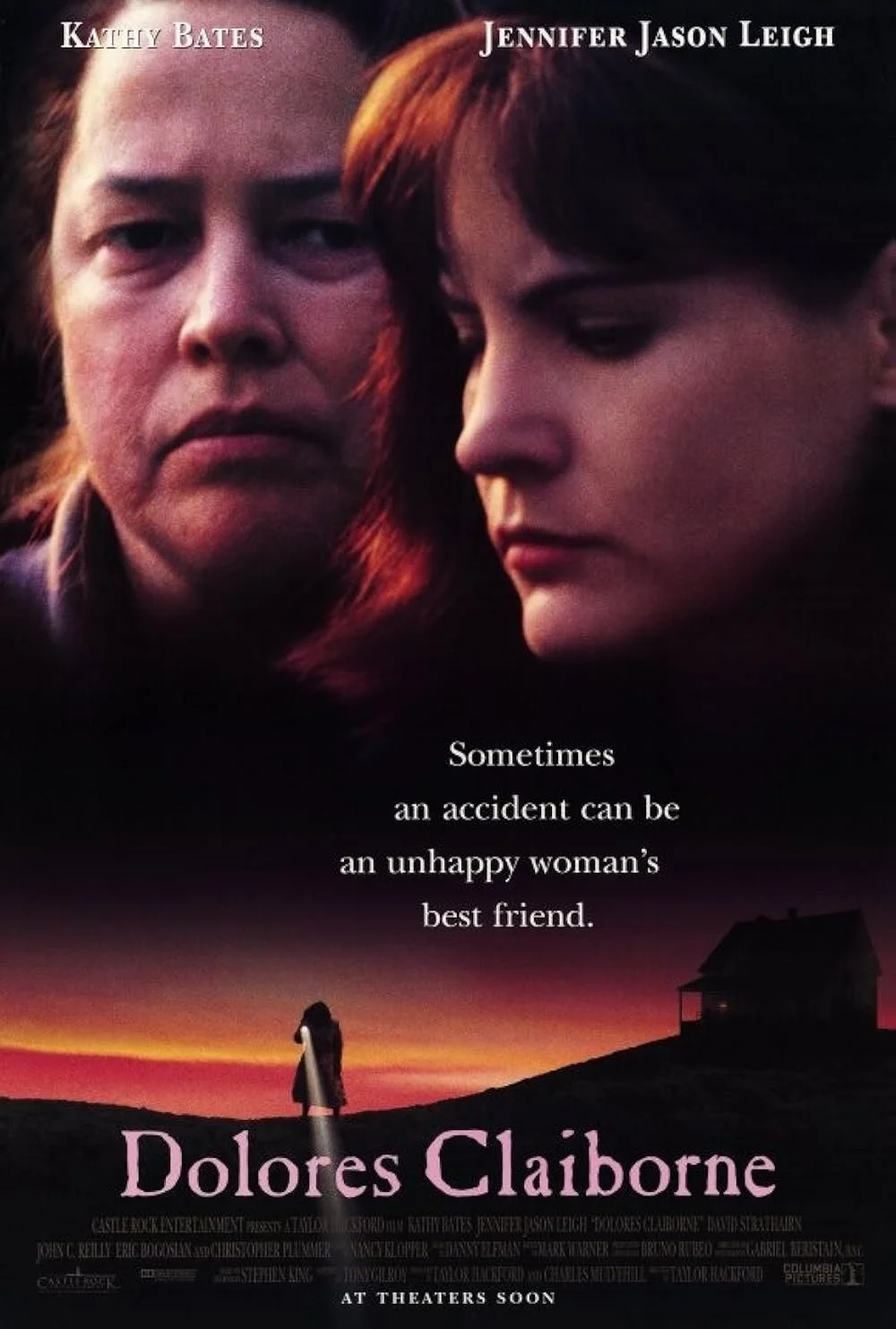
Stephen King knows monsters—shapeshifting clowns, death reaping toy monkeys, haunted hotels. But in 1995 one of King’s less traditional horror stories was given the cinematic treatment in director Taylor Hackford’s DOLORES CLAIBORNE. And while this isn’t supernaturally scary, Stephen King proves that some of the most terrifying monsters are the ones closest to you.
The story’s namesake, Dolores (Kathy Bates) is a hardened and hard-working housekeeper for a wealthy woman in coastal Maine. But when she is caught standing over her employer’s lifeless body at the foot of the staircase following a struggle, secrets and past traumas come tumbling down the stairs.
Selena St. George (Jennifer Jason Leigh) is a workaholic journalist in New York City with several high-profile bylines to her name. She is also a functioning alcoholic who abuses prescription medications and struggles with meaningful relationships including her mother, Dolores. When she returns to her small town under the presumption of her mother’s guilt, she finds herself immersed in a personal trauma from her past she had long since buried.
The story that follows in the 132-minute runtime unfolds largely in flashback, and the fates of these two women are far more complex than each other realize. But director Taylor Hackford’s eye for editing interweaves past and present in a way that is both seamless to the narrative and stylistically intrusive. Past memories literally intrude on the present. The past becomes corporeal, haunting our protagonists. This is especially the case within the St. George house which has succumbed to neglect, the passing of time, and the vandalism from accusatory townsfolk. The dilapidated house is a physical embodiment of the relationship between its central characters. It holds both the briefly fond memories of Selena at a young age, studious and happy, and the heartbreaking scenes of verbal and physical abuse of Dolores from her husband Joe St. George (David Strathairn). But Selena’s memories from home are distorted by denial. She blames her late father’s alcoholism and belligerence on Dolores, just as she accuses her of his murder 18 years prior. But why?
Theatergoers at the time would likely describe DOLORES CLAIBORNE as a mystery, a thriller, a crime drama. I’d argue that the story is a domestic horror and the crimes in question are a whydunnit, as opposed to a whodunnit. And Selena must face her own repressed memories to find out the why, just as the viewers do. And we do just that when Dolores forms an unexpected bond with her notoriously snobbish employer, Vera Donovan over her fears of just how monstrous her abusive husband has become. When Selena hears her mother’s discovery of sexual abuse her reaction was as volatile a denial as an adult as it was she was 13 years old. But it doesn’t make it untrue. Joe St. George was sexually molesting his daughter.
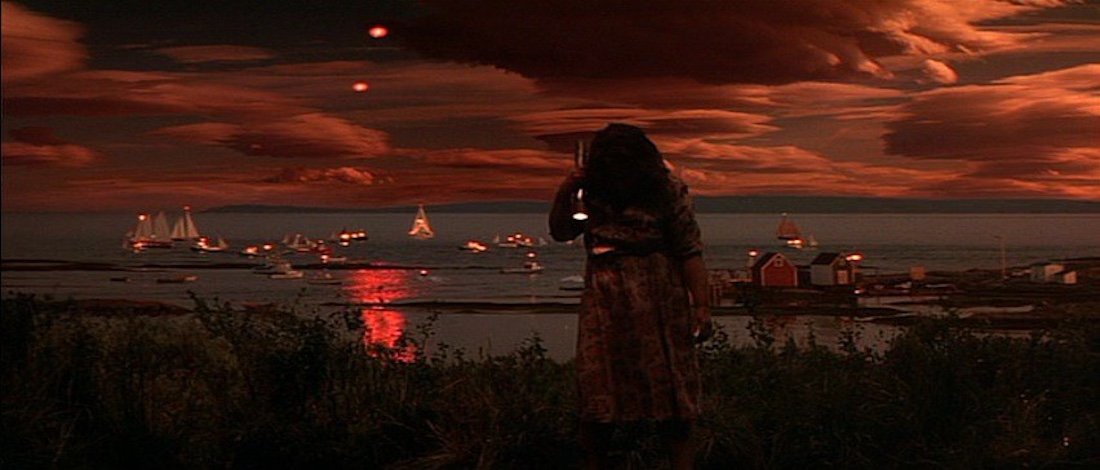
It was Vera Donovan that gave Dolores the solution: orchestrate his death, like she had implicitly done with her philandering husband a year prior. But Dolores paid a hefty price for that “accident.” Ostracized from the town and nearly two decades of estrangement from her daughter. Selena had run from the past and buried herself in work to forget, just like Dolores. When Vera’s health failed and she needed more than just a housekeeper, Dolores moved in and became her full-time caregiver and lifelong friend. She abandoned the St. George house and name, changing it back to Claiborne following Joe’s death. And while the outside world didn’t understand their relationship, Dolores Claiborne and Vera Donovan were connected by murder, by trust, and by being that bitch.
You’d be hard missed not to catch the recurring line that our three female leads repeat to each other over the decades of time that DOLORES CLAIBORNE spans. “Sometimes being a bitch is the only thing a woman has to hold on to.” Dolores was a woman hardened by domestic labor and emotionally wrecked by guilt. Selena was broken by the repressed memories of sexual abuse. Vera Donovan was a women spurned by the fact that even money and status couldn’t buy her a faithful husband. These women spoke their minds and stood their ground. We all know that’s just code for bitch behavior, right?
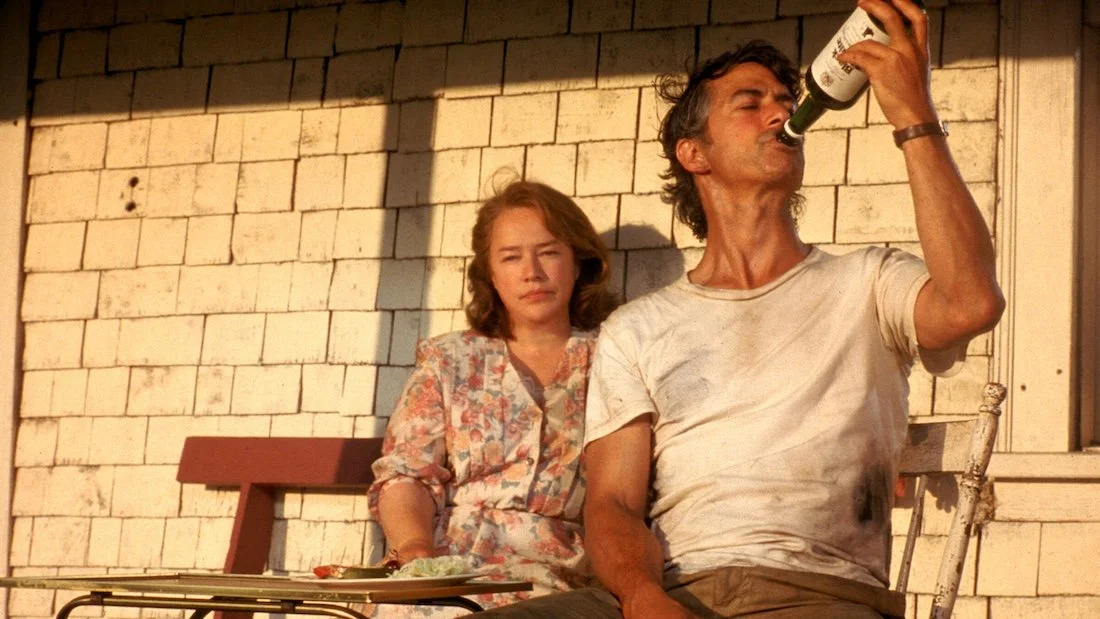
When Joe strikes Dolores for the first—and presumably last time—she crashed a glass pitcher over his head and threatened him with an axe. It was a shockingly audacious moment of defiance (read: bitch behavior). It’s just unfortunate that from young Selena’s perspective in that pivotal scene, Dolores was the instigator of violence and the source of turmoil within the family. That’s the memory Selena held on to: threats of violence from a difficult woman—a sentiment she’d carry with her though adulthood.
And that’s the same first impression the audience would have too. Here comes Dolores, frigid and loud-mouthed woman driving her man to drink. She killed her husband, then killed her boss. Or there’s Selena St. George who can’t manage a functional relationship with a man, but could probably drink one under the table. She sees herself as equal to her male editor and is too demanding in her attempts to further her career. Then there’s Vera Donovan, who worked her staff ragged with constant demands, but ultimately sympathized with Dolores and encouraged her to do what she had to do. Decades later in a dramatic turn of irony, she threw herself down the stairs and begged for Dolores to finish the job, never telling her of the million-dollar would-be motive she would inherit upon her death. It was an uncharacteristic posthumous gesture of gratitude for a lifetime of dedication that Dolores did not see coming—and it angered her because she no longer saw their relationship as transactional.
All three of them were difficult women. Misunderstood women. Bitches.
Ultimately, DOLORES CLAIBORNE is a story that starts with the presumption of murder and subsequent blame and ends with the justification of a mother protecting her child. And maybe I’m just advocating for this character’s demise, but was what Dolores did really murder? She gave Joe St. George exactly what he wanted: a bottle of liquor and the opportunity for domestic violence. And he took to the plan as expected… by getting loaded and getting violent when faced with the accusations of what he had been doing to his daughter. Was it murder when he chased Dolores and fell into that well? Or was it just a death so richly deserved that would have come his way by the bottle…eventually?
In the end the case was dropped, ruled death by misadventure. Vera Donovan’s death was ruled accidental. And Selena finally faced the truth about her father in an unsettling recalled memory aboard the ferry. There was even a more traditional horror movie moment when Selena looks at herself in a mirror to see her reflection’s back turned away from her—a visual reference to her repressed memory forcing her to turn her back to what had happened. She was now free to acknowledge the truth and to heal. And Dolores Claiborne was finally free from persecution.
All the blame, the guilt, the anger…all interwoven in the lives of three women who thought being a bitch was all they had to hold on to. But they also had each other. They just lacked the right perspective to realize it