FERRIS BUELLER’S DAY OFF (1986)

A DIFFERENT DAY OFF: THE ORIGINAL VERSION OF FERRIS BUELLER’S DAY OFF
FERRIS BUELLER’S DAY OFF is a classic. It encapsulates the pure joy of being a teenager without a care in the world and the thrill of rebelling against authority. John Hughes crafted one of the best teen films of all time, but it could have been radically different. Was the original concept better or worse than the final cut? Let’s discuss.
Why am I doing this? Well, I suppose it’s because FERRIS BUELLER’S DAY OFF is one of my all-time favorite movies and – like any movie I love – I tend to hyperfixate on it and deconstruct all of the elements that go into it. I decided to comb through the screenplay and the novelization to see if these versions would have made the final film even better or if the cuts were made rightfully.
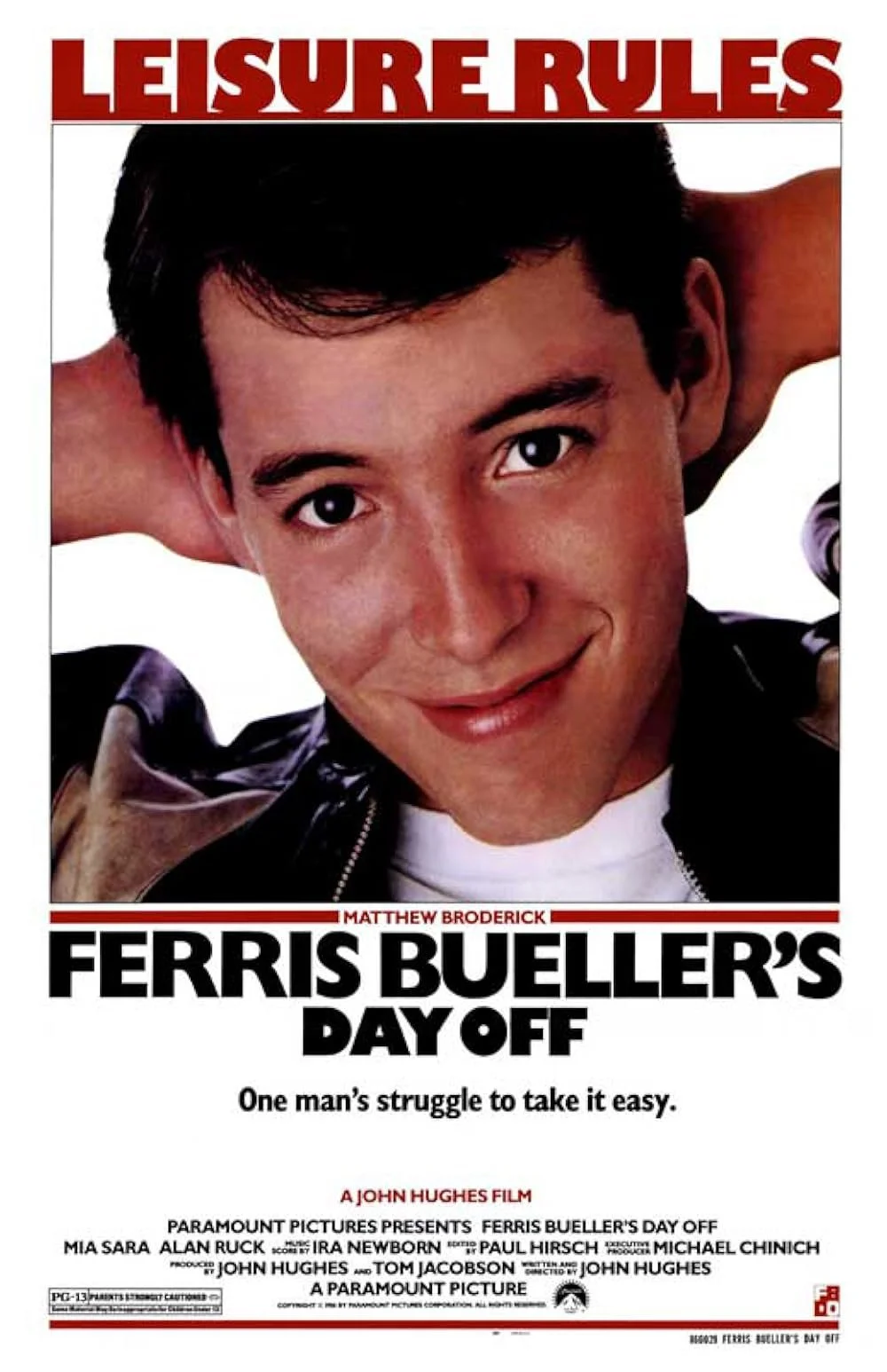
One of the key aspects is the day off itself. Multiple articles have been written about how impossible it is to do everything Ferris and his friends do in the span of an entire day on a whim. Well, according to the original script, this isn’t just a spur of the moment event; Ferris has everything planned down to the last detail. He even has a reason why he’s doing it that adds even more layers to who Ferris is as a person.
Ferris has a multitude of more adventures in the screenplay and novelization, some of which would have added a bit more fun and at least one that feels just a bit too off base. And speaking of bases, what’s a better place to start than Wrigley Field home of the famous Chicago Cubs.
In the final cut we see Ferris, Cameron and Sloane taking in a Cubs game but, in the original script, Ferris is hung by his feet over the bullpen to get his foul ball signed which gets him ousted from the game but leads him to giving a radio interview where he was going to announce he would be the first teenager in space. The radio interview was filmed and a snippet had even made it to the theatrical trailer; unfortunately, the tragedy of the Challenger explosion caused that scene to be cut. While I do find the scene to be humorous, it was a smart idea to cut it, if only because it would be taking Ferris’ shenanigans just a bit too far.
Speaking of too far, Hughes originally scripted a scene where Ferris and crew go to a strip club and Ferris waxes philosophical on why a woman goes into that career path and subsequently hops on stage. Hughes had wanted to keep this in, but he was vetoed, and I feel rightfully so. This feels too much like an extension of Ferris lip syncing on the float and it feels much less kinetic than that scene is.
Many people have accused Ferris of being a sociopath who uses people for his own needs, but one of the key elements that got lost from page to screen is that Ferris has a genuinely altruistic reason for why he’s skipping school. Ferris says multiple times throughout the final film that he’s worried about Cameron. Ferris takes this day off because he doesn’t want Cameron to wind up like Garth Volbeck. “Who’s Garth Volbeck?” You may be asking. Well, allow me to elaborate.
Garth Volbeck is a former friend of Ferris who comes from a rough upbringing. As Ferris puts it, Garth is “so conditioned to grief he doesn’t even feel it anymore.” He has a dead father, a mother who runs a gas station, a sister everyone thinks is a prostitute and a brother in jail. Garth has had such a bad life that he has fallen into a criminal lifestyle that leads to him being arrested.
Garth’s story may have been excised, but Garth himself was not. He is never given a name, but he makes the memorable appearance as Jeanie’s couch mate at the police station. It would have added a nice layer to the character that maybe he could turn his life around, but it does seem peculiar that Jeanie wouldn’t know who he was or vice versa. Perhaps that was why the overall Garth Volbeck bit was cut out; we may never know unless a truly definitive history is released one day.
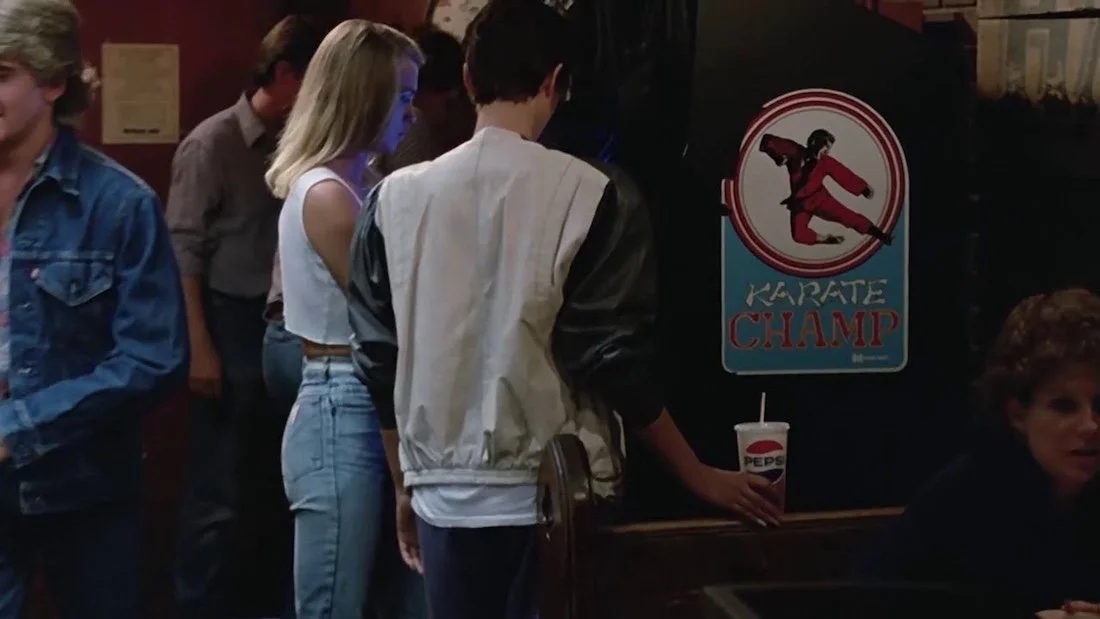
The novelization even takes characters from the original script and expands upon them. For example, the young woman that Rooney accosts in the arcade, thinking that she is Ferris, is a graduate of Shermer High who works for a company that works on arcade cabinets. She degrades Rooney by admitting that she makes more money than he does and has given him the nickname of ‘Turdface.’ None of this is mentioned in Hughes’ screenplay but - per the director’s commentary (found only on the original DVD) - Hughes wanted to use this scene to showcase how truly powerless Rooney is and how out of touch he is with people outside of his small fiefdom of the school. This interaction, while funny, doesn’t need to be added. Seeing Rooney get a blast of Coke to the face is all the humiliation he needs before it gets ramped up later in the film.
Along with these extended character beats we also get two whole characters that were deleted from the final cut but who have vestigial threads remaining. Ferris has two younger siblings who originally were set to bookend the film but, smartly, Hughes decided it was a smarter choice to have it be just Jeanie and Ferris. While the scenes involving these younger siblings are no longer in the film there is a photograph that features the entire Bueller family, six in total, as well as a drawing on the fridge that fits for a younger child. Ferris’ younger sister, Kimberly, makes a brief appearance in the theatrical trailer uttering two simple words, “Syphilitic Meningitis.”

Sloane and Cameron even get more character development. Sloane is revealed to be a child of divorce, her father having left her mother for her secretary and her stepfather being an ex-hippie who doesn’t believe in what he did originally. It adds a nice layer to her character that would have been a strong addition to the final cut, instead she feels a bit like window dressing.
Cameron and his home life are elaborated on, and it is slightly more terrifying than Ferris reveals during his monologue in the restaurant. Not only is Cameron’s house very cold and museum like but his parents fight all the time, even with Ferris around and – in the novelization – they are so anal retentive they keep every screw in their door hinges turned to a perfect 90-degree angle. It is likely these elements were cut to keep things just a bit lighter for Cameron while still allowing us to feel for him.
Character changes and additional scenes aside, both the screenplay and novelization were interesting reads for sure, but they don’t hold a candle to what was released. There are movies saved in the editing room, and this feels like one of them. I’ll close this article with Ferris’ last line from the original script, “Yeah, life is a carousel. A great big crazy ball of pure living, breathing joy and delight. You gotta get one.” It doesn’t quite have the same ring to it, does it?