
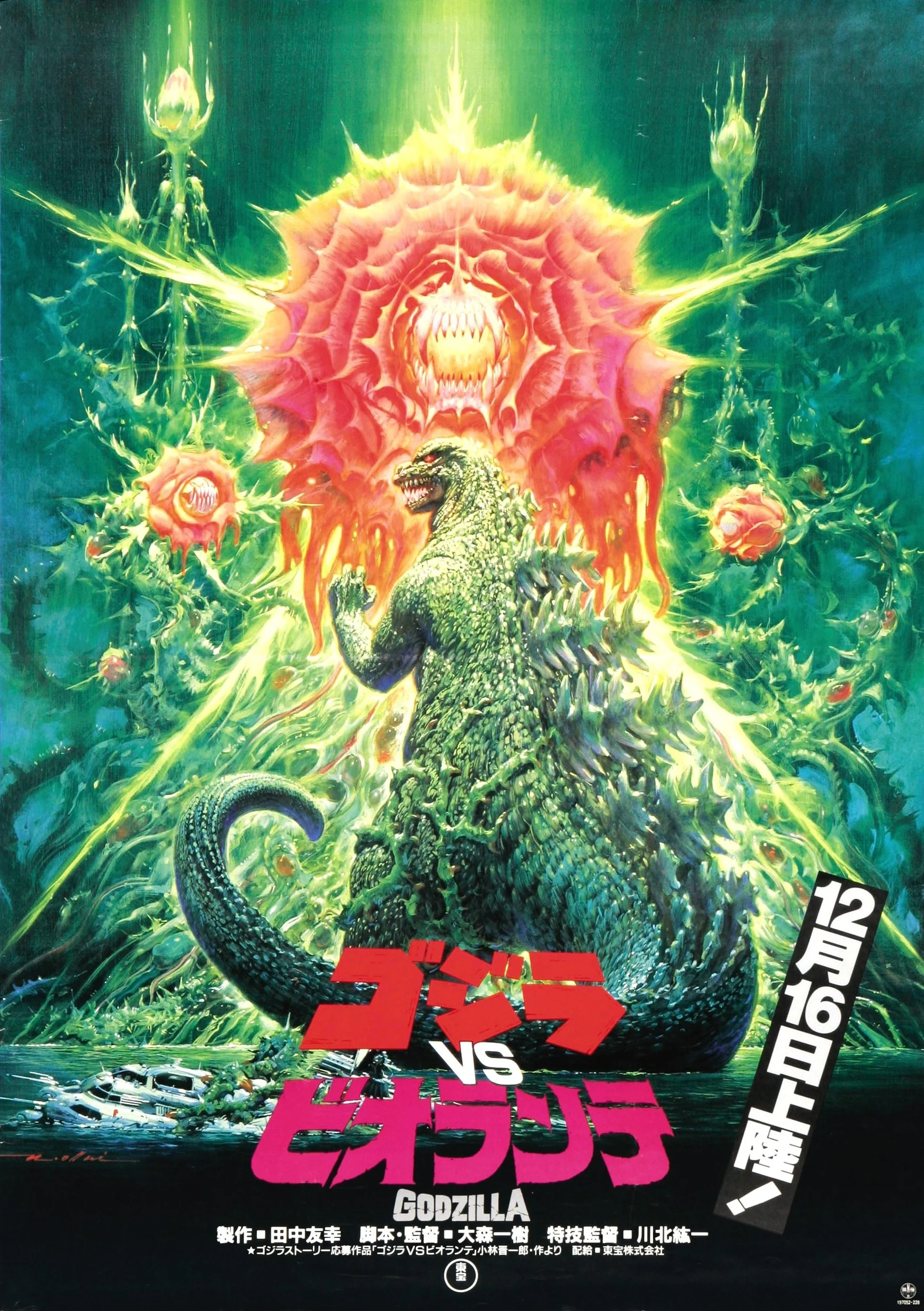
For over 70 years, one film franchise has consistently outlasted its competitors, fully embracing the concept of distinct "eras" much like Taylor Swift. Of course, I'm talking about the legendary Godzilla series. Among its vast offerings, GODZILLA VS. BIOLLANTE stands out as one of the franchise's best films. Brilliantly intertwining compelling social commentary, gritty themes, and spirited Saturday Matinee allure, into a devastatingly captivating and unique Kaiju experience.
The story opens in the wake of the intense battle between Godzilla and the Super X at the end of THE RETURN OF GODZILLA. As cleanup crews labor to decontaminate the devastated city, Godzilla remains imprisoned within a volcano, creating an eerie calm. However, beneath this façade, a fierce struggle brews between two biotech corporations: the American-backed (and lamely named) Bio-Major, and the Saradia Institute of Technology and Science. The latter, understanding that their nation's longstanding reliance on oil cannot endure indefinitely, recruits Dr. Geneshiro Shiragami (Kōji Takahashi). His mission is to harness Godzilla's discarded cells to engineer a strain of wheat that can thrive in desert conditions. Tragically, on the day when the project is poised to achieve its final breakthrough, Bio-Major strikes with a deadly bomb, resulting not only in destroying the facilities but also in the heartbreaking death of Shiragami's daughter, Erika (Yasuko Sawaguchi).
Five years later, still engulfed in grief, Shiragami is approached by scientist Kirishima (Kunihiko Mitamura) and Japan Self-Defense Forces Lieutenant Gondo (Toru Minegishi). They seek his expertise in utilizing Godzilla cells to develop "Anti-Nuclear Energy Bacteria" (ANEB), designed to neutralize Godzilla's potential return and avert possible nuclear devastation. Initially hesitant, Shiragami's resolve shifts drastically when tremors suddenly jeopardize his work. His research, it just so happens, involves searching to make plants immortal, incorporating his daughter's genetic material into a rose he has spliced together in a desperate attempt to keep her soul alive. Driven by this mingling of science and sentiment, he ultimately fuses the Kaiju cells with the rose, giving birth to a new creature he names “Biollante.”
The situation spirals into chaos as Bio-Major agents mistakenly trigger a dramatic explosion that frees Godzilla from his prison within the volcano, igniting more turmoil.
Oh, and this is also the film that introduces Heisei Era regular Megumi Odaka, as Miki Saegusa, a human with strong psychic powers.
Despite the intricate plot, GODZILLA VS. BIOLLANTE maintains an exhilarating pace, clocking in at 105 minutes yet feeling like a succinct hour. Each subplot and time jump flows seamlessly, allowing audiences to stay engaged without losing narrative clarity. The rapid transitions and quick character arcs provide a satisfying momentum, guiding viewers through a well-crafted cinematic experience.
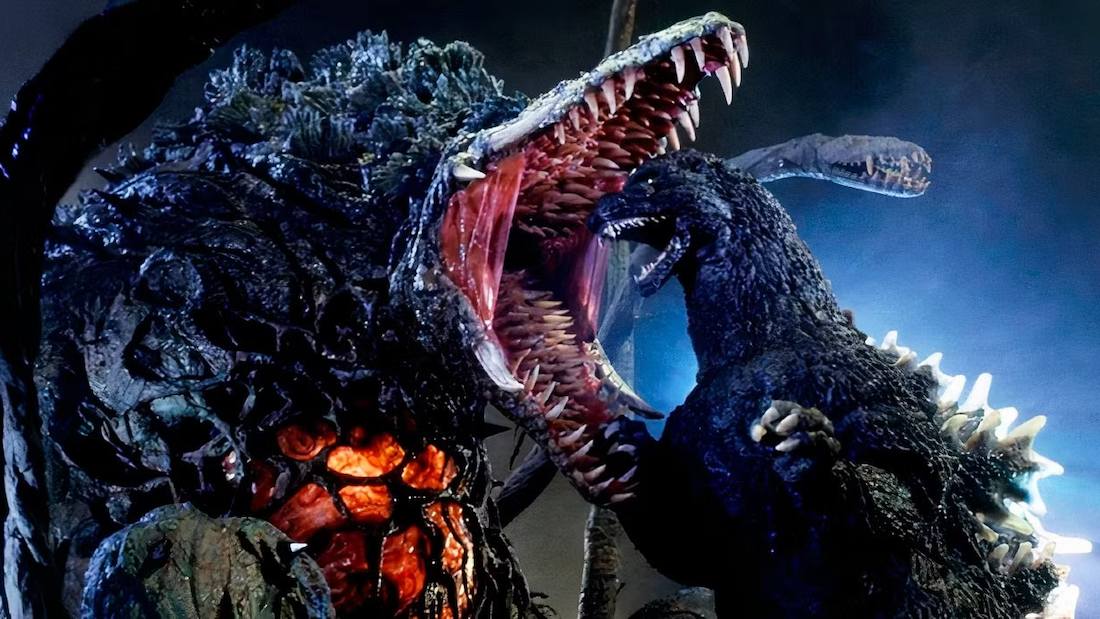
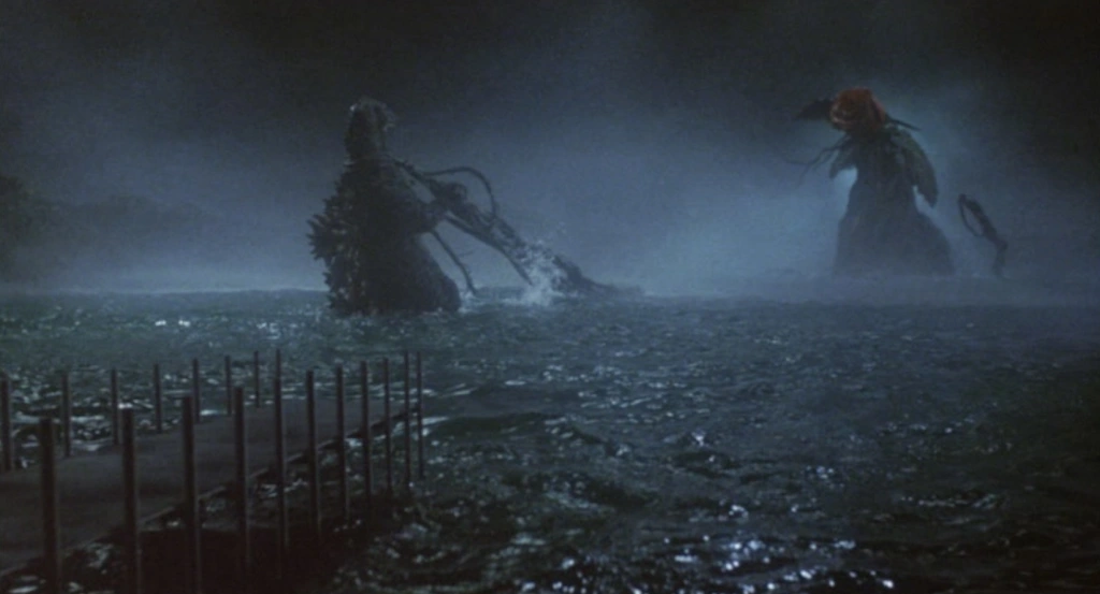
As is typical for this period in the franchise, the action sequences are breathtaking. Spectacular sea battles erupt between ships and Godzilla, while humans engage in thrilling espionage shootouts. The ultimate spectacle, however, lies in the intense confrontations between Godzilla and Biollante. Though brief, these encounters are filled with visceral intensity, showcasing Biollante's formidable razor-sharp teeth and tendrils as they clash with Godzilla's devastating atomic breath. Their second encounter is particularly striking, diverging from the standard bouts seen in previous films—both monsters are shown inflicting deep, green bloody wounds on one another, raising the stakes of their ferocious battle.
Visually, the monster designs are remarkable. Godzilla is given a unique appearance, incorporating cat-like facial features and a distinctive second row of teeth that enhance his intimidating presence. In contrast, Biollante may stand as one of the series' most innovative creatures—an astonishing amalgamation of Godzilla, Audrey II from LITTLE SHOP OF HORRORS, and an alligator. Starting with a literal rose for a head that mutates into a final form Biollante conjures a level of dread that would greatly enrich any future entries in the current Monsterverse.
Throughout the film, a handful of quirky aspects add to the overall charm. Notably, the film exhibits a whimsical devotion to labeling every singular location, proudly displaying names like the Godzilla Memorial Lounge (a bar featuring a concrete slab with Godzilla's footprint overhead), the Mental Science Exploitation Center, the Japan Psyonics Center, and the aforementioned Saradia Institute of Technology and Science. Rather than detracting from the viewing experience, these peculiarities enhance the film's unique character.
The film’s effective integration of scientific concepts and horror within a traditional Godzilla narrative helps it stand on its own. Although other entries have attempted similar approaches, this installment places a significant emphasis on cohesive storytelling, which strengthens its supporting elements. This achievement is particularly noteworthy, especially when there are moments when the film continually shoves ESP into the proceedings.
It is important to note that the positive reception that GODZILLA VS. BIOLLANTE has today was not anticipated during its production. The Godzilla franchise, much like the Star Trek films, has experienced numerous fluctuations in quality. Series producer Tomoyuki Tanaka was uncertain about the franchise's direction following the lukewarm success of THE RETURN OF GODZILLA and the failure of KING KONG LIVES overseas. In response, a public story contest was held, and won by dentist Shinichiro Kobayashi, who shifted the focus from nuclear energy to biotechnology.
Director Kazuki Ōmori dedicated three years to refining Kobayashi's idea, retaining the core narrative of a scientist mourning his daughter while leveraging his background as a biologist. He also drew inspiration from his desire to make a James Bond picture to incorporate elements of corporate espionage. Unlike the "by-committee" aspects seen in future films, Ōmori maintained substantial creative control, resulting in a unique cinematic experience.
While opinions on Godzilla films vary, GODZILLA VS. BIOLLANTE consistently ranks among the top seven in the series, which likely influenced Criterion’s choice to include it as a follow-up to their Showa Era box set. With striking kaiju visuals, exhilarating action, and a compelling narrative, the film rarely misses its mark. If this film has not yet found a place on your list of favorite Godzilla entries, it's highly recommended you view this one asap. You won't be disappointed.