

Have you ever seen a movie so absurd that it made you question whether it was real or if you managed to slip into a momentary state of psychosis? The kind that takes the very concept of sanity and shoves it out of a high-rise window leaving it a bloody, broken mess? Our subject today is one of such cases.
DEATH KAPPA (2010) directed by Tomoo Haraguchi and written by Masakazu Migita is, on every conceivable level, a complete and utter trip. Functioning as both a parody of the genre and as a labor of love dedicated to everything that makes kaiju movies so endearing, it’s something you have to see to believe. Even then, you’ll think your eyes and ears were collectively attempting to gaslight you.
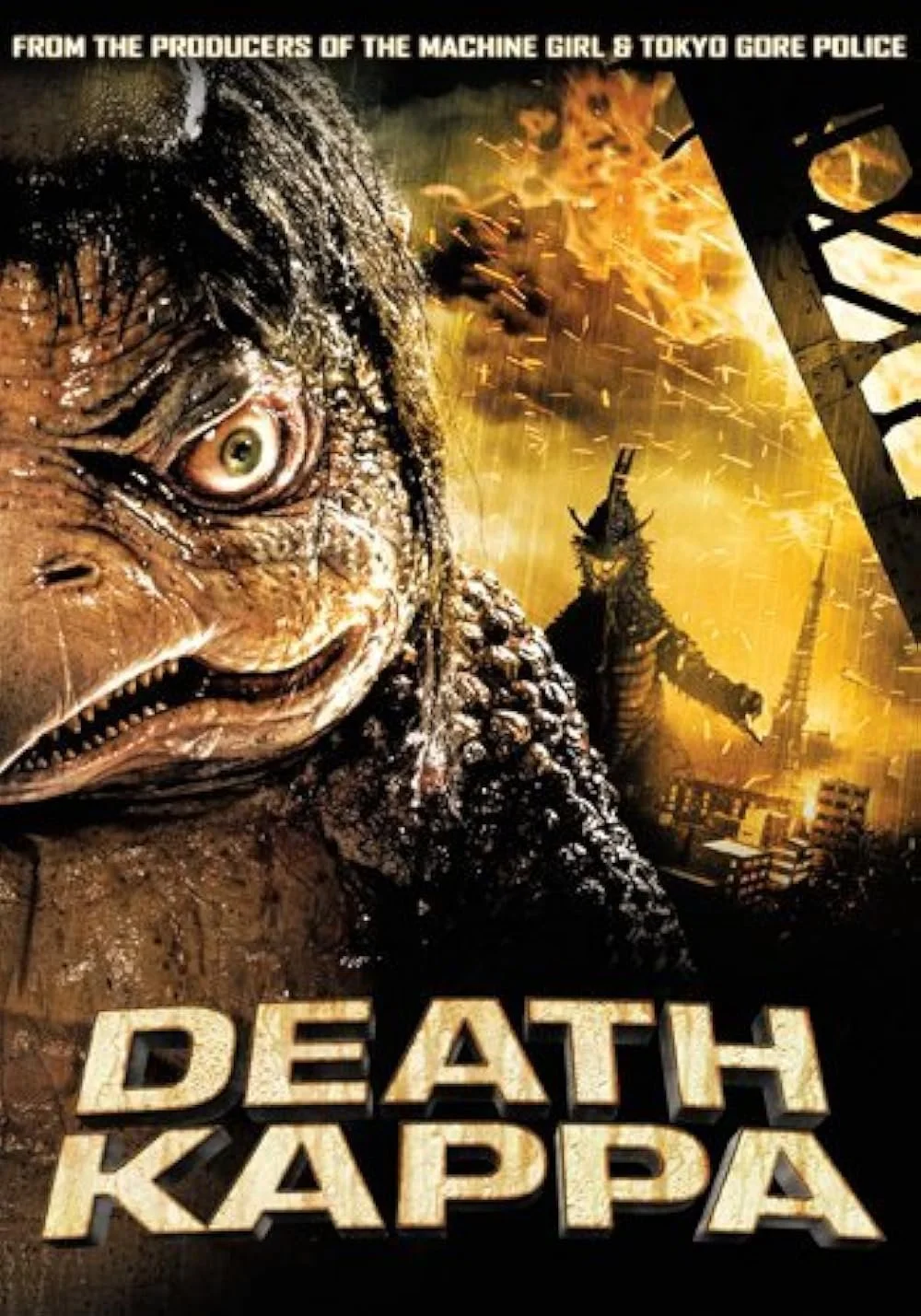
Before getting into it, we need to establish exactly what a “kappa” is to give a frame of reference. As the movie itself explains, kappas are a figure from Japanese mythology that are essentially amphibious, cucumber obsessed, sumo loving goblin creatures with hard plates on their heads. There’s definitely more to the myth, but that’s all the movie tells you so that’s all you really need to know.
The story begins with us being introduced to Kanako who, after failing to become a pop idol in the big city, heads back home to live with her beloved grandmother. Unfortunately for her, the poor old woman is immediately killed the moment she arrives in arguably the most avoidable hit-and-run of all time by a group of drunk hooligans. Before dying, she tells Kanako to protect the kappa her family had, unbeknownst to her, been taking care of. Later that night, she encounters the kappa in the woods while the drunk hooligans are simultaneously slaughtered by an unseen force.
The next day, Kanako finds that the kappa had followed her home and the two bond together in a montage sequence that can only be described as a fever dream if fever dreams somehow made less sense. She is then kidnapped by a sinister research organization established in World War 2 who want to use kappa DNA to create a race of amphibious super soldiers so they achieve their goal of world domination. After the kappa saves Kanako and the two of them bring an end to their experiments, an atomic bomb goes off, destroying the lab.
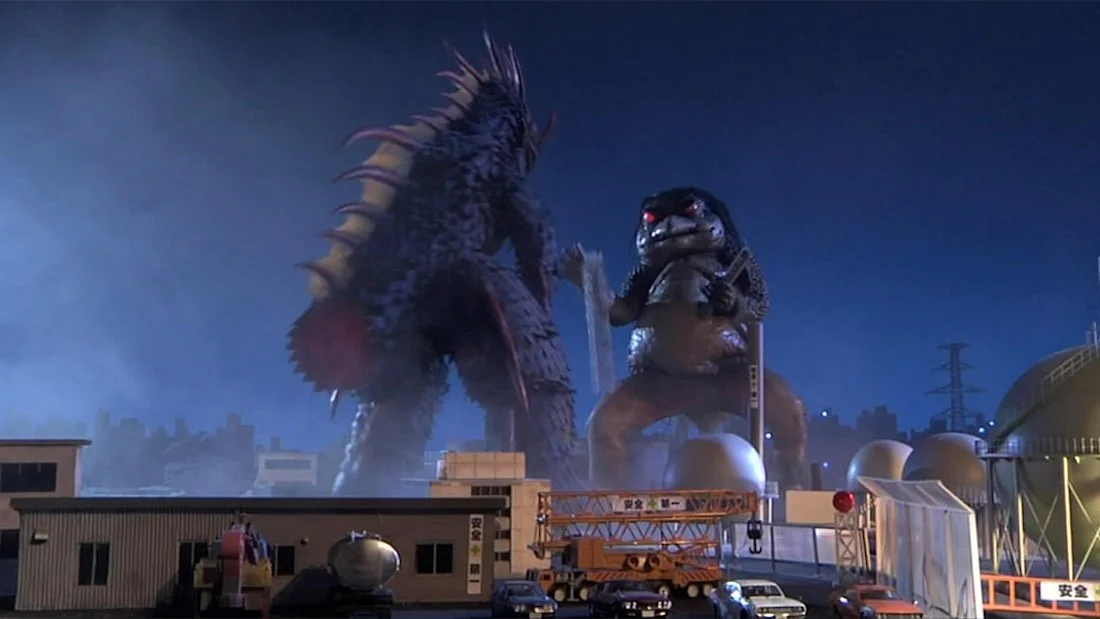
In the wake of the explosion, we cut to a city under attack by a kaiju. It treats the place like its own personal playground of destruction and quickly renders the Self Defense Force powerless. All hope seems lost until the kappa, now mutated into a giant from the atomic blast, takes it down in a face off that feels ripped right from Monday Night RAW. In an odd twist—which is saying something—the kappa then goes on a rampage setting its violent impulses on the very city it just saved.
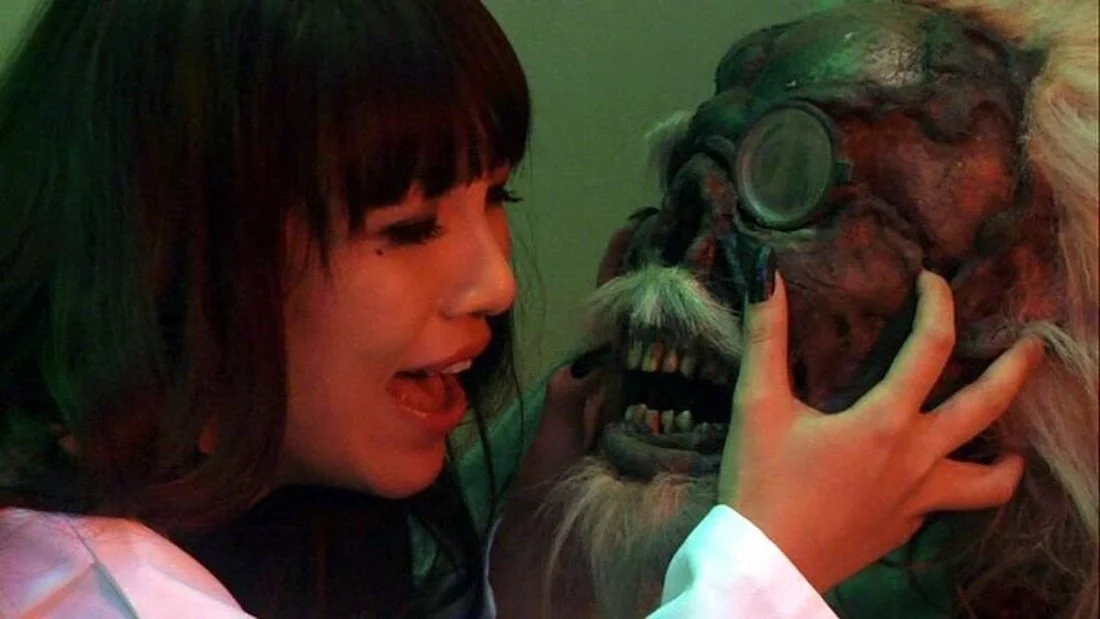
Despite the semi-lengthy plot description, it only manages to scratch the surface of what DEATH KAPPA has to offer. If anything, this is one of those movies that’s best to go into as unprepared as possible. That being said, even if an attempt was made to go deeper, trying to spoil this is like trying to spoil Neon Gensis Evangelion in that it wouldn’t make any sense whether you had context or not. This specific comparison was made because the minds behind Neon Gensis Evangelion, Hideaki Anno, and his long-time creative partner, Shinji Higuchi, both make cameo appearances together. Somehow, their presence doesn’t even crack its top 10 most unexpected moments.
DEATH KAPPA is shameless, and that’s a compliment. It knows exactly what it wants to be, never once asking you to take it seriously. That doesn’t mean you should turn your brain off though, as a part of what makes it such a fun watch is being baffled every other moment from your brain struggling to process what’s happening. Wondering what the hell’s going on isn’t a bug, it’s a feature.
Something cool to note also is the production design by Masaaki Sugiyama. There’s for sure some use of CGI, but it mainly places a heavier focus on practical effects and miniatures. It makes no attempt to hide any of it either. You are clearly watching dudes in monsters suits destroy toy military units while wrecking a tiny, fake city. Refreshingly, it does all of this without a hint of irony or disrespect. The movie wears its love for the kaiju genre on its sleeve, playing everything out with total sincerity.
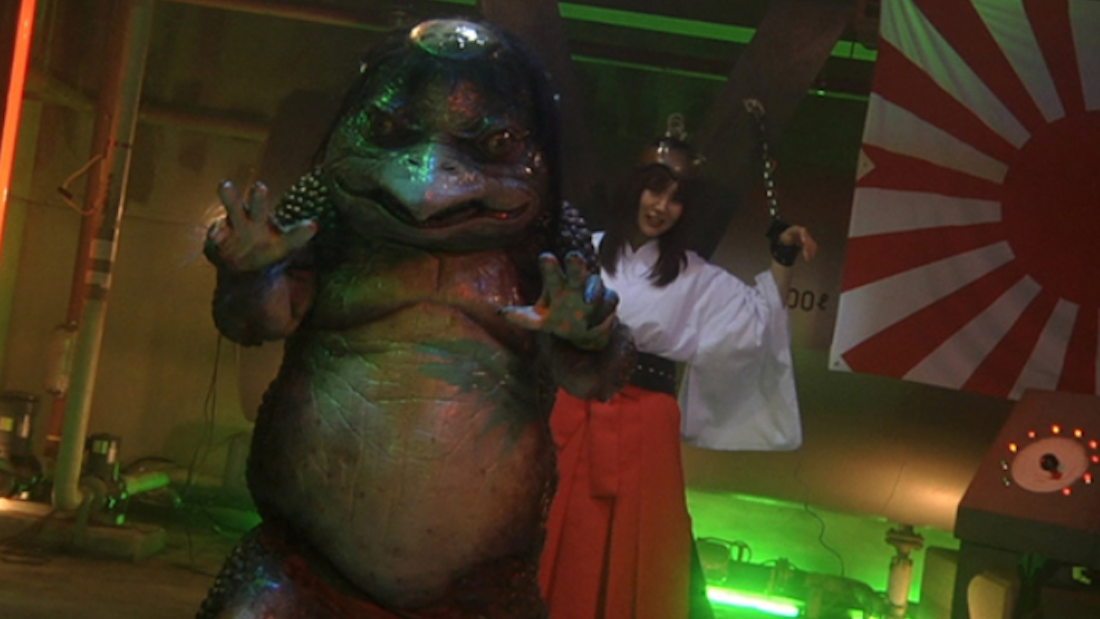
While straight up nonsensical and downright juvenile at times, there is a method to the madness here. If you are willing, or even able for that matter, to meet this movie on its terms you’ll see that every decision made in its construction is tactically calculated to create a singular experience akin to a cinematic induced delirium. Everything that should, by all logic, work against it only adds to its strange charm.
Part of the secret to its success is its runtime. Coming in at roughly 85 minutes, it manages to get all its bizarre wonder on full display without ever overstaying its welcome. It’d be easy for it to hit a point where it collapses under the weight of its own weirdness, but it prevents that by knowing exactly when to quit.
Will DEATH KAPPA be everyone’s cup of tea? Lord no, not even in the slightest. However, if you can vibe with it, you’ll find yourself wanting to preach its gospel to anyone willing to listen. It’s the kind of thing you want to share, if not just for the purpose of making sure what you saw actually existed and wasn’t just some elaborate hallucination. You won’t find anything else quite like it, and it’s all the more special for it.