
MOTHER TRUCKIN’ MAY: CONVOY (1978)
I'll be honest with you: this was my first time watching CONVOY. I knew of it and its general plot and cast. It was a favorite of my elder relatives. When I saw it on the list for Mother Truckin’ May, I felt like it would be a good pairing with SMOKEY AND THE BANDIT (1977). Both are ACAB and focus on the trucking community as the proletariat class in rebellion. Boy howdy, did it deliver! This was one of those magical instances where, as I watched the movie, I could not wait to write about it. I have so many exuberant thoughts spilling out of me that I am actually causing myself stress by having to slow down and put this word soup into coherent sentences.
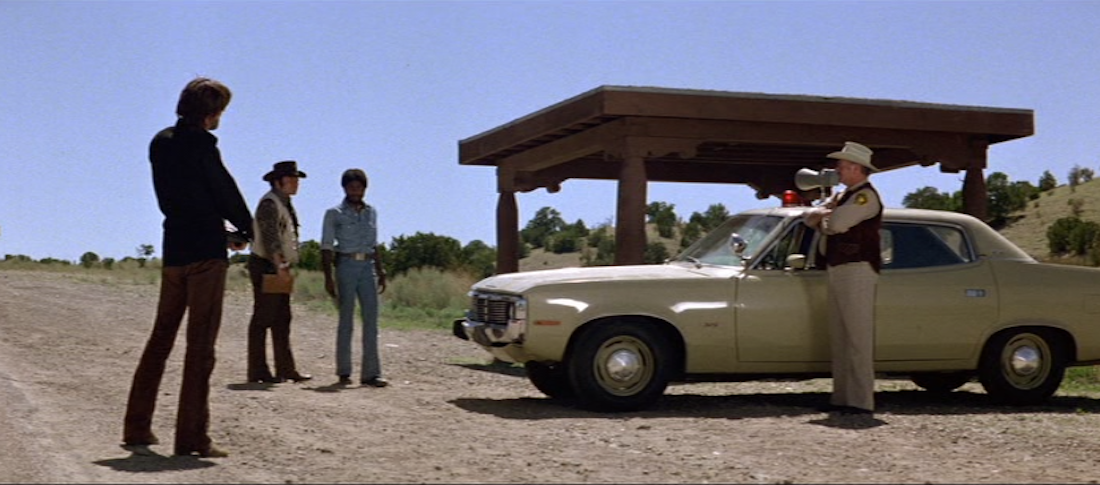
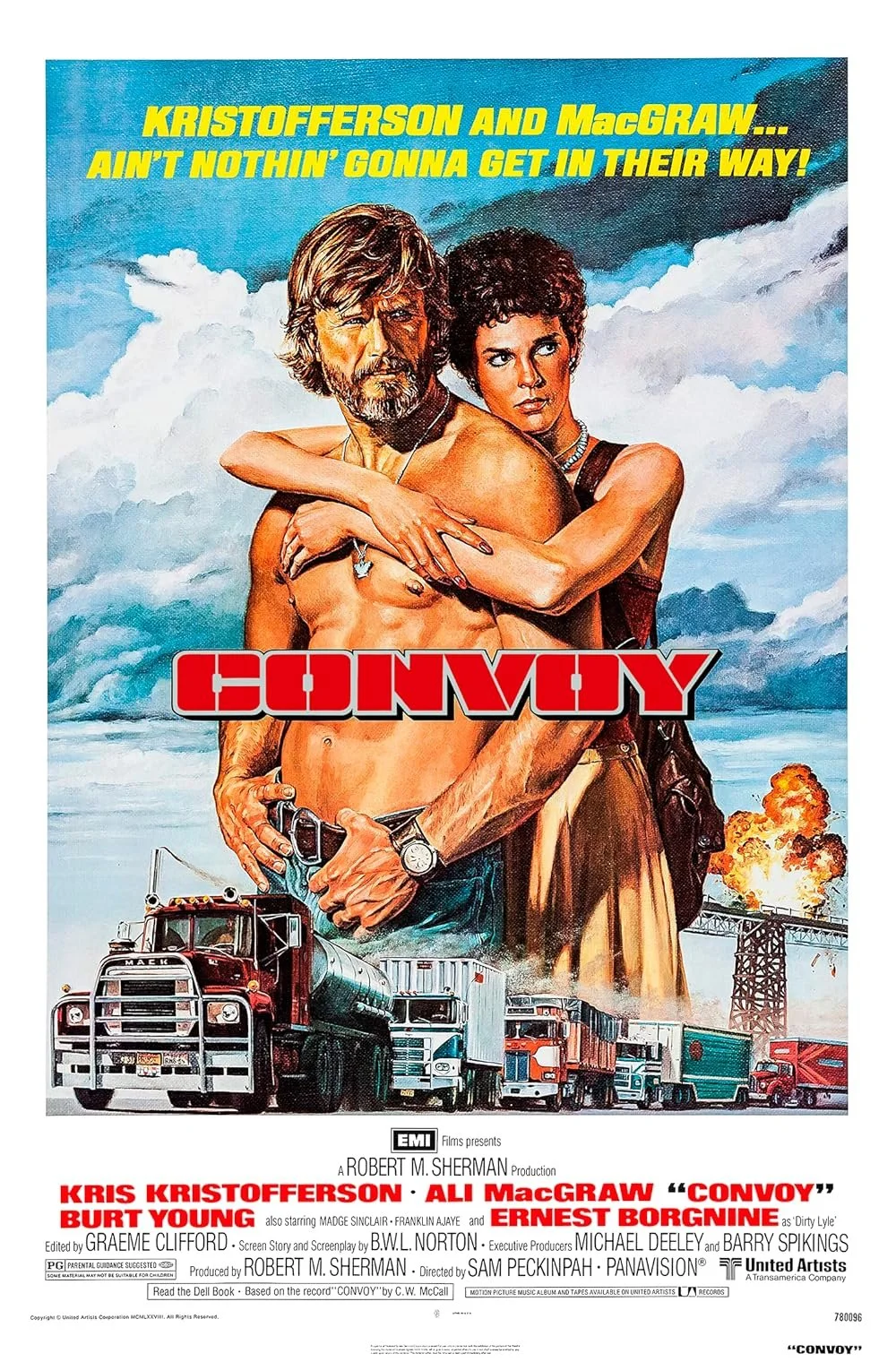
If you’re like me and haven’t seen CONVOY yet, (and I say “yet”, because you absolutely should) let me give you the rundown: Kris Kristofferson, the legendary musician/actor/activist, plays Martin “Rubber Duck” Penwald, a trucker driving a rig full of explosive chemicals. He and his fellow trucker friends fall into a speed trap set by the corrupt Sheriff Lyle Wallace (Ernest Borgnine), who uses his office to intimidate and extort the men. He later follows them to a truck stop where a fight ensues and so begins a small convoy of trucks running for the New Mexico border. This is another CB Radio-driven film where the convoy captivates the working class and throughout the film more trucks and supporters join the convoy, all while being chased by the police through multiple states.
What seems to start as a few rebellious cowboys running from the law for defending themselves turns into a broad message of resistance against various issues oppressing the working class. The convoy means something different to everyone, but people continue to join and support it for its symbolism of community and stalwart defiance against all odds. If this film feels like an old Western ripe with dramatic showdowns and inspiring anti-heroes, that makes a lot of sense; Sam Peckinpah, a celebrated filmmaker of movies like THE WILD BUNCH (1969) directed this movie.
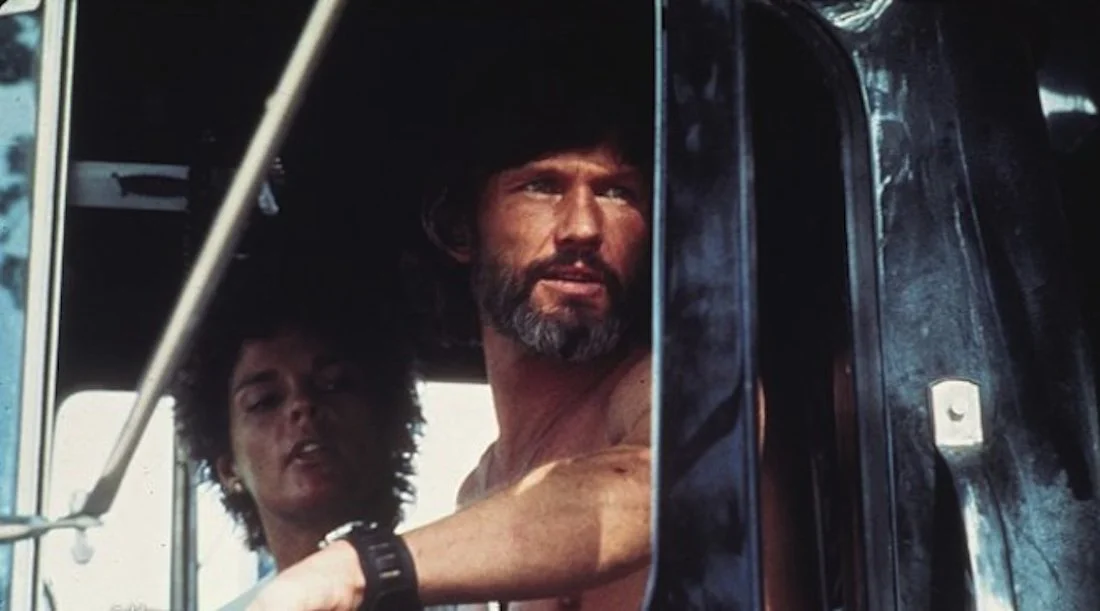
Rubber Duck is joined by the photographer and headstrong Melissa, played by Ali MacGraw. Much like SMOKEY AND THE BANDIT, this is yet another ‘70s movie of hotness, and I am not complaining. You have to give it to MacGraw, who continually refuses to find Kristofferson’s character a shirt to wear as a gift to viewers.
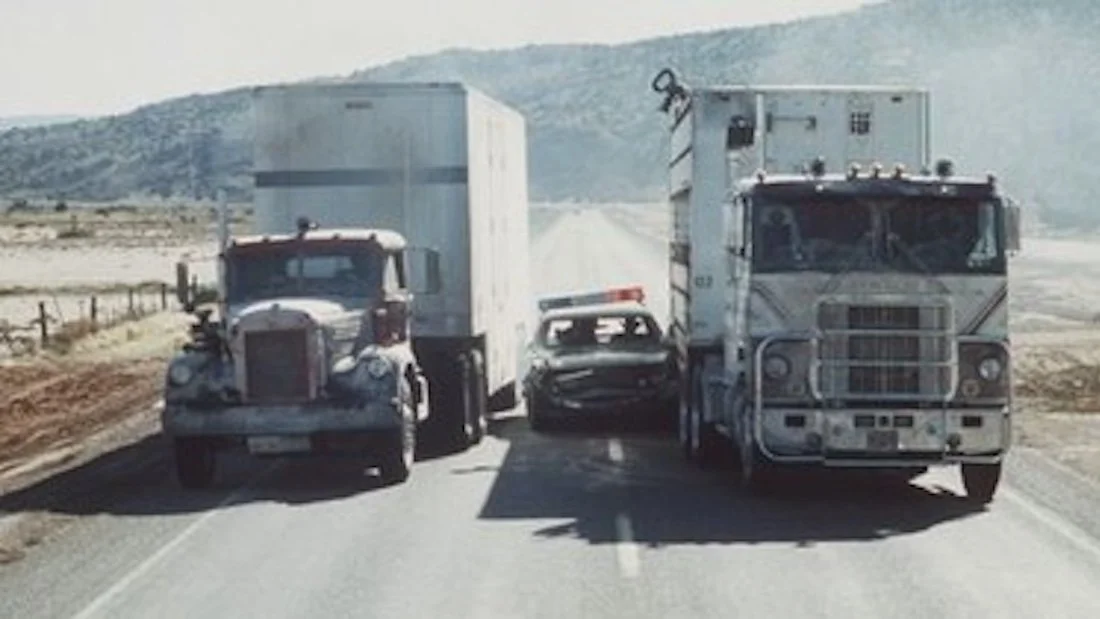
There’s a lot to say about this movie. It’s not the hijinks-filled, smooth-talking jaunt that SMOKEY AND THE BANDIT is. And while there is fun to be had, this film is pretty serious in its message of corruption. Racism and police brutality play a prominent role in the story as well. At times, it is more Western than road flick. Forty-four minutes into the movie, there is a magnificent montage of the police and convoy shown as if in a delicate (yet chaotic) dance of oppression and resistance all set to classical music. This is a swerve from the classic country music that rounds out the rest of the soundtrack. It should be noted that the Father of modern Christmas music and founder of Mannheim Steamroller, Chip Davis did the scoring for this film and also wrote the title song, “Convoy.”
What I find most compelling is that this convoy did not have a specific issue other than initially running from the law. Many of the people who join do so with their own justifications, and they see the convoy as a powerful symbol of dissent. They join in defiance of the establishment—the way things are but shouldn’t be. The strongest revolutions umbrella and champion causes intersectionally, and this portrays that in the simplest way. Sometimes just simply showing up and holding your ground is all it takes.
The way this film also portrays how governments and politicians will exploit social causes for their own gain (while protecting the very people who cause harm) is not subtle. Seymour Cassel is great as the spineless, manipulative Governor running for Senate. Burt Young as Pig Pen/ Love Machine, Rubber Duck’s right-hand man also gives a solid performance of a man who can enjoy fun and games but also holds the line when it comes time.
I do have a couple minor criticisms with this film, albeit both are a matter of personal preference. For its story, I think it could have run a little tighter. The majority is spent illustrating the building up of the convoy. The hard stuff all happens very quickly in the final act. I also laughed at the way Rubber Duck becomes “Jesus of the truckers,” but it’s not for me.
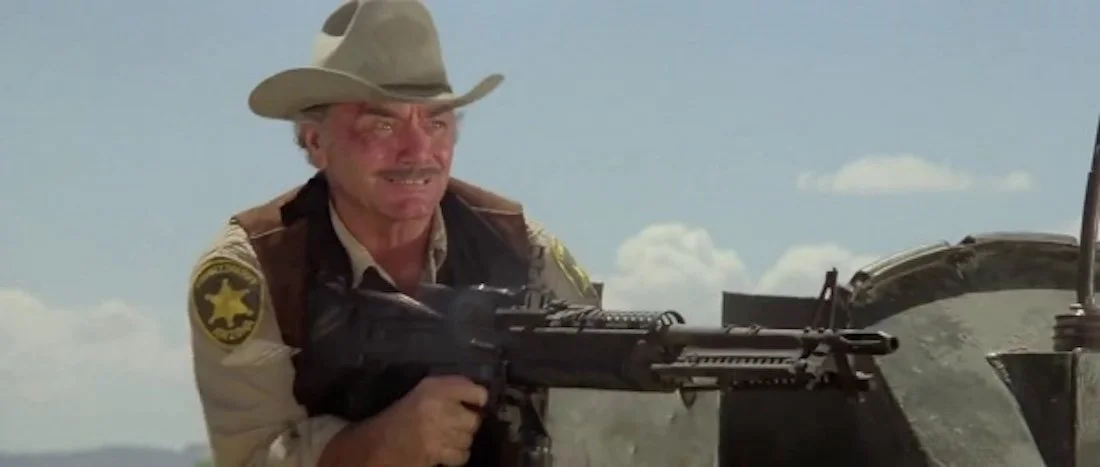
Overall, this film and the general trucker movie phase showcases the anxiety and tension of the working class in the 1970s. With many political, financial, and social crises, like the end of the Vietnam War, the gas crisis, and the Civil Rights movement, working class people were under a lot of pressure. Truckers were portrayed like modern day cowboys who weren’t beholden to the restraints of normal, polite society. It’s as if they had a power that us 9-to-5 folks didn’t, because they were protected by 18 wheeled, multi-ton vehicles, which gave them almost a symbolic defense against the powers of corrupt law. As Rubber Duck’s character says when the bigoted Sheriff declares that he IS the law, “Piss on your law.” And he’s right—if a law doesn’t protect the people and the environment, what good is it?
If I could program a Drive-In double feature of trucker movies, it would be this and SMOKEY AND THE BANDIT. With both, you get a sense of the little guy fighting back against the corrupt government. Both are also fun and will speak to your soul in different ways, but at the core they both come back to how important it is to build your community and help one another. A timeless message that we need now more than ever.
10-4, Good buddy.