UFOctober: NOPE (2022)
I love Jordan Peele’s NOPE. Its impact on me was so immediate I don’t think any other film in 2022 had a chance of knocking it off the top spot as my favorite movie of that year. Peele’s third film was so rich in subtext and allegory that I was compelled to make it a cornerstone of my master’s thesis. And at this point I’m ready to argue it’s a seminal film of the 2020s. It’s obviously in conversation with Ryan Coogler’s SINNERS about the Black experience in America, both in its past and present depictions of racial politics, but for Neon Splatter’s UFOctober I opted for a different reading of Peele’s genre mashing blockbuster. Instead, I want to open this themed month about an under-discussed aspect of the dread undergirding both the film and our reality: Climate Anxiety.
Broadly defined, climate anxiety (otherwise known as eco-anxiety) is the state of unease associated with climate change and other environmental catastrophes. As a brief example, climate anxiety typically manifests in a disaster film like THE DAY AFTER TOMORROW, where the weather causes irrevocable damage on the world at large. Peele’s film is chock full of tension, but this miasma of environmental dread is a key thought underpinning the film as it speaks to a larger idea on how man’s disrespect of nature and negligence towards the effects of climate change continually haunt us. This ecological alarm is manifested through three prominent animal characters featured throughout the film — Gordy, Lucky, and Jean Jacket. What follows is a brief examination of how Peele’s film uses these characters to exhibit humans’ perpetual state of climate anxiety created by their lack of respect towards nature, the inevitable violent result of this disrespect, and the ramifications of humanity’s failure to learn from these vicious outbursts.
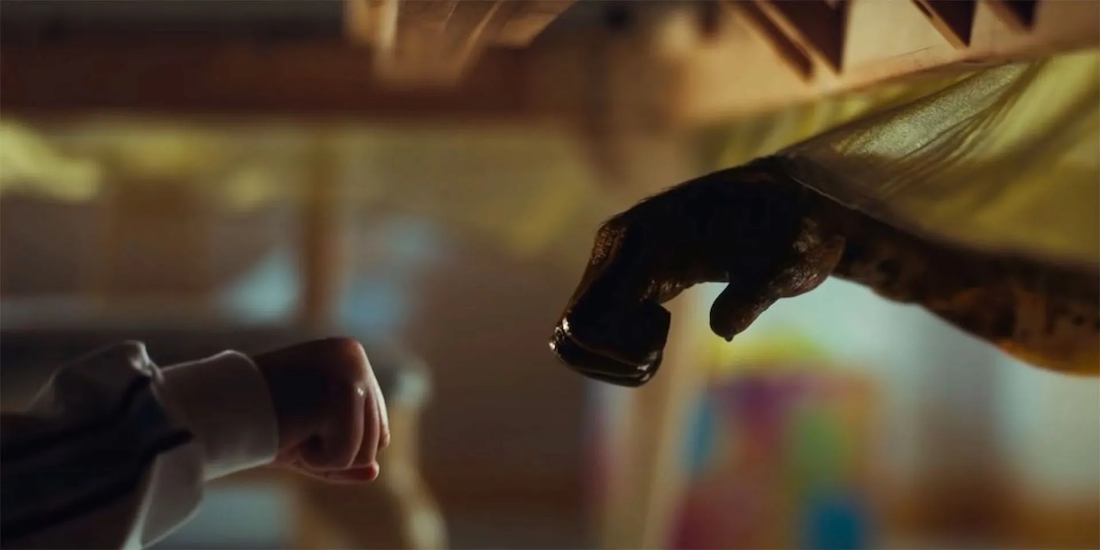
Gordy the chimpanzee is the first and perhaps most important character of NOPE because he is the throughline that connects Jean Jacket and the film’s overarching themes. He was the star of a fictional ‘90s sitcom, Gordy’s Home, and eventually snapped after several balloons popped during filming. During Gordy’s rampage, he killed and mauled several human members of the cast and crew before being killed himself by the police. It’s one of the film’s standout sequences that is both terrifying and thematically relevant given how inexplicable and sudden his violence. No one understands why Gordy reacted the way that he did, but in that same respect no one bothered to respect what Gordy was either: an animal. Given human clothes, a family, a name, he was anthropomorphized to the point of being set up as a running joke. The violence that followed was his bloody punchline.
And yet even in death, Gordy served as a joke. MAD Magazine and SNL sketches made light of the tragedy, and even though the show was cancelled after the incident, no one would learn the right lessons from it. The Gordy’s Home incident should have been a key moment in the treatment and understanding of animals on film and TV sets that led to better conditions for these animal performers. Instead, it exists as a joke that would be largely forgotten about in time. In NOPE, the casual disregard for such brutality is a specter that haunts both the film and our own reality as we continue to ignore or make light of the increasing events of ecological violence and devastation.
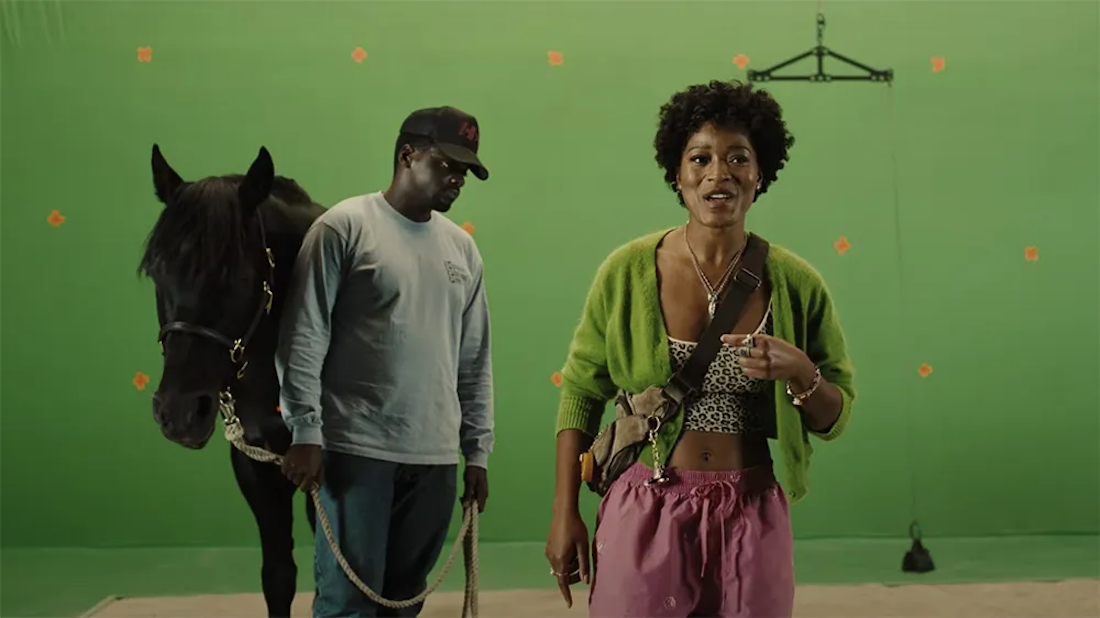
The story of Lucky the horse continues this unfortunate trend, even if its disruption isn’t nearly as bloody. Early in the film, OJ Haywood (Daniel Kaluuya), a horse trainer and handler for film productions, has Lucky on set to film a commercial. During a shot set up, OJ continually tries to impart safety guidelines for the cast and crew on how to best handle Lucky, as well as advocating for the animal needing a break. But when a crew member reflects a VFX orb in Lucky’s face, the animal has a momentary outburst, kicking a sandbag. In this instance, OJ — and perhaps Peele himself —is actively trying to instill a safe environment for animals and humans to collaborate, and is ignored by a crew that doesn’t take the issue seriously enough. Adding insult to injury is the fact that OJ is not only fired from set, but that Lucky is replaced by a digital counterpart. This is both a refusal on the side of the filmmakers to acknowledge their wrongdoing and to learn from their mistakes, opting instead to replace Lucky entirely with something that they can control because it makes them more comfortable. Lucky becomes a manifestation for eco-anxiety here as he displays humanity’s desire for control. When unable to get what they want, humans prefer to replace nature with technology rather than learn what is necessary to have a peaceful coexistence with animals. It’s a move that further distances humans from their relationship to nature, thus deepening the fear that comes when nature inevitably strikes back due to its continual mistreatment.
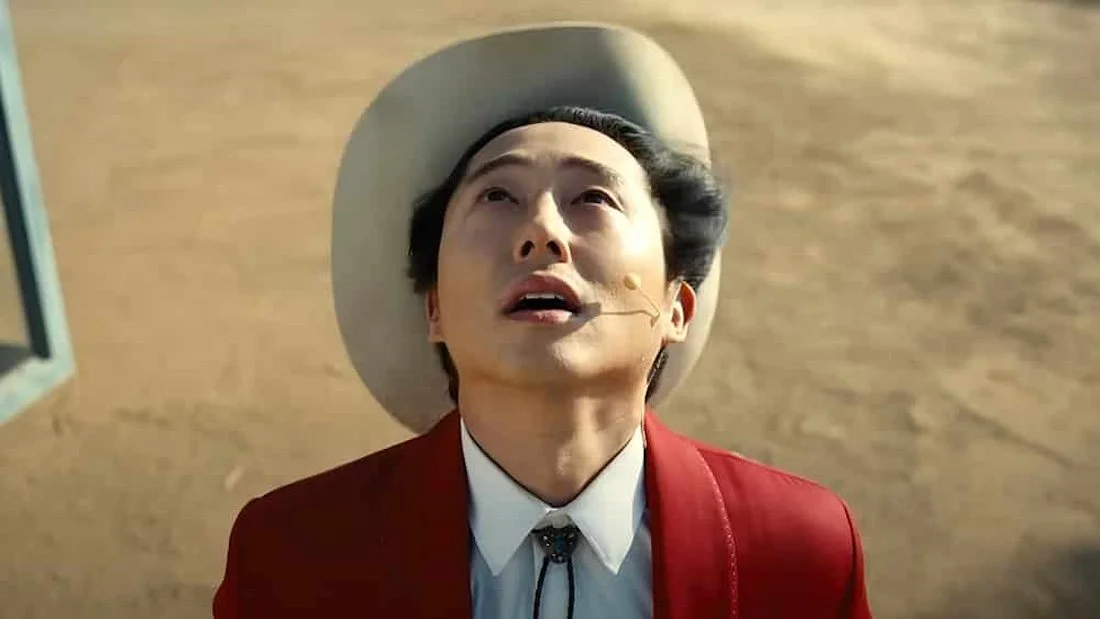
Finally, we arrive to the alien Jean Jacket. While it causes much of the devastation throughout the film, its biggest moment of carnage comes when it is lured to Jupiter’s Claim by Ricky Park (Steven Yeun), one of the two survivors from the Gordy’s Home incident. OJ had been selling his horses to Ricky to keep Haywood Ranch afloat, and in turn Ricky had been offering up the horses to the alien entity in the hopes of domesticating the extraterrestrial. When offered Lucky, Jean Jacket instead devours everyone in attendance, Ricky and his family included, in one of the film’s most terrifying sequences. Later, after having rescued Lucky and surviving an encounter with Jean Jacket himself, OJ reflects on why Ricky failed in his attempts to domesticate Jean Jacket: “He got caught up trying to tame a predator. You have to enter an agreement with one.” This quote from OJ shows how the film explains the eventual defeat of Jean Jacket: Respect. Respect was not given to either Gordy or Lucky, and they lashed out with the violent consequences. By respecting Jean Jacket’s capabilities as a predator, OJ, Emerald (Keke Palmer), and Angel (Brandon Perea) are ultimately able to destroy Jean Jacket in a final confrontation.
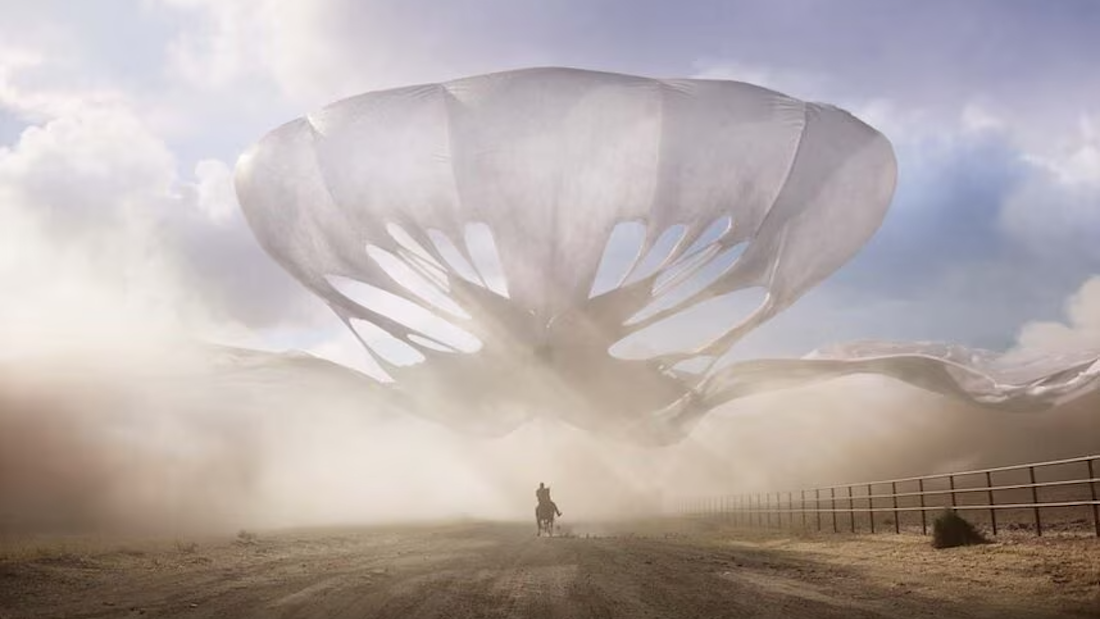
When looking at Jean Jacket as an avatar for climate anxiety, what NOPE ultimately proposes is that in order to overcome this pervasive fear, one must “enter an agreement” with nature. In other words, humans must come to respect nature. This respect shouldn’t be made to serve the ends of domination or destruction, but of co-dependence. Only by respecting nature and its devastating potential can we overcome this anxiety. When nature lashes out, we must not make light of its impact like those who made fun of the Gordy’s Home incident. Nor should we try to control what we cannot through technology, like how Lucky was replaced by a digital double. Instead, we must meet the natural world as it is, because only then can we start to make true changes.
Even with the grand scope of Peele’s third effort—its oscillation between horror, science fiction, and western genres, the incredible Michael Abels score, the first ever live action rendition of the AKIRA bike-slide, and so much more—I love the simplicity of NOPE’s message to combat our growing fears of climate change: Respect.