
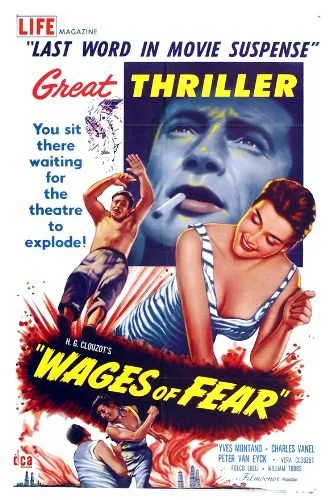
MOTHER TRUCKIN’ MAY: THE WAGES OF FEAR (1953)
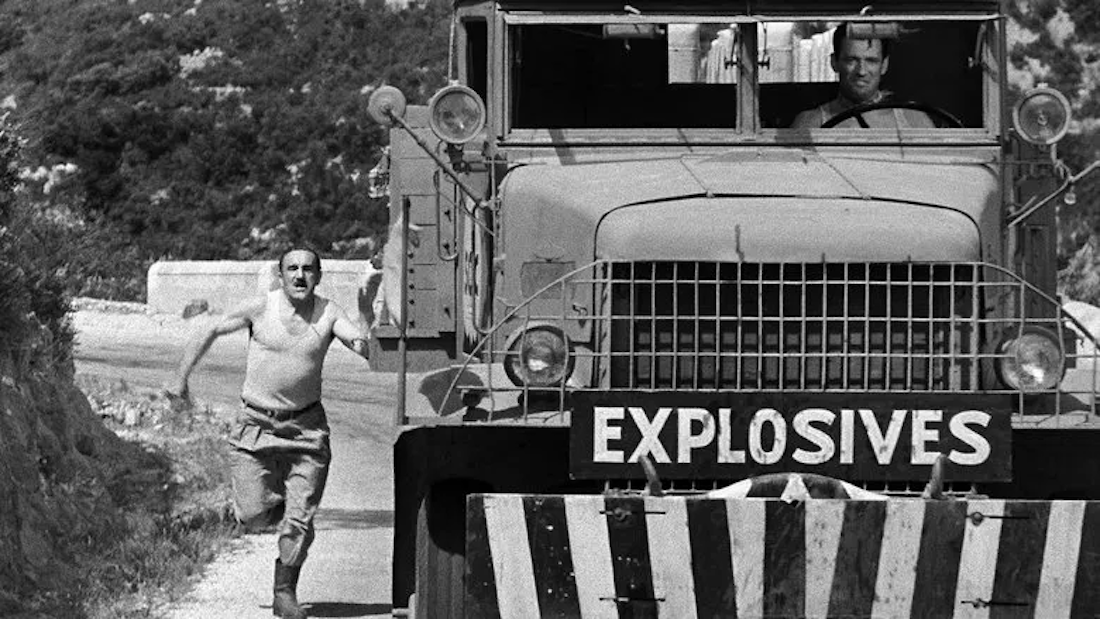
I once saw this in a movie about a truck that had to speed around the jungle, keeping its speed over forty, and if its speed dropped, the truck would explode! I think it was called THE TRUCK THAT COULDN’T SLOW DOWN. Truck-ré bleu! Amirite, ladies and gentlemen? Fuck, I finally get to write about prestige cinema, winner of top prizes at both the Cannes Film Festival and the Berlin International Film Festival as well as securing the title of “Best Film” for the 1955 British Academy of Film and Television Arts (BAFTA) Awards, and I start of with a misappropriated quote from The Simpsons and a hack line that probably would have been cut from an episode of Klondike Kat! Damn my penchant for paltry puns and poorly presented Parisian patois! What would my lord and savior Savoir-Faire do? He would pivot. Let’s pivot. Right now you could be asking “Hey, Pepito! What’s new?” Well, what LE SALAIRE DE LA PEUR (1953), known stateside via its English titular translation as THE WAGES OF FEAR, may lack in cinematic au courant it more than makes up for it in sheer truck driving tension!
THE WAGES OF FEAR is a harrowing tale of desperation and detonation in the wake of economic imperialism. The plot of the picture is positioned around a quartet of down on their luck European expatriates idling in the impoverished and isolated fictional town of Las Piedras in South America. Mario (played by Yves Montand) is a goldbricking Corsican playboy. Luigi (played by Folco Lulli) is an Italian cook and Mario’s roommate who learns he’s suffering from a pulmonary embolism. Shigeru Miyamoto is undoubtedly a super big fan of this film [insert Super Mario Bros. (1985) game over sound effect here]. Jo (played by Charles Vanel) is a Parisian with a heavily hinted criminal past. Finally, there’s the enigmatic German, Bimba (played by Peter Van Eyck) who spent three years in a forced labor camp and is grappling with the trauma of his father’s death at the hands of Nazis. It’s their respective painful pasts and pitiful lack of prospects that persuade all four characters to embark on their perilous pilgrimage.
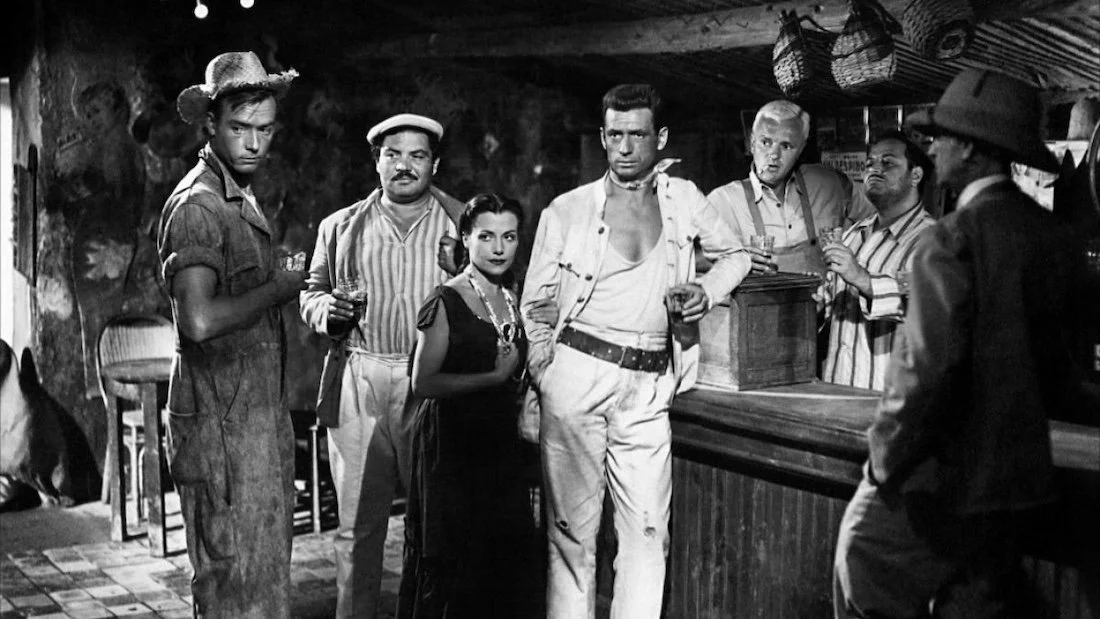
With very little in the way of gainful employment Mario, Jo, Luigi, and Bimba are all resigned to dwell in a desert of drunken poverty as the American owned Southern Oil Company (SOC) dominates the economy and resources of the region (as Mario says “Wherever there's oil there's Americans”) until a raging inferno breaks out on an oil field 500 kilometers away. Corporate mucketymucks hatch the harebrained scheme to use two trucks full of nitroglycerine to execute a massive blast extinguishment in order to generate a powerful shock wave to force the flame away from the fuel source to instantly displace the surrounding oxygen, thus snuffing the fire out like a giant candle. The only hiccup in the plan is the highly volatile nitroglycerine has to be transported 300 miles over extremely rough terrain risking life, limb, and ignition for those foolhardy enough to transport it but the allure of $2,000 USD a person (approximately $24,828.05 today adjusted for inflation) is enough to entice our four fruitless focal figures who SOC foreman Bill O'Brien describes as “Only fit for loafing.”
No, Donny, these men aren’t nihilists. More like absurdist existentialists with a fatalist bent because as the incorruptible critic, Jay Sherman, always said “Camus can do, but Sartre is smartre!” Colonial capitalism has dictated that their lives are either worthless or only worth risking to extricate themselves from the clutches of the SOC. The reliance on gallows humor is an essential coping mechanism for the drivers, whistling while passing a graveyard as it were, along with the copious amounts of cigarette smoking in close proximity to trucks chock full of highly combustible chemical compounds. These tiny flames along with every bump in the road is what keeps the characters and audiences white-knuckling throughout the picture teaching the Car-X Man the true meaning of “rattle, rattle, thunder, clatter, boom, boom, boom” and making him humble. Honestly, this whole intense escapade feels as much an infrastructure issue as well as an indictment of alleged alpha males in a masterclass of misanthropic moviemaking. Men will literally drive trucks full of nitroglycerin instead of going to therapy.

The plot wasn’t the only teetering terrain traversed by THE WAGES OF FEAR, the production was rather tumultuous as well. As Jo says in the film "When you ask for trouble it always comes.” Director Henri-Georges Clouzot originally wanted to film on location in South America but found it to be cost prohibitive. Plan B was to shoot in Spain, but star Yves Montand (Mario) refused to work in Estado Español as long as fascist dictator Francisco Franco was in power so instead filming took place in the south of France, near Saint-Gilles, in the Camargue. Beginning in the summer of 1951, shooting didn’t wrap until 1952 due to numerous weather and financial delays going 50 million francs over budget. And despite being released in 1953 it didn’t premiere in the U.S. until two years later and only after substantial cuts (accounts range from 21 to 50 minutes of content being chopped) were made to remove alleged anti-American sentiments.
Regardless of these rocky roads to release, THE WAGES OF FEAR was the fourth highest grossing film for France in 1953. It was also a huge hit in the United Kingdom despite being subtitled even though foreign-language films screened in the U.K. at the time were typically dubbed. Widespread American audiences didn’t see a “director’s cut” of the film until it was released on LaserDisc in 1991 and wouldn’t see the definitive French theatrical cut until it was restored and rereleased worldwide on Blu-ray/DVD in 2017 but the film’s influences can be felt in well-regarded works such as Steven Spielberg’s made-for-TV opus DUEL (1971), William Friedkin’s grittier reimagining of the source novel with SORCERER (1977), or as I implied with my opening sentence, the impact this flick had on Jan De Bont’s SPEED (1994) is incontrovertible.
All this to say THE WAGES OF FEAR is a tense theatrical truck driving thrillride that deserves its accolades and your attention as vital viewing for those who celebrate Mother Thruckin’ May. As a permanent passenger princess, I put forth that this picture is perhaps the pinnacle of propulsion perturbment. Sure, I might offend a few of the cinephiles with my cocky stride and musky odours. Oh! I'll never be the darling of the so-called “film bros” who cluck their tongues, stroke their beards, and talk about “What's to be done with this Vito Nusret?” But I refused to believe that I was the only one eating cereal and chuckling "Oh Mario... you dumb bitch!" when dude was dipping all over the road in the denouement's doomed drive to the “Blue Danube.”