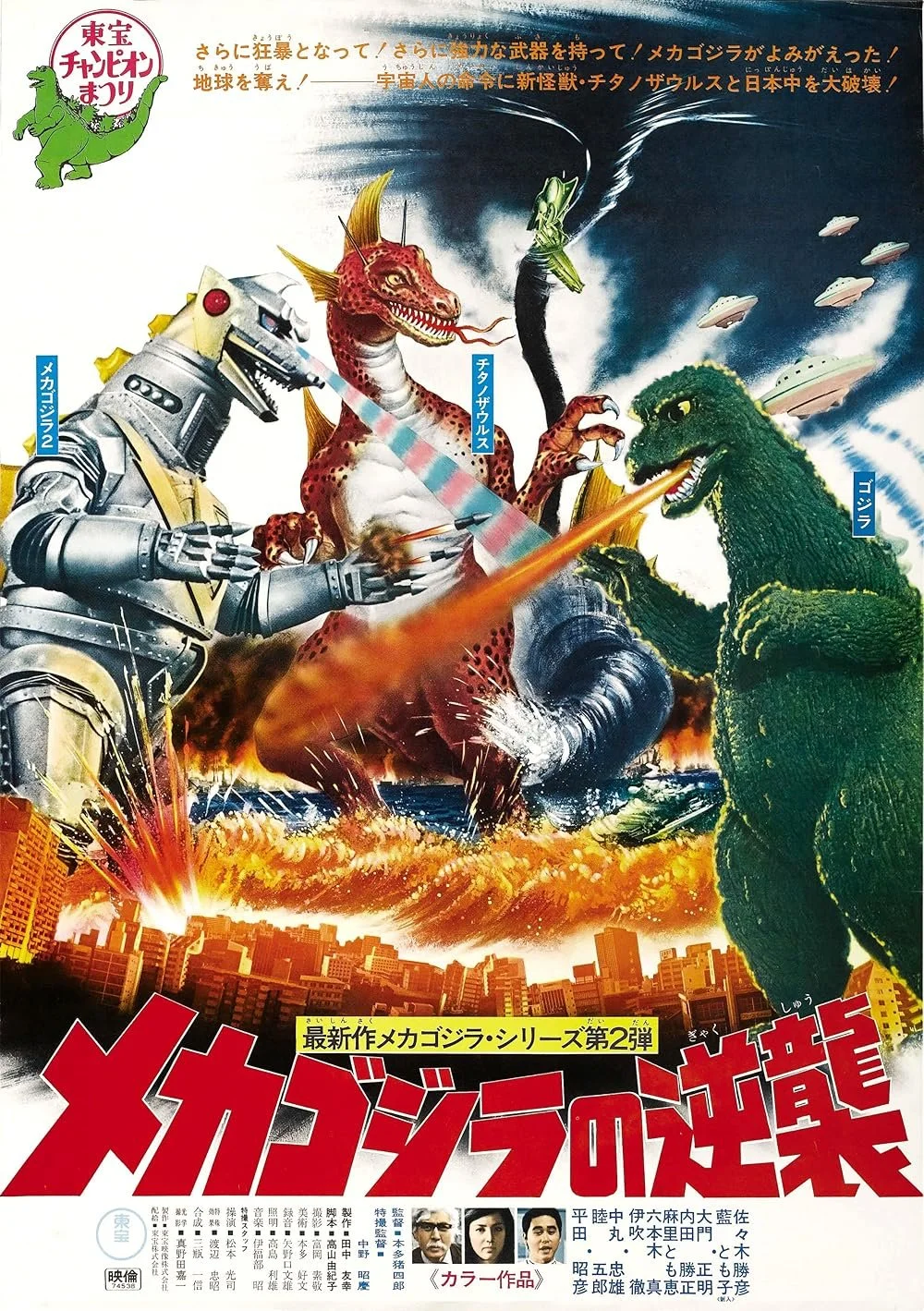
TERROR OF MECHAGODZILLA (1975)
Six years after helming ALL MONSTERS ATTACK (aka GODZILLA’S REVENGE) in 1969, Godzilla franchise co-creator Ishiro Honda returned to direct TERROR OF MECHAGODZILLA, the franchise’s 15th film and the Shôwa era’s final installment.
TERROR OF MECHAGODZILLA immediately follows 1974’s GODZILLA VS MECHAGODZILLA, focusing on government organization Interpol investigating a kaiju named Titanosaurus’ connection to a believed-dead mad scientist named Dr. Shinzo Mafune (Akihiko Hirata). Meanwhile, Mafune and his cyborg daughter Katsura (Tomoko Ai) work with the Black Hole Planet 3 aliens to rebuild Mechagodzilla. Katsura’s later physical connection to Mechagodzilla motivates her to sacrifice herself, giving Godzilla a fighting chance to destroy the mechanical kaiju.
Honda’s direction is way more subdued than that of his ‘60s installments and director Jun Fukuda’s work on the previous film. His approach memorably elevates the human drama between main protagonist Akira Ichinose (Katsuhiko Sasaki) and Katsura. Kiyoshi Nakano’s effects during the kaiju battles liven up the dour atmosphere, having some great low angle shots by cinematographer Sokei Tomioka as well.
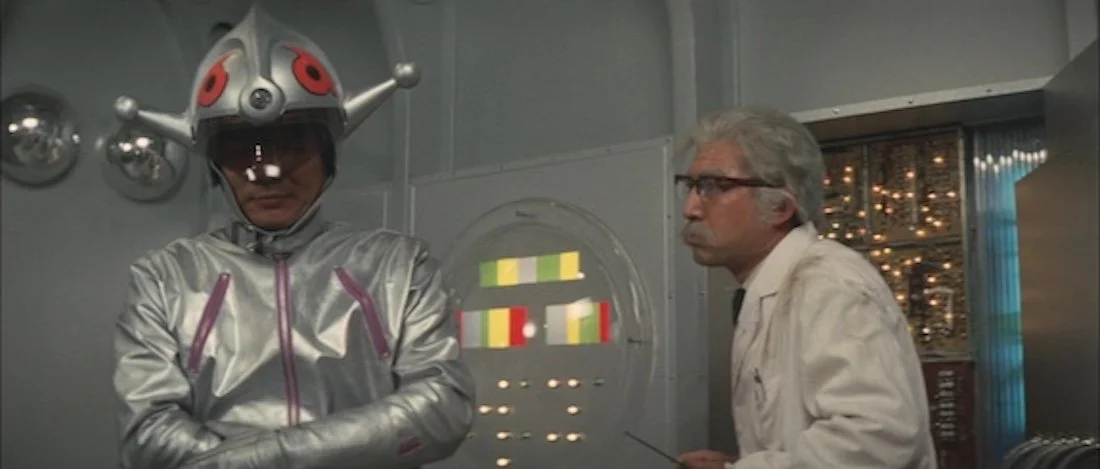
TERROR OF MECHAGODZILLA also reunites Honda and Hirata, who the former directed in the original GOJIRA film. Mafune isn't as interesting as Serizawa because of his anticlimactic and cartoonish character arc. The parallel between Serizawa and Katsura’s sacrifices in the original film and TERROR OF MECHAGODZILLA respectively bookend Honda’s work in the franchise.
Speaking of Katsura’s role as basically the actual protagonist, she has a poignantly dynamic arc. Ai delivers an engaging performance, especially when the aliens’ revival of Katsura turns her into an emotionless shell in the third act. Considering most kaiju’s Japanese names end with ra (Gojira, Mosura, Kingu Gidora, etc.), her name may hint at her connection to Mechagodzilla.
TERROR OF MECHAGODZILLA’s screenwriters Honda and Yukiko Takayama admirably build Katsura and Ichinose’s romance, successfully generating sympathy for these characters. Although a couple of their scenes in the third act are great, the need to progress the plot’s central mystery behind Titanosaurus hampers their chemistry. Of course, I can’t forget to talk about the film’s literal breakout star.
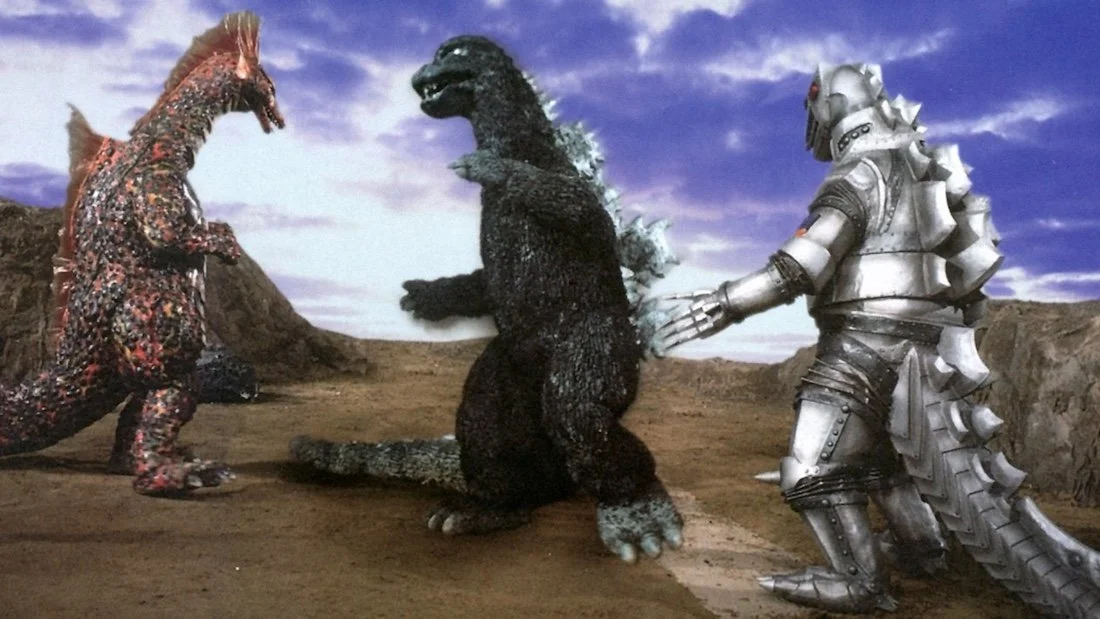
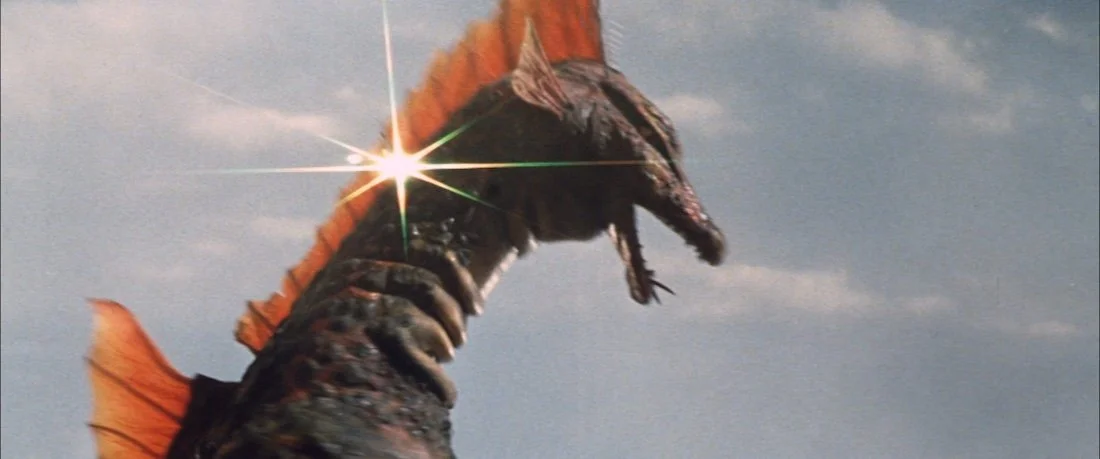
TERROR OF MECHAGODZILLA introduces the kaiju Titanosaurus, who dramatically overshadows the title character and Godzilla himself. As the movie takes its time before Godzilla inevitably shows up to fight Titanosaurus, it’s one of the installments where he has very little screentime. It wouldn’t be surprising if the filmmakers envisioned the Titanosaurus plotline as a standalone movie, especially since the script disregards continuity when explaining Mafune’s backstory.
Assuming TERROR OF MECHAGODZILLA is set in 1975, if two Godzillas and an Anguirus showed up by 1960, why did Mafune’s superiors fire him? Since GODZILLA RAIDS AGAIN is seemingly set in 1955, the kaiju’s existence validated Mafune’s theories. This point is a nitpick, but even the makeup for the Black Hole Planet 3 aliens differs from the previous film’s. The makeup goes from a PLANET OF THE APES-inspired simian look to now resembling the same franchise’s mutants. These problems sadly cemented TERROR OF MECHAGODZILLA’s fate as a financial disappointment.
The recycled alien invasion plot, along with the franchise’s declining popularity, apparently made TERROR OF MECHAGODZILLA one of the lowest-attended Godzilla films, similar to 2004’s GODZILLA: FINAL WARS. After 15 movies in a 20-year span, Japanese audiences probably got tired of the franchise’s formula. Admittedly, TERROR OF MECHAGODZILLA’s grim atmosphere looks jarring next to GODZILLA VS. MECHAGODZILLA’s zany charm.
While TERROR OF MECHAGODZILLA ended the Shôwa era on a lukewarm note, it’s luckily not the era’s chronological conclusion. That distinction belongs to 1968’s DESTROY ALL MONSTERS, which is a much better film. The former’s mostly great human cast gives it an edge though.
TERROR OF MECHAGODZILLA’s failure put the franchise to rest for around a decade, until GODZILLA (1984) heralded its return. It’s a shame Honda didn’t get a chance to direct one of the Heisei era films before he died. That era’s somewhat realistic storytelling better suited his filmmaking sensibilities. He was supposedly in talks to direct 1993’s GODZILLA VS MECHAGODZILLA II at least.
Ultimately, TERROR OF MECHAGODZILLA is a refreshingly dark mixed bag of a finale to the Godzilla franchise’s Shôwa era.